

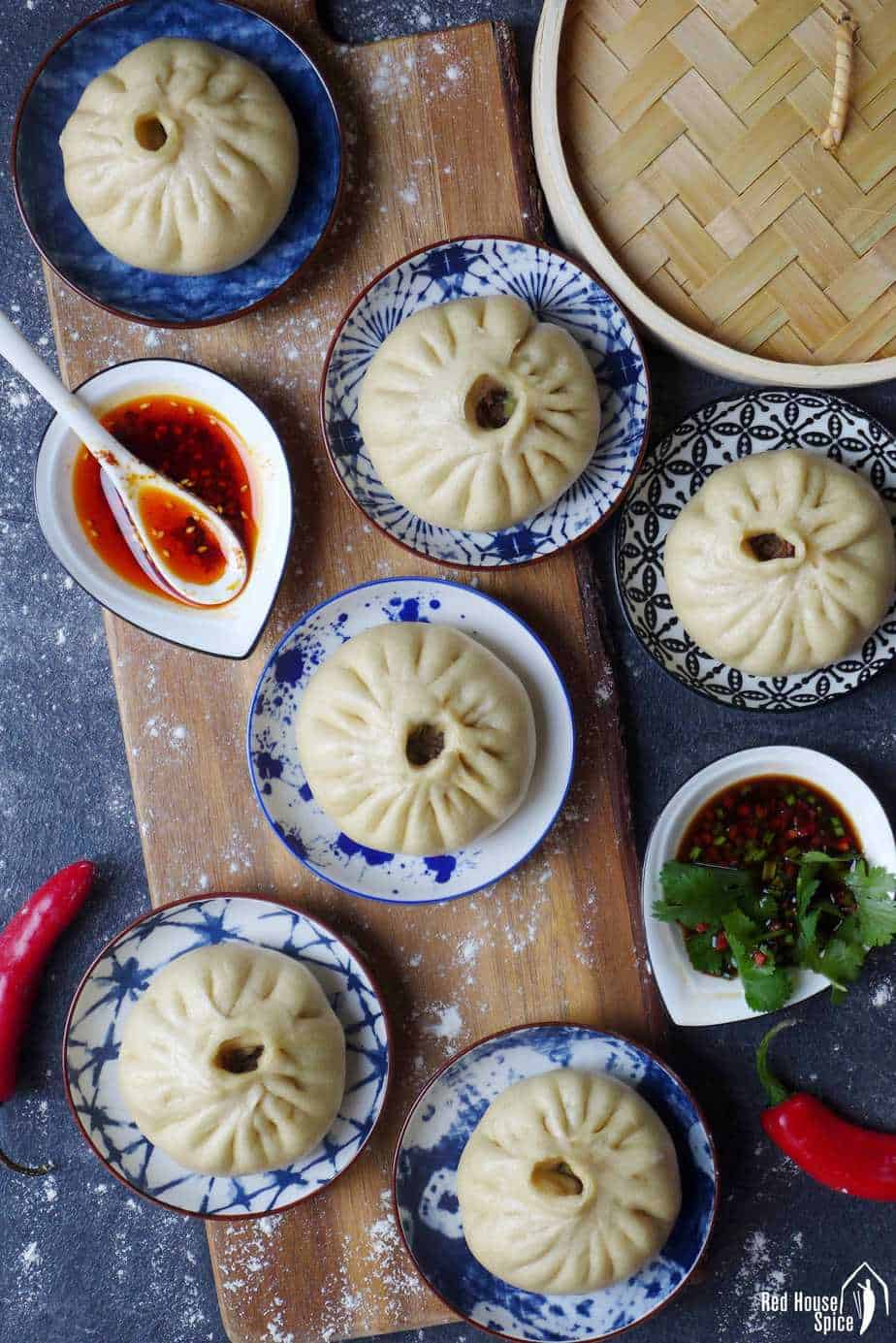
Tasty, juicy filling with soft, fluffy wrappers, homemade bao buns are super comforting! This guide offers tips and tricks to ensure a fail-proof cooking experience.
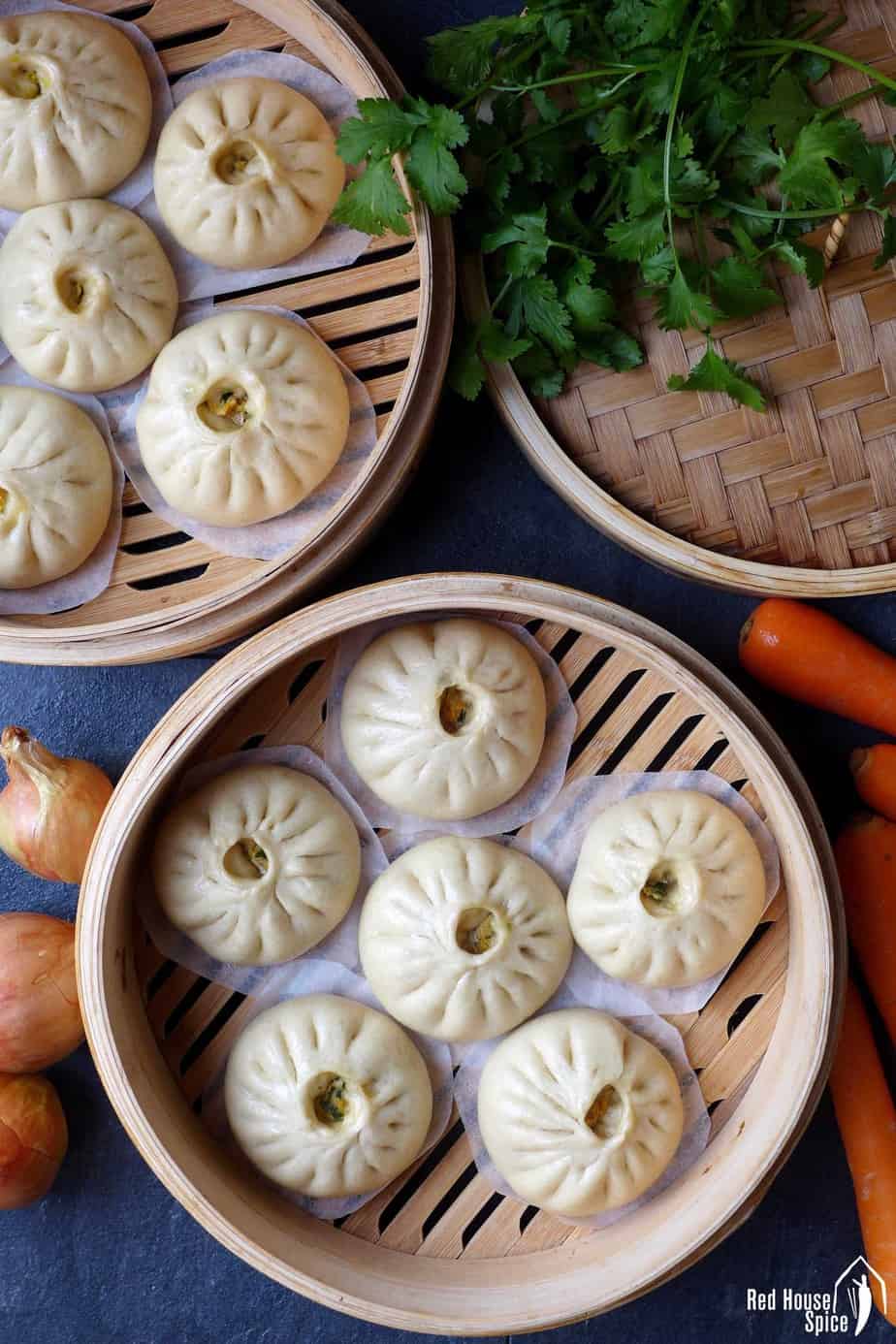
Pin this now to find it later!
Pin ItTable of Contents
Popular as street food and an everyday family dish in China, steamed bao buns (Baozi, 包子) is one of the foods I really enjoy cooking.
They are not difficult to make but it can be very tricky to get them right, especially when it comes to making a nice wrapper which rises properly, has a smooth look and a soft, fluffy texture.
Today, I’m sharing all the knowledge I’ve gained through trial and error over the years.
Flour choices
Which type of flour shall I use to make bao buns? My answer to this FAQ is all types of wheat flour works (regardless of the gluten level). However, you may wish to choose a particular type of flour to achieve a certain look/texture.
Do you like them fluffy and less chewy? Then use flour which has a medium to low gluten level. Check the nutrition label on your flour package. The protein content should be under 11g per 100g flour. As far as I know, common all-purpose flour in the UK and the US is within this range. It’s the type I use most frequently for bao buns.
Cake flour has 8-9g protein in 100g flour, so it delivers the least chewy texture. If like me, you don’t have easy access to cake flour, there is a simple substitute: Mix all-purpose flour with cornstarch (ratio: 5:1 by weight). Sift before using.
Another note: as yeast is used as a raising agent in bao buns, do not use self-raising cake flour which is commonly available in the UK.
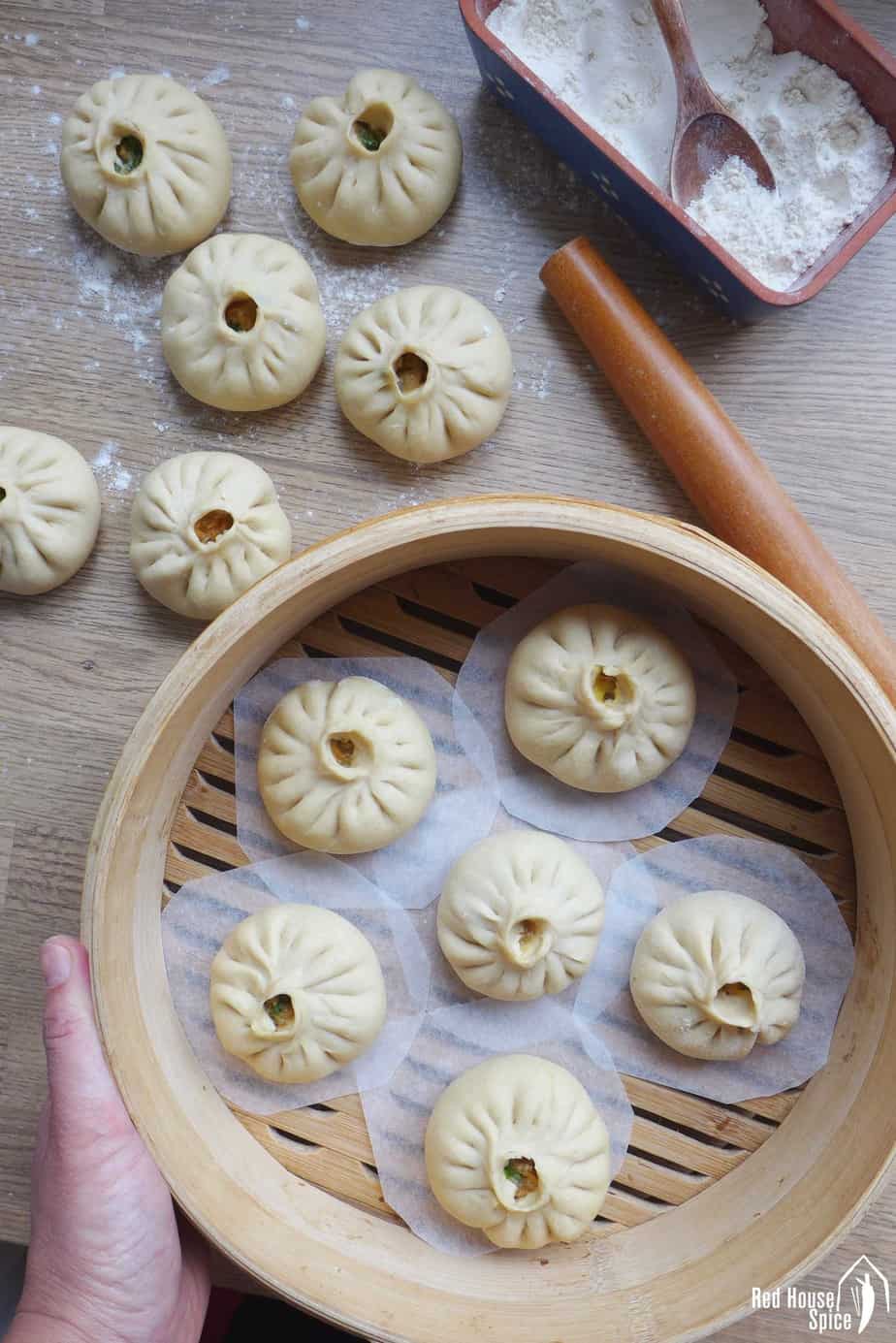
Is special bao flour better?
Flour specifically labeled as Bao bun flour/Mantou flour is available in Chinese/Asian shops. It has a low gluten level (around 8g protein in 100g flour) so it’s good for producing fluffy Bao. However, personally I don’t like it as it’s heavily bleached and processed (that’s why it produces a whiter finished look). I’ve tried several brands of bao flour and I find them lacking in natural wheat flavour.
Make the dough
Unlike dumpling (Jiaozi) dough which is made from water and flour, bao buns call for the leavened dough which involves the use of yeast. The wrapper rises during the process of steaming.
My recipe for Bao bun dough requires five ingredients: all-purpose flour; dried yeast; sugar; cooking oil, and lukewarm water.
- The flour & liquid (water + oil) ratio is 2:1 by weight. It may vary a little depending on the type and the brand of your flour.
- The water & oil ratio is 10:1 by weight. It’s better to choose the cooking oil which doesn’t have a strong taste (eg. rapeseeds, sunflower, canola, vegetable, etc.).
- For every 500g of flour, you will need 2 teaspoons of dried yeast. Add the same amount of sugar or a little less (but not more).
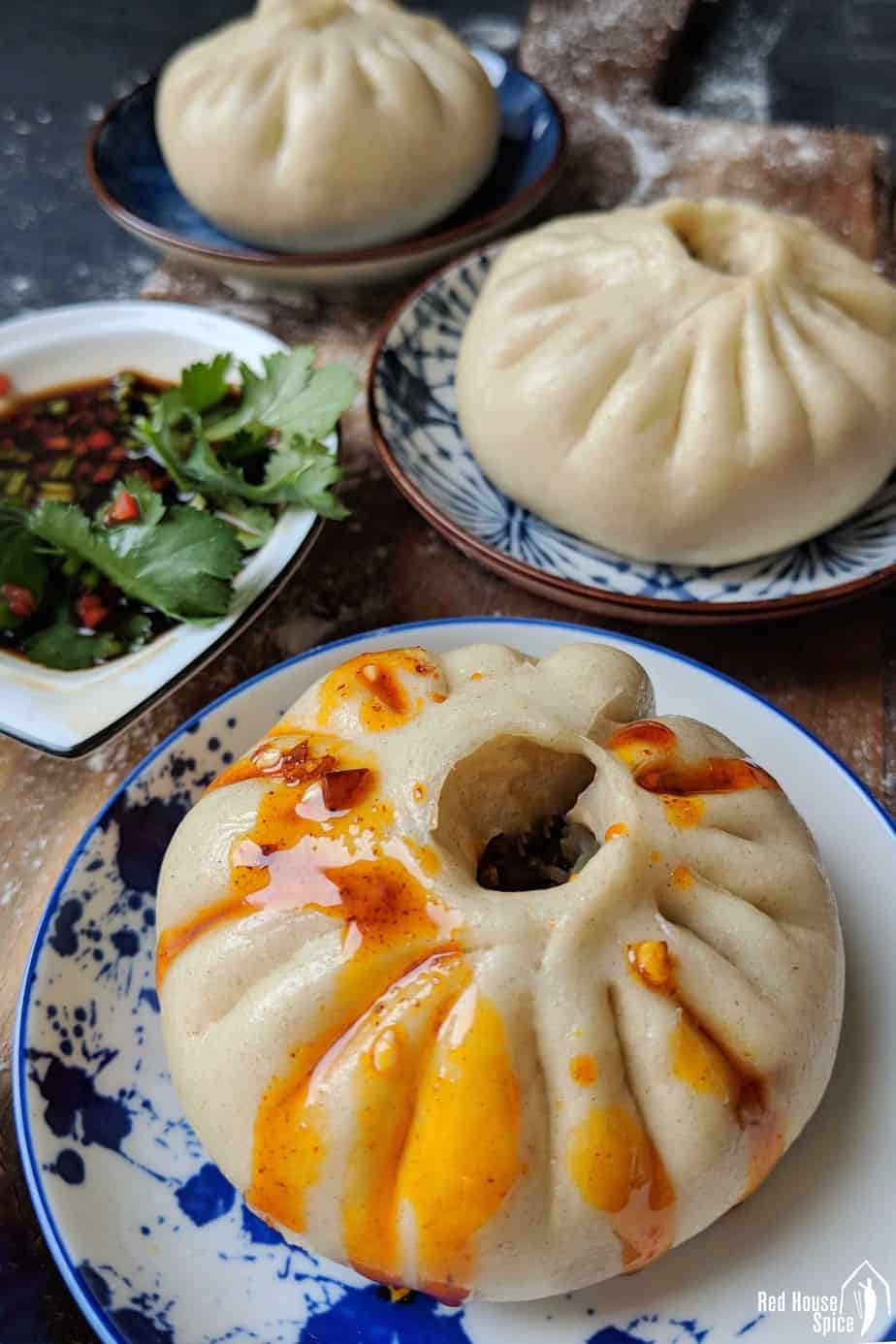
Why is kneading important
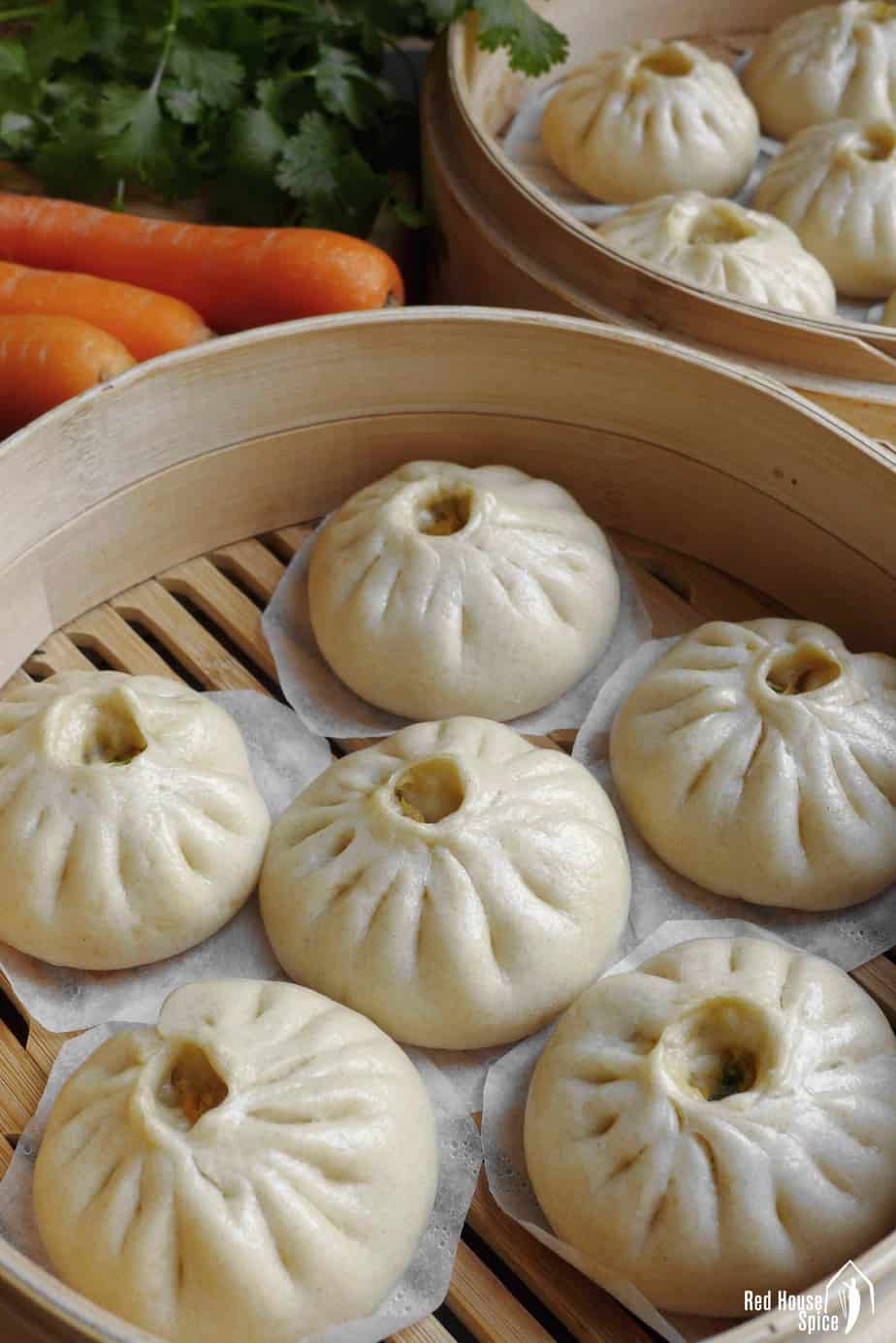
Everyone loves a bao bun with smooth, even skin. Unfortunately, homemade ones can easily end up with a pot-marked look. The well-kneaded dough will create even air bubbles inside the dough and therefore lead to a smoother appearance after steaming.
I’ve done a test with my six-year-old daughter. We kneaded two identical pieces of dough then rested and steamed them in the exact same way. Obviously she has much less strength and skill in kneading. So her buns had a much rougher look. Another surprising finding was that extended kneading will lighten the colour of your dough.
Here are my tips on kneading:
- You may use your hands or a stand mixer with a dough hook. Knead until the dough is very smooth.
- For me, the best practice is to initially combine the dough in the stand mixer for 5 minutes or so, then knead with hands to finish.
- After the dough has risen and before shaping the buns, you need to knead the dough again until it returns to its original size and the smooth look.
Rest the dough
Fermentation takes place when you leave your yeast dough to rest. As yeast is very sensitive to temperature, the required resting time varies a lot. To double the size of the dough, it can take as little as 40 minutes if the room temperature is high (and/or if the dough is small in size), or up to 1.5 hours if it’s cold.
To accelerate this process, you can:
- Place the dough bowl in a warm room/area. For example, near a radiator or a preheated oven.
- Heat up a glass of water in the microwave then put your dough bowl inside (keep the glass in). Shut the microwave door.
- Turn on your empty drier for 2 minutes then place the dough bowl inside (I learned this trick from food blogger Nagi).
- Cover your bowl with a damp cloth as humidity also affects fermentation.
Leave the dough to rise until its size doubles. Then knead again to remove any bubbles trapped inside. After shaping the dough into individual Bao, leave them to rise a second time before steaming, about 15 minutes this time.
Make the filling
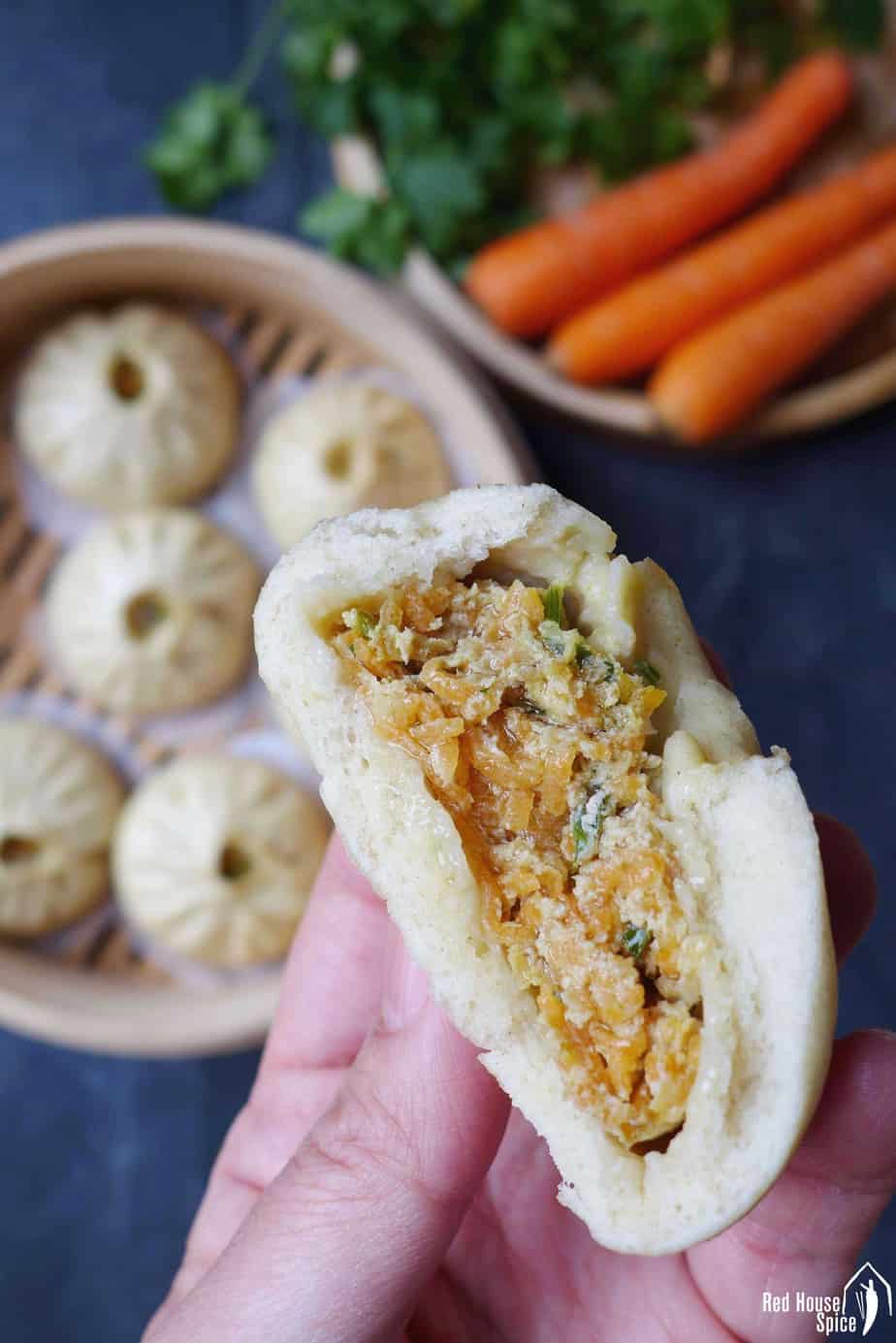
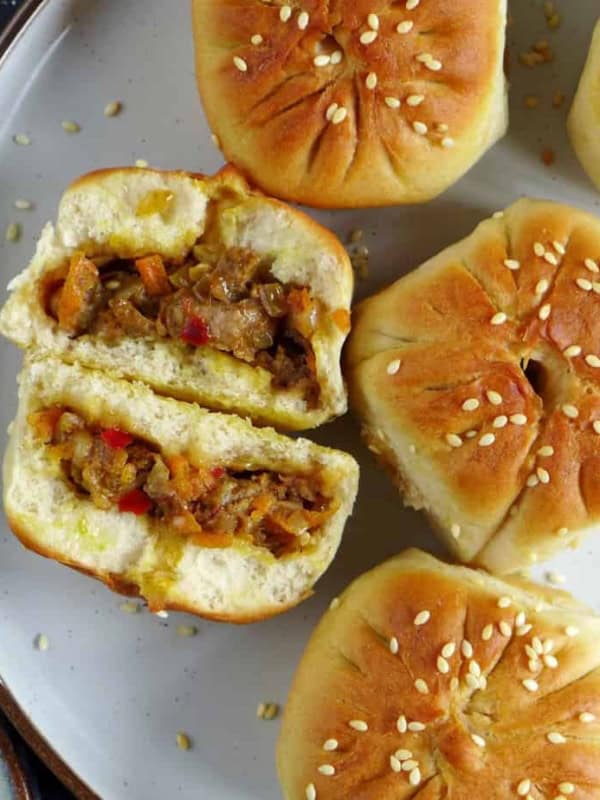
I use pork and carrots as the main ingredients in this recipe. Onion and coriander are added to boost the flavour.
- Add water/stock to the pork will produce a juicy filling. You can find more tips on this topic in my post “How to make great dumpling fillings”.
- Briefly stir fry carrot and onion in a little oil. This will enhance their flavour and give the filling a soft texture.
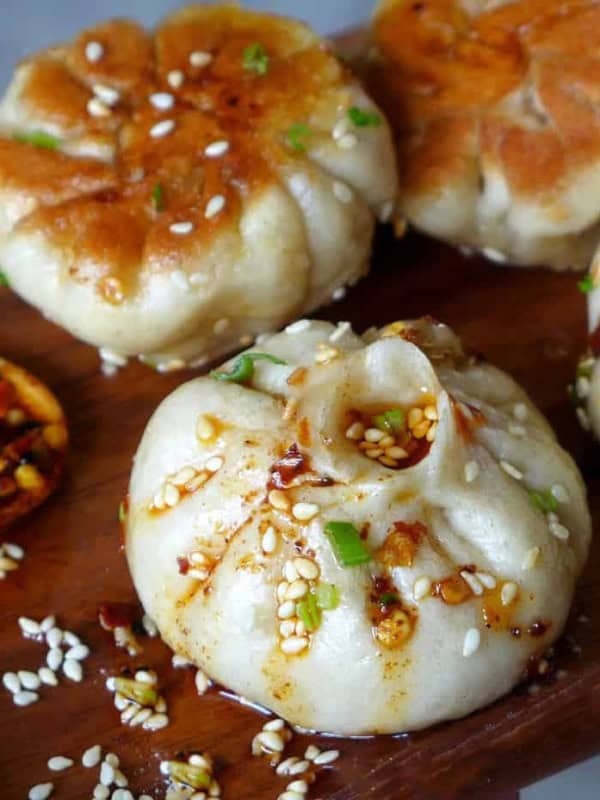
Other bao recipes


📋 Recipe card
Love this recipe? Please leave a 🌟🌟🌟🌟🌟 rating and a comment. Thank you!
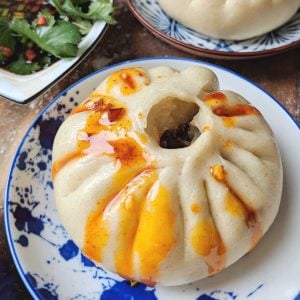
Steamed bao buns (包子), a complete guide

Video
Ingredients
For the dough
- 300 g all-purpose flour , or cake flour, see note 1
- 1 teaspoon dried yeast
- 1 teaspoon sugar
- 1 tablespoon cooking oil, see note 2
- 140 ml lukewarm water, see note 3
For the filling
- 150 g minced pork
- 1 teaspoon light soy sauce
- 1 teaspoon oyster sauce
- 1 pinch ground Sichuan pepper, or Chinese five-spice powder
- 1/4 teaspoon salt
- 4 tablespoon water, or unsalted stock
- 1 tablespoon cooking oil
- 150 g carrot, grated
- 1 small onion, finely chopped
- 2 tablespoon coriander, finely chopped
Instructions
Prepare the dough
- Mix flour, yeast, sugar and oil in a bowl. Pour in water little by little while mixing.
- Combine and knead with your hands until a very smooth dough forms (see note 4).
- Cover the bowl with a damp tea towel and leave to rise in a warm place until doubled in size (It will take between 40 minutes to 1.5 hours depending on the room temperature).
Mix the filling
- Put pork, soy sauce, oyster sauce, salt and Sichuan pepper/Chinese five-spice in a mixing bowl.
- Swirl constantly while gradually adding water/stock until no more liquid can be seen.
- Brief stir fry grated carrot and onion in oil until softened. Add to the pork along with chopped coriander.
Shape the buns (Please refer to the video below)
- Knead the dough until it goes back to its original size.
- Divide it into 12 equal portions. Roll each piece into a disk-like wrapper.
- Place some filling in the middle of a wrapper then fold into a bao shape.
- Leave all the assembled buns to rest for another 15 minutes or so.
Steam the buns
- Place the buns (with parchment paper underneath each one) in the steamer basket (see note 5). Leave 2cm space between the buns and the side of the steamer.
- Start cooking with cold water over a high heat. Turn the heat down to medium-low when the water starts boiling.
- Cook for 15-18 minutes.
Serving with a dipping sauce
- Serve them warm, on their own or with some dipping sauce (find inspirations in my post Six dumpling sauces).
Storage & reheat
- You can freeze cooked buns. Leave to defrost in the fridge then steam for 8 minutes to warm up, or steam for 15 minutes without defrosting.
Notes
Your Recipe Notes
Nutrition
Nutrition information is automatically calculated, so should only be used as an approximation.












Hi! My bun skins are rather tough/ dry after steaming . What could be the reason?
I’m not sure exactly what went wrong as I don’t know the full detail of how you prepared the dough. It might be that you dough is a little too hard (not enough water), or the proofing is not enough.
Hi Wei , thank you for your excellentand easy to follow recipes.
I live in the tropics and my kitchen temperature is around 28 C. I find that my dough proofs to double its size in about 40 minutes in my oven if I switch it on at 180C for exactly 90 seconds before putting the dough in. If your kitchen temperature is lower you will have to adjust the preheating time. A. L.Chan
Thank you Chan for sharing your tips!
Very helpful. Thank you. God bless
Thank you for sharing your recipe! Would the buns stay fluffy and soft when reheated from frozen? If not, would it help if I added a dough enhancer? Thank you. Tina
Follow the instructions in my recipe to reheat the buns in a steamer. They will be as fluffy as they were.
Thank you:))
Help!!!
Hi Wei
I am having the hardest time making your dough recipe. I don’t know what I’m doing wrong!!??? I have follow your recipe to the tee, but my dough never Turn out smooth!! I’ve tried my mixer and hand mixing and kneading, but not even close to what the outcome should be:( Before I give up…:( what’s else can I do?
Measuring from cups and tsp….
2cups of flour (all purpose)
1 tsp of quick active yeast
1 tsp of sugar
1/2 of warm water plus extra 1tbsp of water
Used my mixer and it never turn into a smooth dough…just small pieces of dough not coming together. Then I tried finishing it by hand mixing/kneading and it just falls apart, not smooth at all 🙁
Help!!
Char
Sorry to hear that Char! It sounds like you dough was too dry. I’ve noticed that you didn’t follow my recipe as the measurement you mentioned doesn’t correspond to what I suggest in the recipe. It seems that you forgot to add oil. And measuring flour by cup can be problematic and inaccurate. I recommend you measure with a kitchen scale.
Hello and thank you for the recipe!
I would like to make these in advance and freeze them. Which works best: steaming the bao then freezing the finished buns, or freezing uncooked bao then steaming later? Thank you!
Hi April! It’s best to freeze cooked bao. Defrost in the fridge then steam for a few minutes to reheat. I don’t recommend you freeze uncooked ones.
Thanks for sharing! I’m excited to try this recipe . One question: I’m vegetarian and was thinking of replacing the pork with mushrooms or tofu — would this affect the steaming process at all? Should I pre-cook the mushrooms/tofu with the carrots and onion? Thanks!
Hi Darby! It’s perfectly fine to make them with vegetarian fillings. You don’t need to precook anything. All go into the wrappers raw. If you’re interested, have a look at these posts. You can use any of these fillings to make bao buns: Vegan dumpling with tofu filling, How to make great dumpling fillings, Chinese chive pockets, Pan-fried vegetarian dumpling.
Very interesting hints for making baos.
Very comphrehensive.
Glad you find my guide helpful. Happy steaming!
Great recipe
Hi thank you so much for this recipe! Every time I make bao zi the flour doesn’t rise and is hard and flat 🙁 we use a machine to knead the dough, I wonder if that is the problem?
Hi! The dough can be kneaded by either hands or a machine. It’s perfectly fine to use a stand mixer (I do it most of the time). Check if your instant dry yeast is active (it loses its effectiveness over time). If time permits, I suggest you read the entire post (not just the recipe card at the end of the post) which explains lots of tips and tricks to help you succeed. Happy steaming!