

Making dumpling wrappers from scratch couldn’t be easier! In this section of my ultimate dumpling guide, you will learn to master this basic skill with ease.
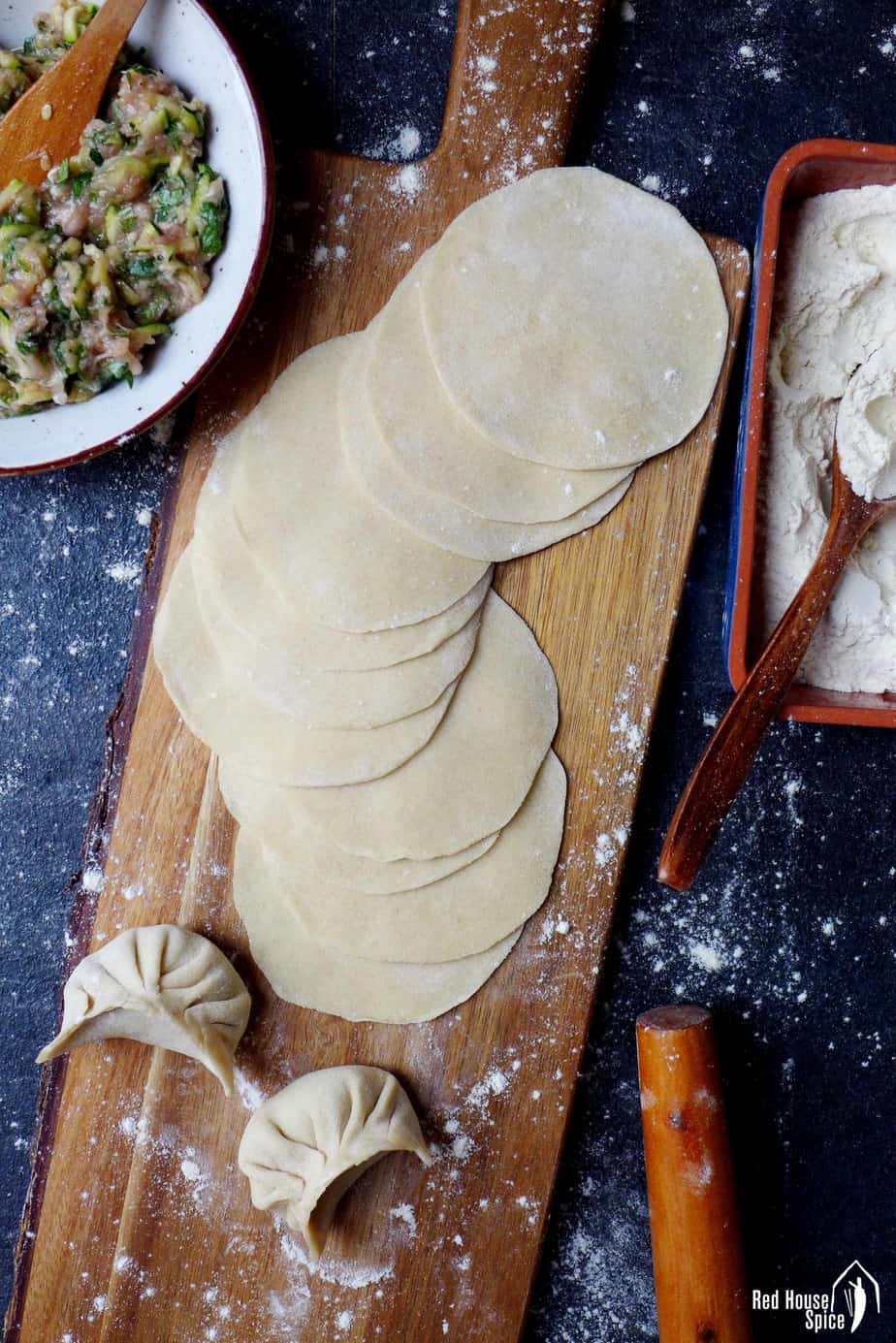
Pin this now to find it later!
Pin ItWith the Chinese New Year (Spring Festival, 春节) fast approaching, I’ve decided to create a series of posts on Chinese dumplings to say THANK YOU to my lovely readers for another year of support.
This ultimate guide will cover all aspects of homemade dumplings, the iconic dish of Chinese cuisine. Today, we start the journey with homemade dumpling wrappers (饺子皮).
Which flour to use?
Let’s get down to the basics: what kind of flour is required for Chinese dumplings? Contrary to popular belief, you don’t need to buy flour produced in China or flour specifically labeled as “dumpling flour”. You can produce excellent dumpling wrappers using regular flour sold in your local shop.
The most common all purpose flour works just fine! However, it’s a good idea to understand your flour.
- Flour with a medium level of gluten works best. The dough is easy to work with. The cooked wrappers are tender but still have a pleasurable chewy texture.
- The gluten level varies in all purpose flour sold in different countries. Check the protein content on the nutrition label (per 100g flour).
- 10-11g = ideal
- 12-14g = more resilient
- under 10g = soft
The good news is that you can alter the texture if you wish.
- Like your wrapper softer: add some corn starch to the flour or make a hot water dough instead of regular cold water dough (Continue reading to find out how).
- Prefer a more resilient texture: add a little salt to the dough.
The flour water ratio
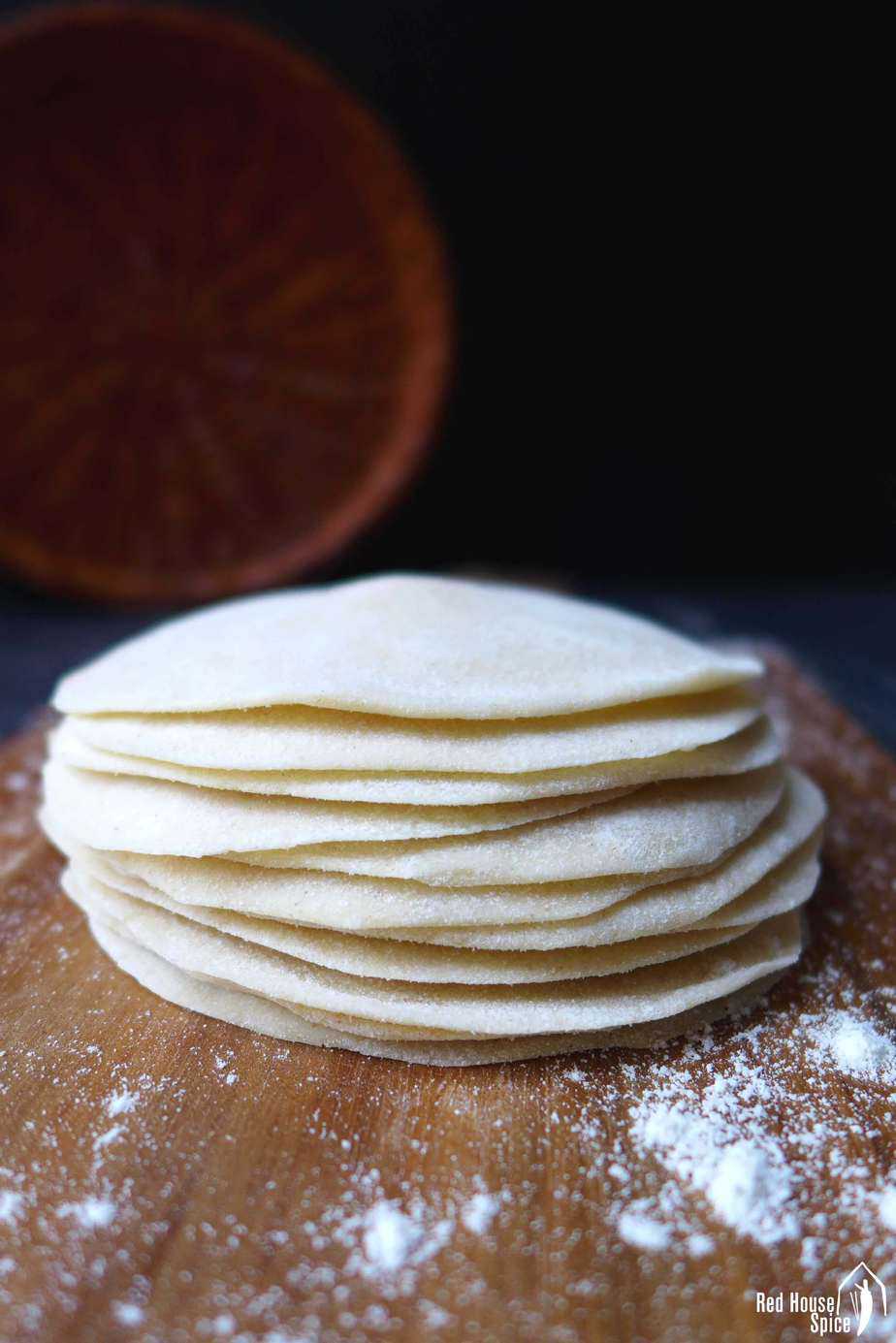
For making dumping wrappers, you would need a reasonably soft dough which is easily rolled but not so soft that it sticks.
Ratio:
- 250g / 2 cups all purpose flour
- 125-130ml / 0.5 cup water
*Please be aware that it’s less accurate to measure by cups.
This is the perfect ratio for me when using British regular plain flour (aka all purpose flour) which has a medium gluten level (10-11g protein per 100g flour). If you are using flour from another country, it might have a different water absorbing capacity. In general, the higher the protein content, the more water you would need to achieve the same consistency.
You might need some trail and error to find your very own perfect ratio. If you are new to homemade dumpling wrappers, I suggest you make the dough by hand for the first time instead of relying on a dough kneading device. This way you will be able to constantly “feel” the readiness of the dough and add more flour or water as required.
Make the dough by hand
I usually mix flour and water in a bowl. You can also do it directly on a flat floured surface. Add water to the flour gradually. Gently mix with a pair of chopsticks / spatular until no more loose flour can be seen. Then combine and knead with your hand.
At this stage, the dough ball should be medium firm and have a rough appearance. Leave it to rest (covered) for 10-15 minutes then knead it into a smooth ball. Cover and rest the dough a second time for at least 30 minutes.
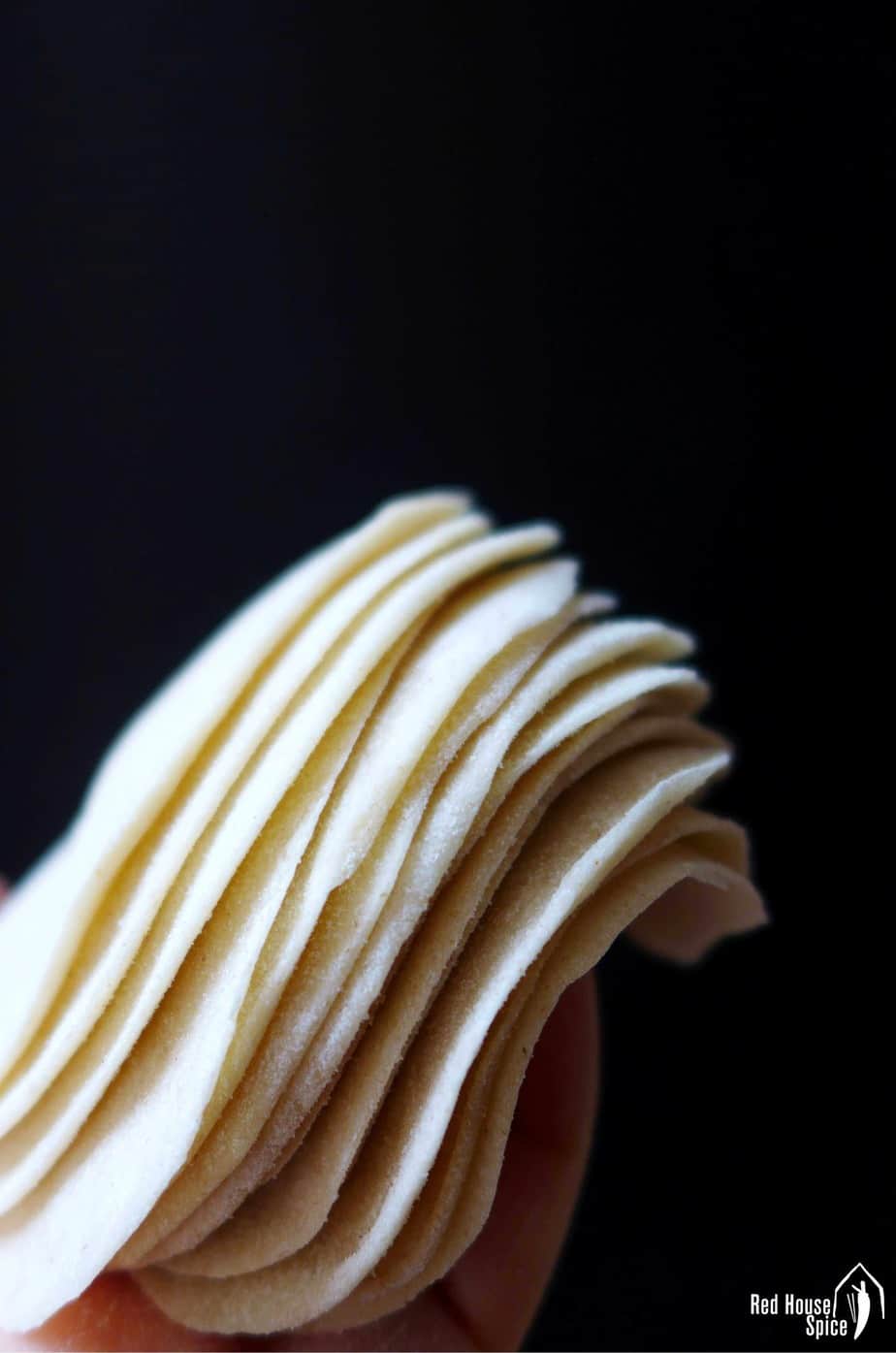
The resting process will help to soften the dough. The longer it rests, the softer it becomes. If you use flour high in gluten, it’s better to rest it a little longer. A Chinese cook would say the finished dough should be “as soft as an earlobe”.
Other dough varieties
What I have outlined is the most commonly used all purpose dough for Chinese dumplings. If you prefer a dough that is more supple to work with and more tender when cooked, I recommend another two types of dough:
- Hot-water dough. Let’s say the total water required is 300ml. Firstly, mix the flour with 200ml of boiling water. Then add 100ml of room temperature water to the mixture.
- Semi-starchy dough. Replace about 1/4 of the flour with corn starch. Don’t forget to sift to ensure an even mix. Wrappers made of this dough have a lovely shiny appearance when cooked and are tender on the palate.
These two types of dough work perfectly when the dumplings are either steamed or pan-fried. However, for water boiled dumplings I would suggest you use the regular dough.
* Some Cantonese dim sum dumplings use transparent wrappers that are entirely made of starch. Please refer to my post “Har gow: crystal prawn dumplings (虾饺)” for the wrapper recipe.
Shape the wrappers
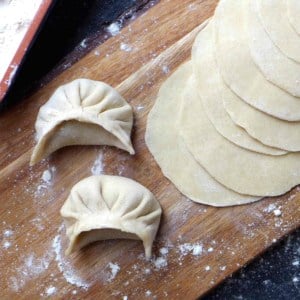
Here comes the most intimidating part: rolling the dough into individual wrappers one at a time. I admit it’s a labour-intensive, time-consuming job. But when you get the hang of it, you can make them quite efficiently. Here are the steps (Please refer to the the video above):
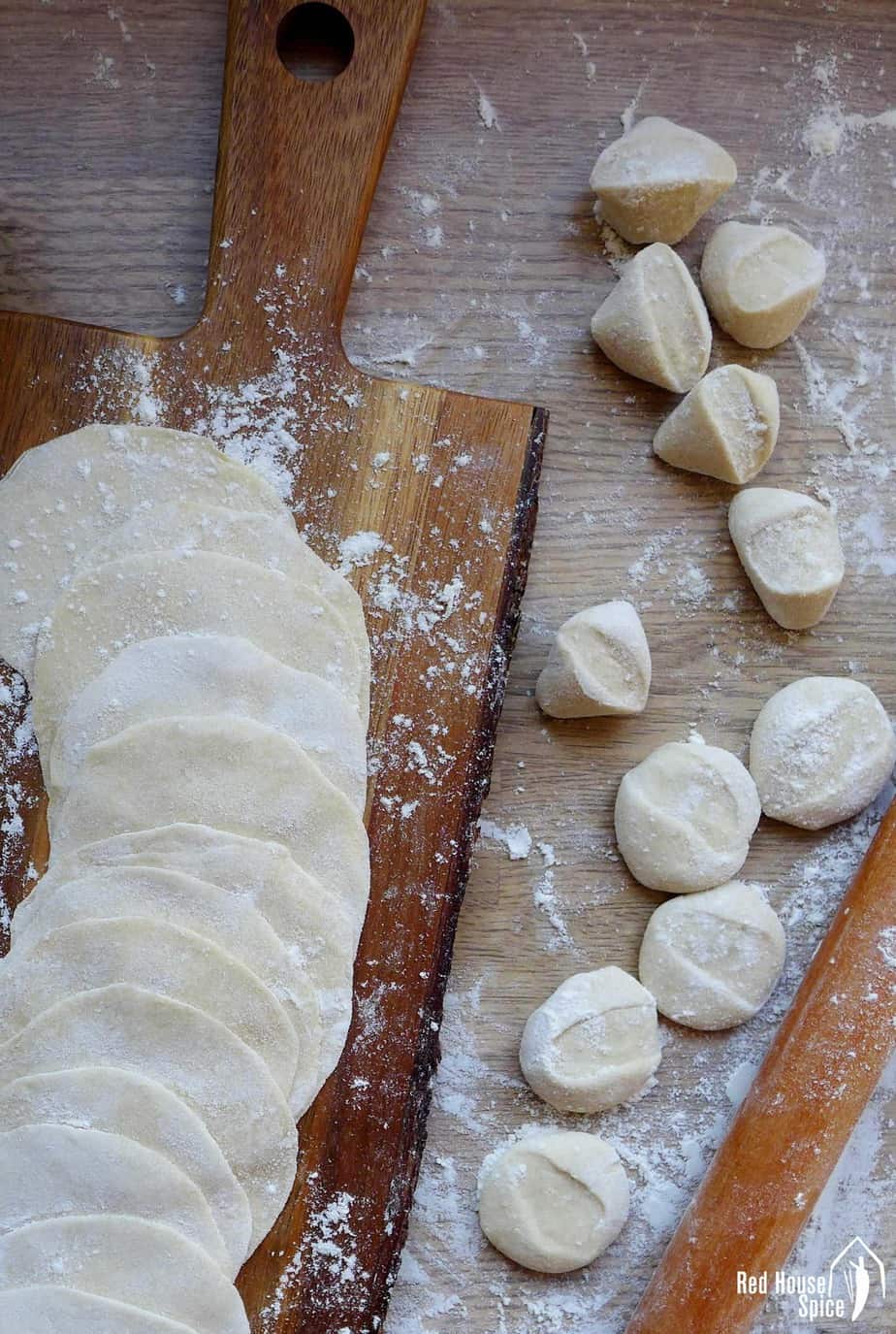
- Make a loop / rope with the dough.
- Cut it into equal sections.
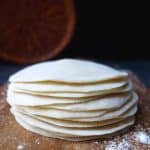
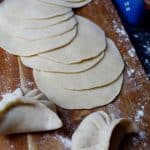
- Press each piece into a small disc with the palm of your hand.
- Use a rolling pin to flatten it into a thin disc.
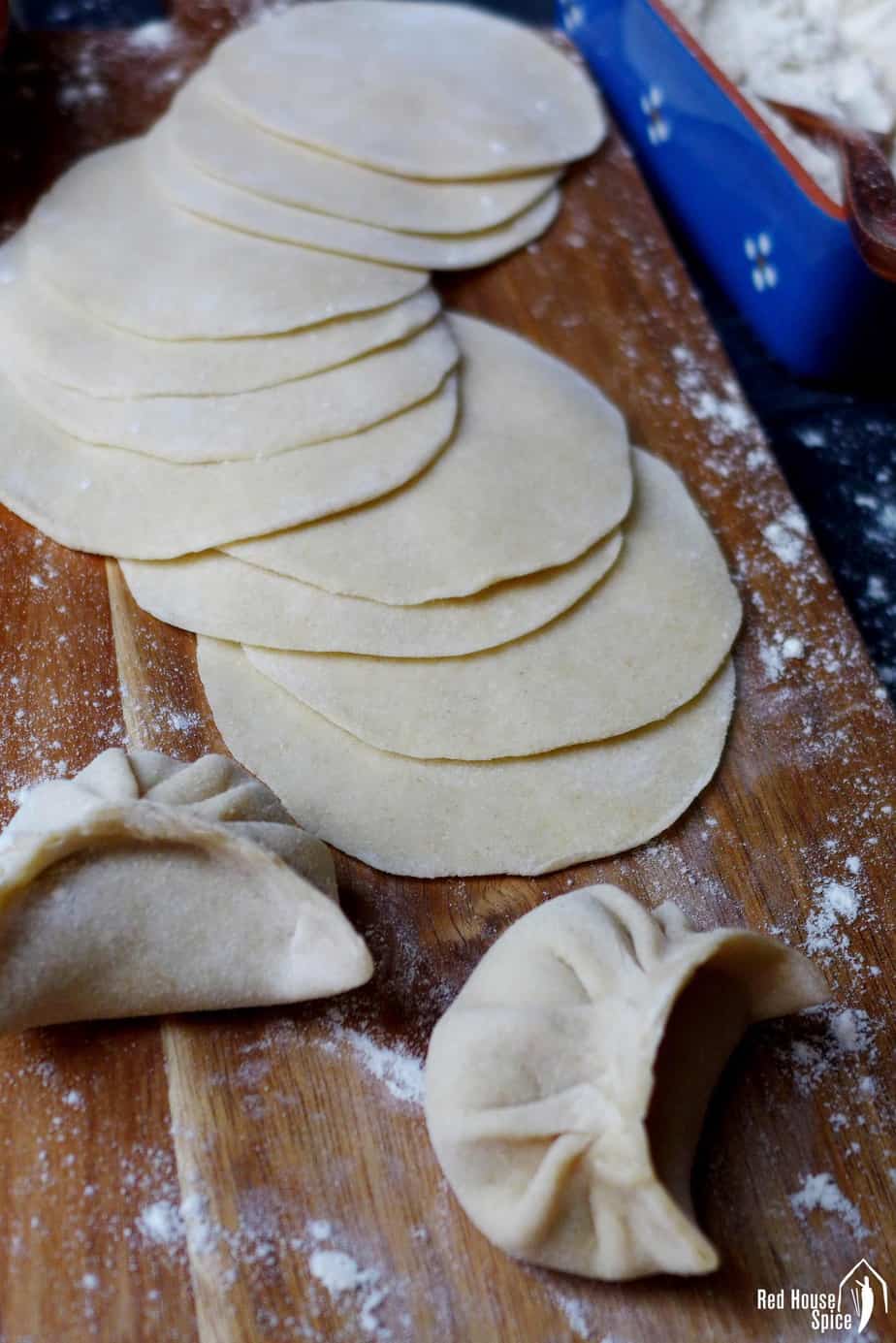
Ideally, the wrappers should be thicker in the middle and thinner around the edge. So the edge of the dumpling wouldn’t be too thick after sealing. To achieve a good result when rolling out the dough, a particular hand coordination is required.
One hand moves the rolling pin halfway over the dough and then rolls back. The other hand turns the wrapper a little each time in a circular motion. Roll, turn, roll, turn…(see how it works in my video above). Once you’ve got the rhythm right, the perfect wrappers can be made in no time!
* Always remember to dust with flour if the dough sticks. Cover the unused dough to prevent it from drying out.
* Alternative way: Use a pasta maker to roll the dough into a thin sheet (similar to how you make wonton wrappers). Then cut out wrappers with the rim of a wine glass or something similar.
Store the wrappers
Freshly made dumpling wrappers need to be used immediately. Otherwise they become dry and difficult to shape. In Chinese households, making dumplings is usually a family activity in which everyone participates. So the wrappers are always used straightaway by those who are in charge of dumpling assembly.
If you are working alone, remember to roll less than 10 wrappers at a time and assemble them. Then get back to your rolling action to produce the next batch. Don’t forget to dust with flour if you wish to pile up the dumpling wrappers.
Make them in advance: Homemade wrappers can be frozen. Sprinkle extra flour (or even better, use cornstarch) in between each wrapper. Place them in an air-tight plastic bag (squeeze out the air as much as possible). Defrost in the fridge then use them straightaway.
Use up the leftovers: No dough is wasted in my Red House kitchen. I always use leftover dumpling dough to cook Cong You Bing (Scallion Pancakes). Even it’s just enough for a small one, I think it’s worth the effort.
Other dumpling recipes
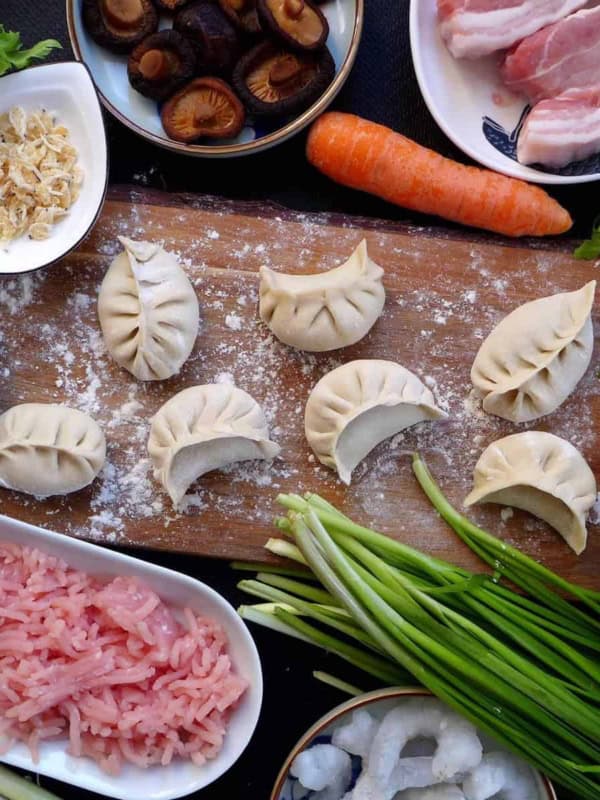
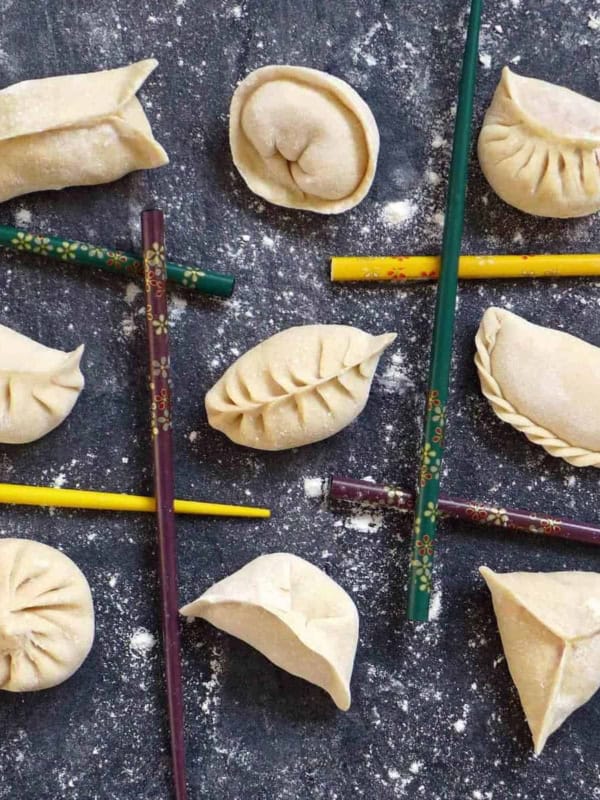
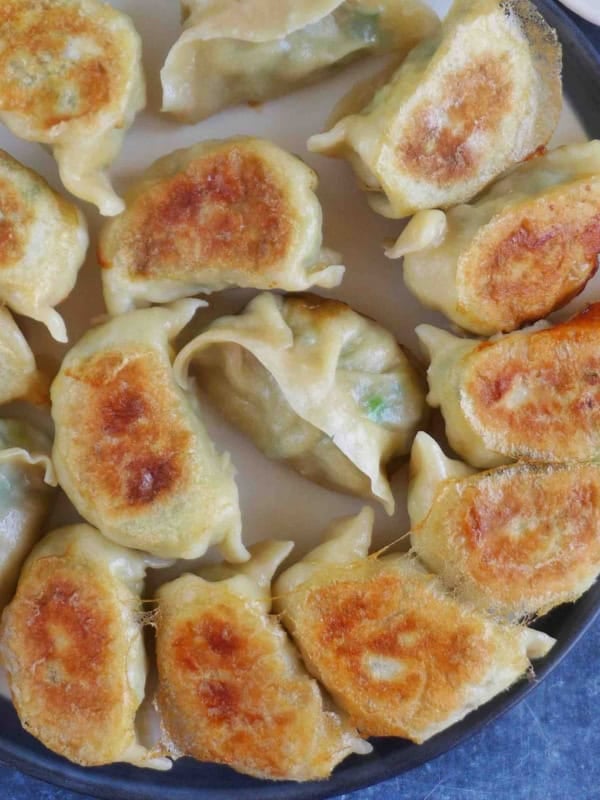
Now that the wrappers are made, why not check out other dumpling-related posts?


I’ve also included dumpling recipes in my new cookbook Three Meals Four Seasons.
📋 Recipe card
Love this recipe? Please leave a 🌟🌟🌟🌟🌟 rating and a comment. Thank you!
Homemade dumpling wrappers (饺子皮)

Video
Ingredients
For making around 30 wrappers
- 250 g all-purpose flour, about 2 cups, plus some for dusting
- 130 ml water, 1/2 cup+2 tsp (see note 1)
Instructions
- Add water to the flour gradually. Gently mix with a pair of chopsticks / spatular until no more loose flour can be seen. Then combine and knead with your hand. Leave to rest covered for 10-15 minutes then knead it into a smooth dough (see note 2).
- Cover and rest the dough again for 30-60 minutes until it becomes soft (Chinese cooks would say “as soft as an earlobe”).
- Make a loop with the dough then divide it into four parts. Roll one part (cover the rest to prevent them from drying out) into a rope then cut into 7-8 equal sections.
- Press each piece into a small disc with the palm of your hand. Then use a rolling pin to flatten it into a thin disc. Dust with flour if the dough sticks (Please refer to the video below).
- Use the fresh wrappers immediately. If you wish to freeze them for later, sprinkle extra flour in between each wrapper. Pile them up then place into an air-tight plastic bag (squeeze out the air as much as possible). Defrost in the fridge then use them straightaway.
Notes
Your Recipe Notes
Nutrition
Nutrition information is automatically calculated, so should only be used as an approximation.











Lovely post!
And I wonder how many people, after reading that “the dough should be as soft as an earlobe”, touched their ear to check…like I did 😂
Thank you for the very detailed instructions. 👩🏼🍳🥟🥟🥟📝
Ancestors’ wisdom makes cooking a little more fun, right? Glad you find my post helpful!
We’re very confused. Right away there doesn’t seem to be enough water. We measured correctly but can’t seem to make all the loose flour stick. It’s just too dry. We would appreciate any help!
Sorry to hear that! Did you measure the flour by cups or grams? As I mentioned in the recipe note, measuring with cups is less accurate. Also, flour from different brands varies in water absorption capacities, so you may need to adjust slightly. However, the dough shouldn’t be overly dry if the ingredients are measured according to the recipe.
thank you .It amazed me as i thought it so difficult when in China how fast the made them. I think you gave me the chance to try and thank you again.
Have a try! You’ll enjoy its simplicity for sure.
Can the dumplings skin be frozen ?
It’s best to use these dumpling wrappers right away. If you plan to freeze them, sprinkle extra flour (or even better, use cornstarch) in between each wrapper. Place them in an air-tight plastic bag and freeze.
Hi! Can I use this recipe to make pasta aswell? Like Lasagne plates, noodles etc
This dough recipe is not suitable for making noodles/pasta. Have a look at my post on Ramen Noodles and Hand-pulled Noodles.
I’ve tried making this today and it’s my first time making dumpling skin from scratch. I made both soup and pan fried dumplings with the skin. They turned out so nice just like the one bought from my local Chinese restaurant. Love it and thanks so much for the recipe!
It’s simpler than you imagined, right? So happy it worked well for you, Maya!
I’m looking for a recipe for gluten free dumplings for someone who is coeliac. Can I adapt this recipe y using a commercial GF flour?
Gluten-free flour won’t work for this recipe. To make gluten-free friendly dumpling wrappers, check out my recipe for Har Gow which uses wheat starch. Remember to make sure to use wheat starch that’s clearly labelled as gluten-free as regular wheat starch contains a tiny amount of gluten.
thank you so much for sharing wonderful recipe’s..
Made my first dumplings ever with this wrapper recipe. They were awesome! I added more water since my flour had more protein than the flour used in the recipe, like suggested, plus subbing out some flour for corn starch to alter the texture. I pan fried them on one side and finished by steaming them!
So happy to hear your positive feedback Brooke! Glad you enjoyed the recipe.
Hi,
I have been trying to make dumplings multiple times, but for some reason I still cannot get it right. My skin is very doughy and when boiled, does not turn transparent or delicate; it turns kind of stodgy and yellow, with white patches on it… I have tried kneading with a stand mixer, letting it rest for a few hours, all-purpose or plain flour, more and less flour- but it doesn’t seem to be working. Please do you have any advice?? 🙁
Hi Jasmine! Here are thoughts on this: wheat-flour dumpling wrappers aren’t supposed to be “transparent” after cooking (they can be translucent if thin enough); If they taste overly doughy, that’s probably because the wrappers aren’t rolled thin enough or the dough is too firm; Unless you use special dumpling flour (which is usually heavily bleached), the wrappers wouldn’t look super white (but shouldn’t be yellow though); White patches? That could be caused by dusting flour stuck on the wrapper dough. Hope this helps!
Cannot wait to try this recipe – the food science sounds accurate and love the tips to alter the consistency…. Will let you know how they turn out.
Happy cooking!