
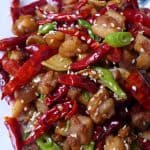
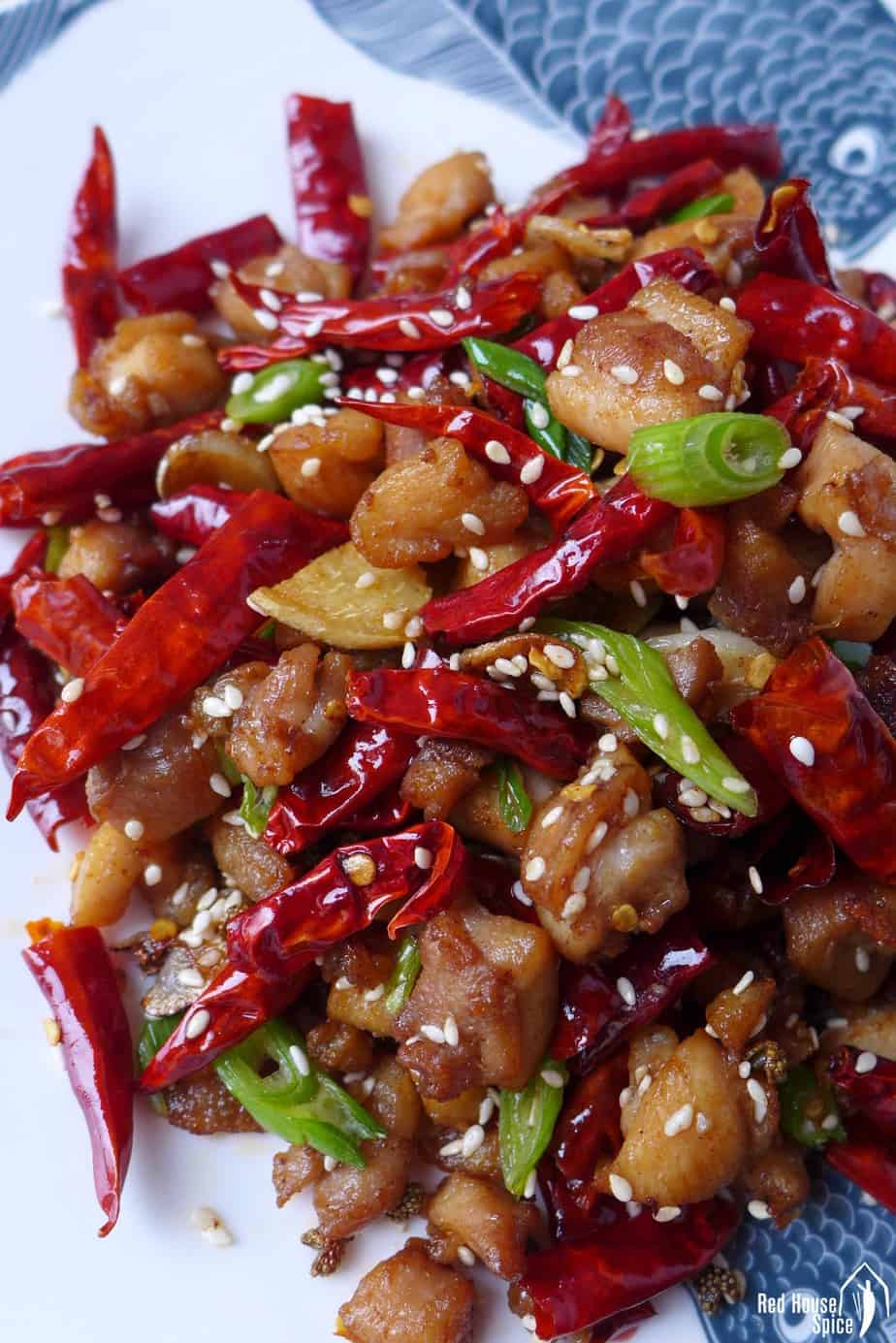
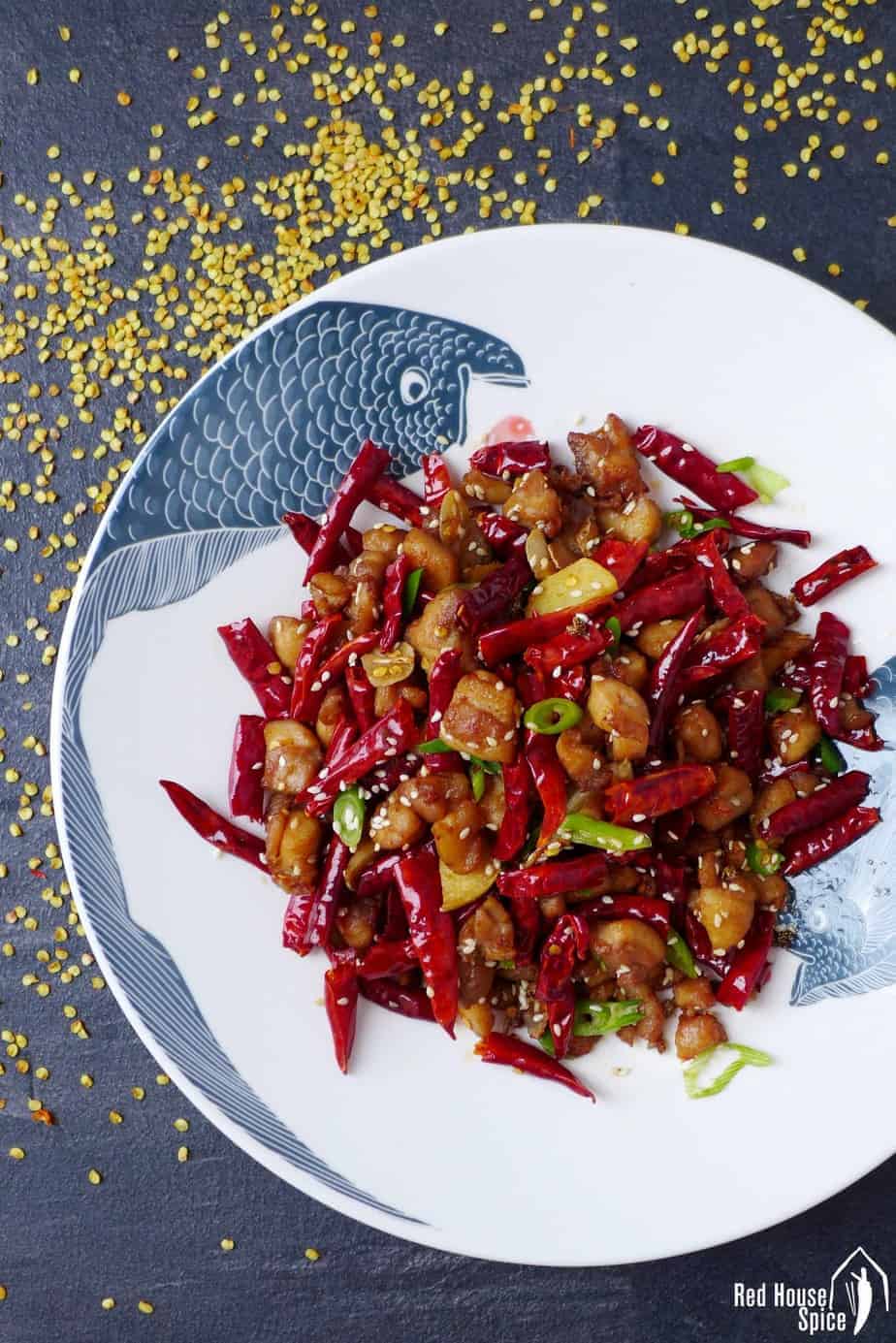
Crispy, tasty chicken pieces stir-fried with a generous amount of dried chillies and Sichuan pepper, Mala chicken is a classic delicacy not to be missed.
Pin this now to find it later!
Pin ItAs you may have noticed, I’m a huge fan of Sichuan food. Today’s recipe Mala chicken (Chongqing Laziji, 辣子鸡) is another signature dish of this fascinating cuisine.
Originating from Chongqing city, Mala chicken is popular nationwide in China. Vibrant in colour and sharp in taste, it’s a classic delicacy not to be missed.
Many people think mala chicken is a fun dish to eat. In restaurant versions, small pieces of chicken are usually buried in large amounts of dried chillies. So sometimes you really need to make an effort to find the chicken. It’s like a treasure hunt! My homemade version has more balanced proportions. However, please feel free to increase the volume of chillies if you enjoy the hunt!
Marinate the chicken
A tasty plate of mala chicken shouldn’t be just hot. It needs to be aromatic too. The marinating process allows the chicken pieces to absorb all the flavours from the seasoning.
- You will need ginger, spring onion, light soy sauce, Shaoxing rice wine, white pepper and salt.
- 20 minutes is the minimum time for marinating.
- I often leave it in the fridge overnight for an even better taste.
- Before deep-frying, don’t forget to remove the ginger and spring onion.

Deep fry twice
The marinated chicken pieces need to be deep-fried twice to achieve the desired texture and look. Temperature control is quite important during this process. It’s straightforward if you have a kitchen thermometer at hand. Otherwise, you need to watch attentively for the clues (Please refer to my video).
- The first time: Add chicken to the oil when it reaches 160°C / 320°F. You may put in one piece to test. You should see bubbles immediately appear around the chicken. Fry for about 3 minutes until the edges of the chicken turn lightly brown (adjustment may be necessary depending on the size of your chicken pieces).
- The second time: Wait for the temperature of the oil to rise to 180°C / 356°F. At this point, the surface of the oil should look very calm and you would see a little smoke appear. Once you add the chicken, the oil should bubble intensively. Fry for no more than 1 minute this time. The finished chicken should be evenly golden and crispy on the outside.
The mala flavour
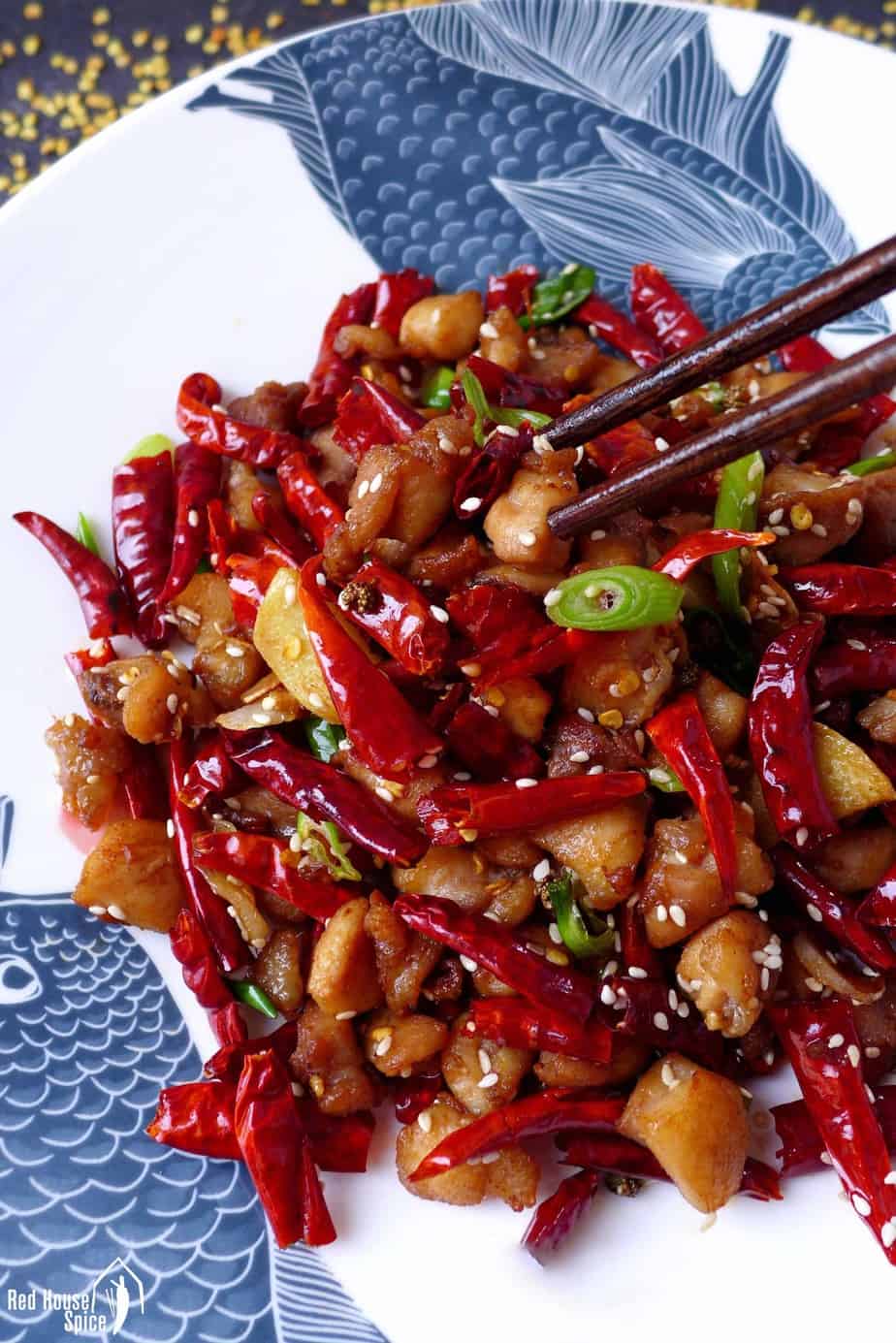
Needless to say, the key flavour of this dish is “Mala (麻辣)”, namely hot and numbing. You will need quite a lot of dried chillies and Sichuan pepper to create this addictive taste.
Classic mala chicken calls for 3 types of dried chilli produced in Sichuan province, China. They have different levels of heat and aroma. For home-cooked version, please feel free to use any good quality, aromatic dried chillies that are available to you. If you think the dish might turn out to be too spicy (considering the quantity required), I suggest you remove the seeds from the dried chilli.
I like using green Sichuan pepper for this dish as they produce a more intense numbing effect than regular dark red Sichuan pepper. Try it if you can get hold of them.
The final stir fry
Finally, it’s the stir-frying process to combine the chicken with the spices. There is one thing that I’d like to stress: Use medium-low heat to slowly bring out the flavour of the spring onion, ginger, Sichuan pepper and dried chillies without burning them. Retain the same heat when adding the chicken and other seasonings. Right before you dish out, sprinkle sesame seeds and finely chopped spring onion.
More Sichuan dishes to try
If you find this mala chicken tempting, have a look at other classic Sichuan dishes on the blog:
Mala chicken (Chongqing Laziji, 辣子鸡)

Video
Ingredients
Group 1
- 400 g / 14oz chicken thigh, deboned with skin on (see note 1)
- 6 slices ginger
- 1 stalk spring onion, cut in sections
- 1 teaspoon light soy sauce
- 1 teaspoon Shaoxing rice wine
- 1/4 teaspoon salt
- 1 pinch ground white pepper
Group 2
- 500 ml / 2 cups cooking oil, see note 2
Group 3
- 30 g / 1oz dried chillies, or to taste
- 1 teaspoon whole Sichuan peppercorn, see note 3
- 8 slices ginger
- 4 cloves garlic, sliced
- 1 teaspoon light soy sauce
- 1 pinch sugar
- 1 teaspoon Shaoxing rice wine
- 1 teaspoon toasted sesame seeds
- 1 stalk spring onion, finely chopped
Instructions
- Cut the chicken into bitesize cubes. Mix with all Group 1 ingredients. Marinate for 20 minutes (or longer if you wish). Remove ginger and spring onion before deep frying.
- While waiting, prepare the dried chilli. Break each one into half then remove the seeds (see note 4).
- Heat up oil over a high heat. When the temperature reaches 160°C / 320°F, gently slide in chicken pieces. Fry for 3 minutes or so (when the edges of the chicken lightly brown).
- Remove the chicken from the oil. Continue heating up the oil. Put the chicken back in when the oil reaches 180°C / 356°F. Fry for 1 minute then take out.
- Leave about 1 tablespoon of oil in the wok. Fry ginger, garlic and Sichuan pepper over a medium low heat for 1 minute. Add dried chillies. Retain the heat level and fry until fragrant (do not burn).
- Stir in chicken pieces. Add soy sauce, sugar and rice wine. Cook a further 2 minutes. Sprinkle sesame seeds and spring onion. Give everything a quick stir then dish out.
Notes
Your Recipe Notes
Nutrition information is automatically calculated, so should only be used as an approximation.












Your website is an haven of wisdom in a digital desert.
Hi I tried cooking today. All good except it’s not spicy enough. What do you suggest to do?
Thanks for trying out my recipe Amy! For a spicier taste, try using dried chili pepper that has a high level of heat. Also, make sure you use low heat to slowly infuse the oil with the dried chili before adding the deep-fried chicken pieces. Hope this helps!
Hi,
I am confused about Sichuan kong pao chicken and Laziji. Are they supposed to be the same but with variations or they are totally separate recipes? The ingredients look the same, right?
Hi Allan! They are totally separate dishes. The cooking methods and ingredients required are different and the taste is different too. I have a recipe for Kung Pao Chicken. Check it out!
Is there anything else you can use if you have no sichuan pepercorns
There isn’t any spice that resembles the taste of Sichuan peppercorn (learn more about this unique Chinese spice in my Sichuan Pepper Guide). So I can’t recommend a substitute. That said, you may skip it for this recipe. The final flavour of the dish will be different but still tasty.
Hi Wei, I fell in love with laziji a while back and have been trying to make it at home for several months. I have tried several recipes, including yours, but I can never get the crispiness that I get from Sichuan restaurant laziji. Do you have any tips for ensuring that it turns out crispy, or do you know how chefs achieve the crispiness in Sichuan restaurants? Also, restaurant laziji is always bursting with flavor, but mine is always dull, and I do not know why.
Hi Taylor! To achieve extra crispy texture you would need abundant amount of oil for deep frying. This way the oil temperature doesn’t drop too much when chicken is added (Home cooks normally tend not to waste too much oil). Also you need control the temperature very well, particularly for the second around at higher temperature.
Regarding the flavour, it’s highly likely due to the fact that most Chinese restaurant chefs use MSG and/or other flavouring agents to enhance the taste.
Hi Paul. If your chillis are already cut into pieces, I wouldn’t suggest you rinse them in water. You may “dry fry” them in advance: fry over a low heat without oil for a short while. Be careful that do not overcook/ burn the chillis.
Hi Wei, it’s me again! Still working on preparing the perfect Lazi Ji (how I love this dish). I’ve managed to acquire the specific varieties of Sichuan chilies you’ve mentioned in a post above. I wonder, hoe to prepare them for hygienic use. Do I rince the chillies, or even cook them for a short while? Will that not affect their ability to spice the chicken? I’ve got the chillies cut in parts, I fear that the small remainder of the seeds will wah out entirely.
But I suppose some cleansing is wise?Paul
Hi, some lazi ji recipes also include corn starch in the marinade. What are your thoughts about that and what function does corn starch have in a dish like this?
Hi Paul. Corn starch is commonly used in marinade for tenderising the meat. Personally I don’t think it’s essential for this dish as chicken thigh pieces taste tender enough without it.
Hi! This looks DELICIOUS!! My sister and I are wondering – what kind of dried red chillies do you use? Is there a specific type with the “perfect hotness”? Thanks so much for sharing! We’ll be making a chili and spring onion pancakes soon… love from Sweden!
Hi Hannah! The “perfect hotness” differs depending ones’ own preference. The authentic Chongqing Laziji calls for three types of local dried chilli (Er Jing Tiao/二荆条, Qi Xing Jiao/七星椒, Xiao Mi Jiao/小米椒) which make the dish both hot and aromatic. However it’s very difficult to find all three of them (if any) living outside China. I use randomly found dried chilli (Indian or Italian brand) for this dish and the result are pretty good. If you enjoy spicy food, I suggest you go for the chillis with a high level of spiciness. The finished chicken pieces would be less spicy than the chillis themselves.
Hi Wei, what would you consider the best Chinese (dried) chilli to add flavour to a dish?
Also, are there variaties of green huajiao? Which would you consider best?
Er Jing Tiao (二荆条) is a very good variety of Chinese dried chilli. Regarding green Sichuan pepper, I don’t have a particular variety to recommend. Have a look at my Sichuan Pepper Guide which includes tips on how to identify good quality Sichuan pepper.
Hi wei!!! I love your Chinese cooking tips, it’s so helpful I cannot be more happy to learn from you. In this recipe here https://blog.themalamarket.com/sichuan-chili-oil-recipe/ they say to use Er Jing Tiao, Zi Dan Tou, and Xiao Mi La, which it differs from your suggestion a bit. Which one is more authentic, any suggestion will help me!!
The only difference between my suggestion and theirs is Qi Xing Jiao or Zi Dan Tou (look at my comment on August 06, 2019). I’d say both work perfectly. In fact restaurants in China have their own “unique/secret” combination. Highly you don’t notice any difference if you change the combination a little. Hope this helps!
Thank you Wei, this takes me back to the time I visited Chongqing while i lived in China for some years! Will give this a go sometime. I also ate the best spicy noodle soup I ever had there, amazing.
You are welcome Jay! Yes Chongqing Xiaomian (spicy noodles) is absolutely addictive.