
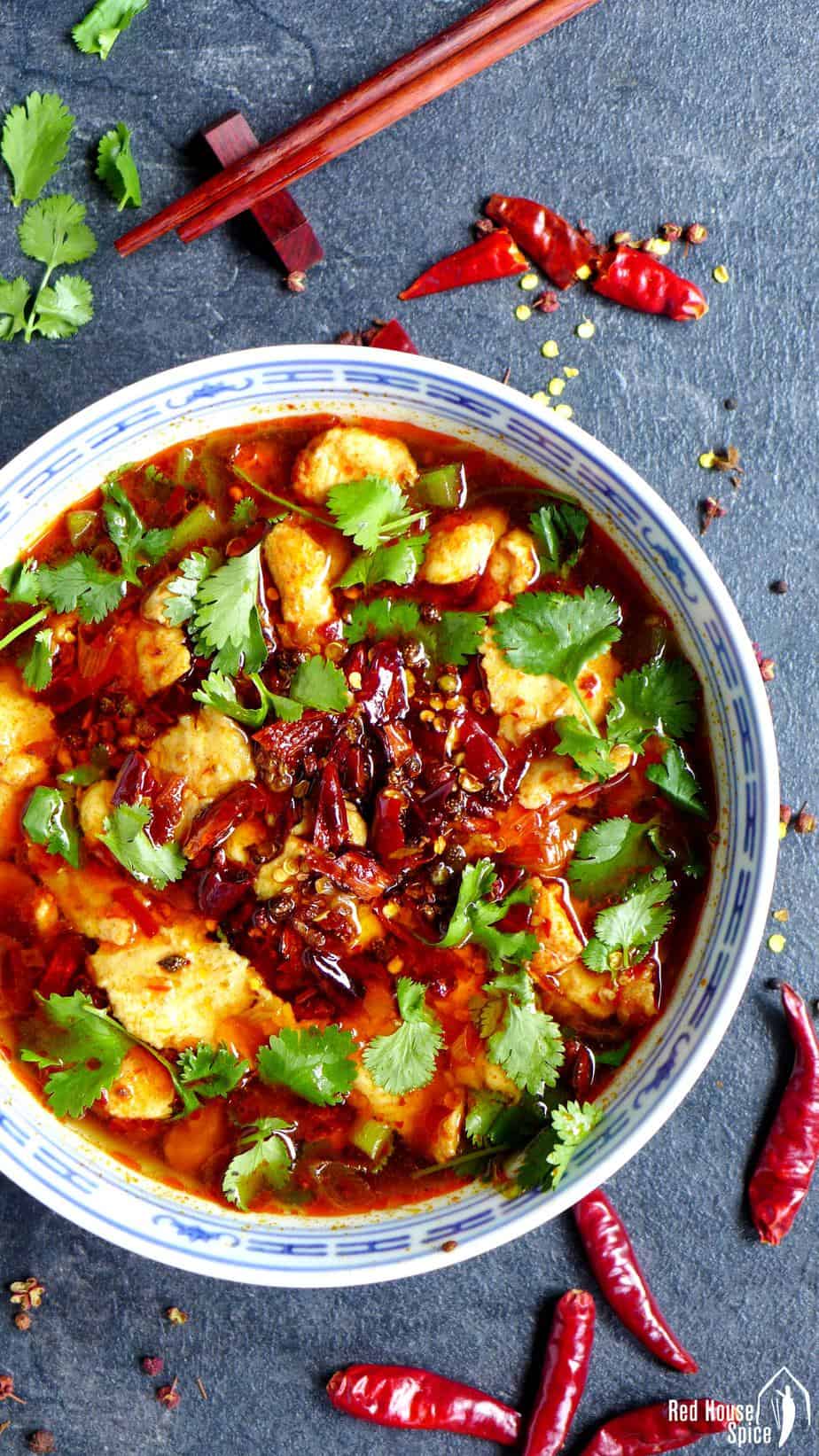
Tendre fish fillet poached in seasoned water, then topped with spices, Sichuan boiled fish is tasty, pungent and super addictive.
Pin this now to find it later!
Pin ItI still remember exactly where I ate Sichuan boiled fish (Shui Zhu Yu/水煮鱼) for the first time. It was a tiny little restaurant specializing in Sichuan cuisine hidden in a quiet neighbourhood of Beijing.
At that moment, I only knew a few famous Sichuan dishes, such as Mapo tofu, Kong Pao chicken, Shredded pork with garlic sauce, etc.. I found Sichuan boiled fish so stunning that later on it became the one dish that I always order whenever it’s on the menu.
It’s tender & succulent
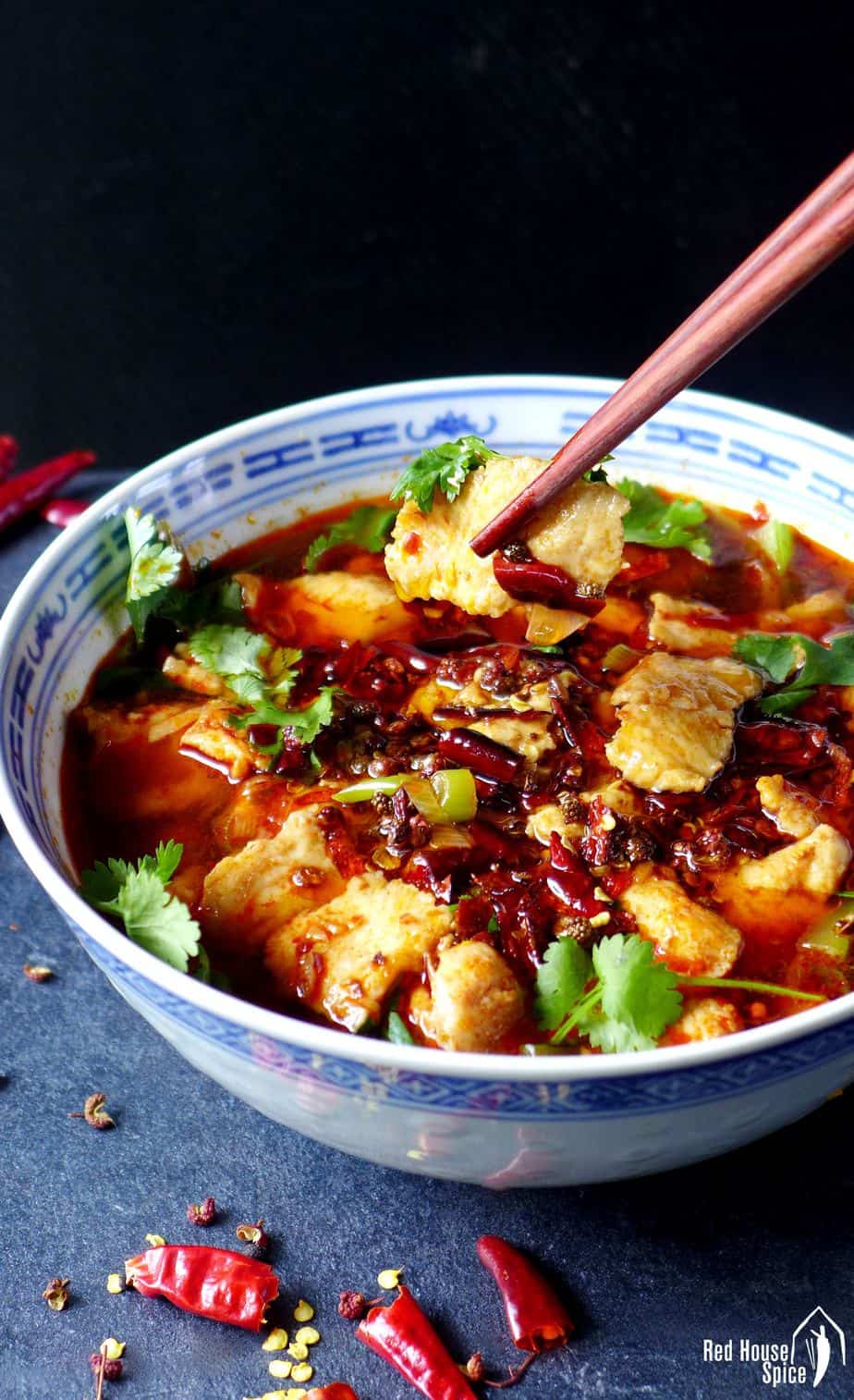
Literally, the Chinese name of Sichuan boil fish “Shui Zhu Yu (水煮鱼)” means water boiled fish. The marinated fish slices are poached briefly in seasoned water. They taste very tender, succulent and packed with flavour. Another Sichuan classic, Suan Cai Yu (Sour Vegetable Fish), shares similar characteristics.
To achieve the best result, I recommend you use fresh fillets instead of frozen ones. In China, restaurants often have fish tanks from which the customers can choose live fish to be freshly prepared for this dish (Don’t fancy fish, try Sichuan Boiled Beef instead).
It’s super spicy
As one of the most pungent Chinese dishes, authentic Sichuan boiled fish is famous for its hotness. My friend Junyang adored this dish but unfortunately, she has a low tolerance for spicy food. She used to rinse the fish in a glass of water to reduce the hotness. And little by little she has eventually increased her tolerance.
In my recipe, you can see that the spiciness comes from the generous use of 3 ingredients: dried chilli, Sichuan chilli bean paste and chilli powder.
It gives you a numbing sensation
Sichuan boiled fish is also pungent in another way: it delivers an intensive numbing sensation to your mouth by using quite a lot of Sichuan pepper (it’s an acquired taste but very addictive once you become accustomed to it).
You might have heard or used regular Sichuan pepper (Huajiao, 花椒) which is red in colour. In fact, there is another type of Sichuan pepper called Majiao (麻椒) which has the same shape and size but is green in colour. It’s often used in Sichuan boiled fish to enhance the fragrance. However, you can use regular Sichuan pepper if you can’t find the green ones.
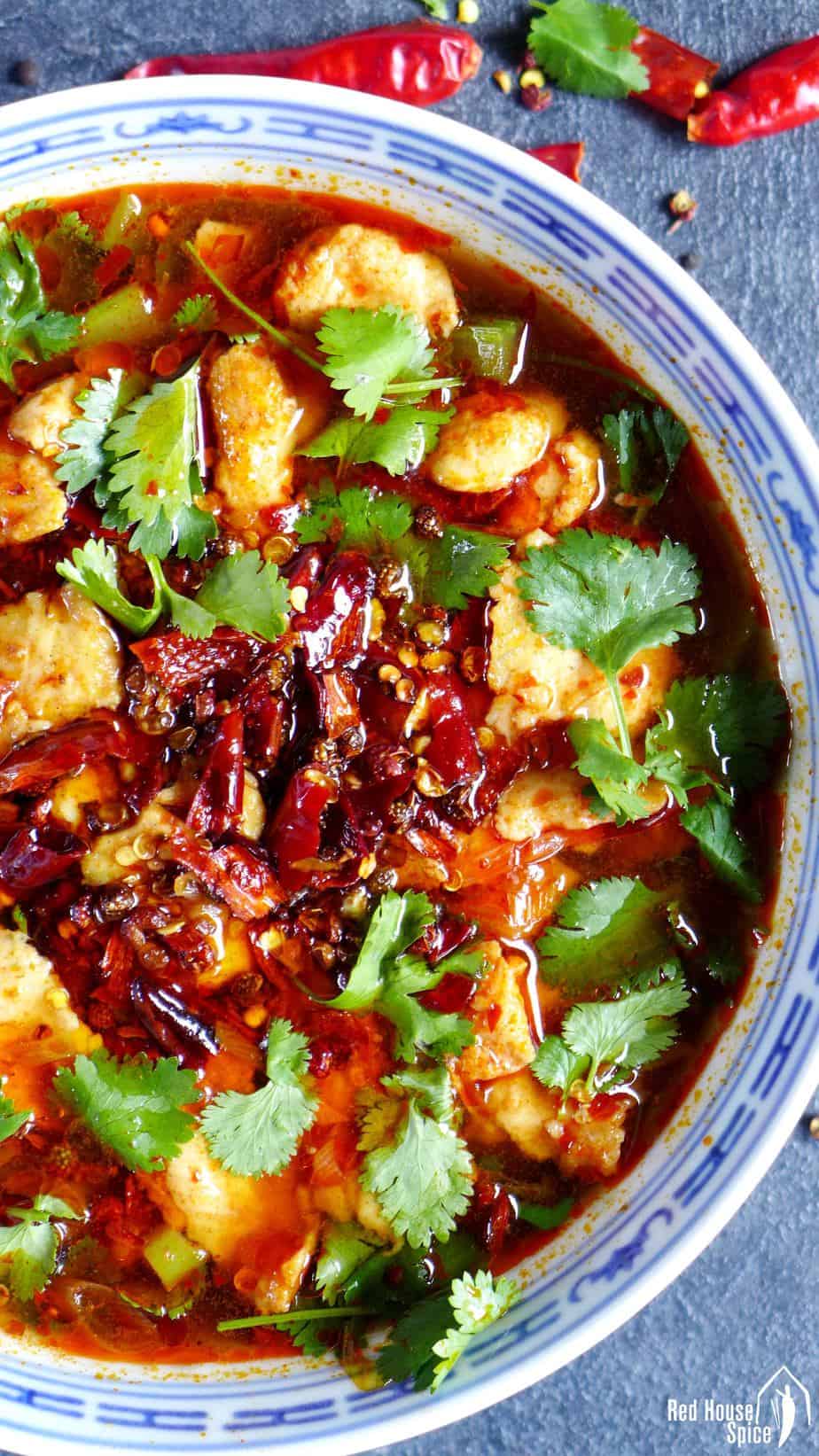
It’s easy to cook!
Many people find it intimidating to cook Sichuan boiled fish at home. I was one of them until I had a try. It’s pretty straight forward. There’s no particular cooking skill involved. As long as you have all the ingredients to hand and follow a detailed, well-written recipe, nothing will go wrong.
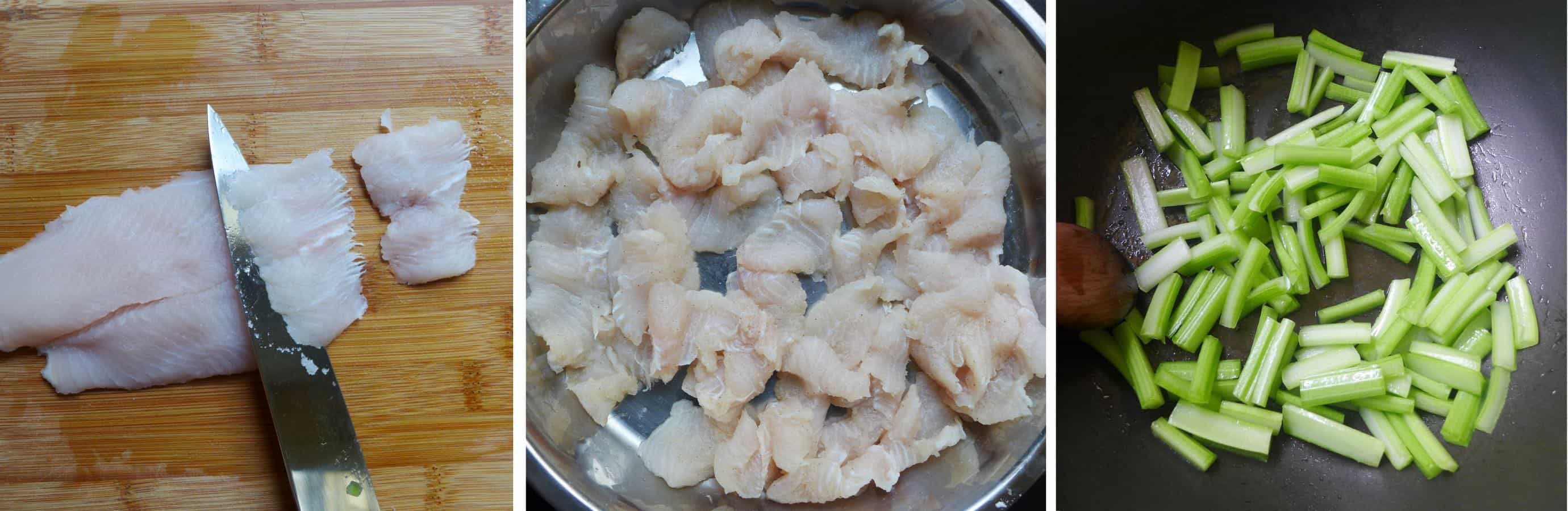
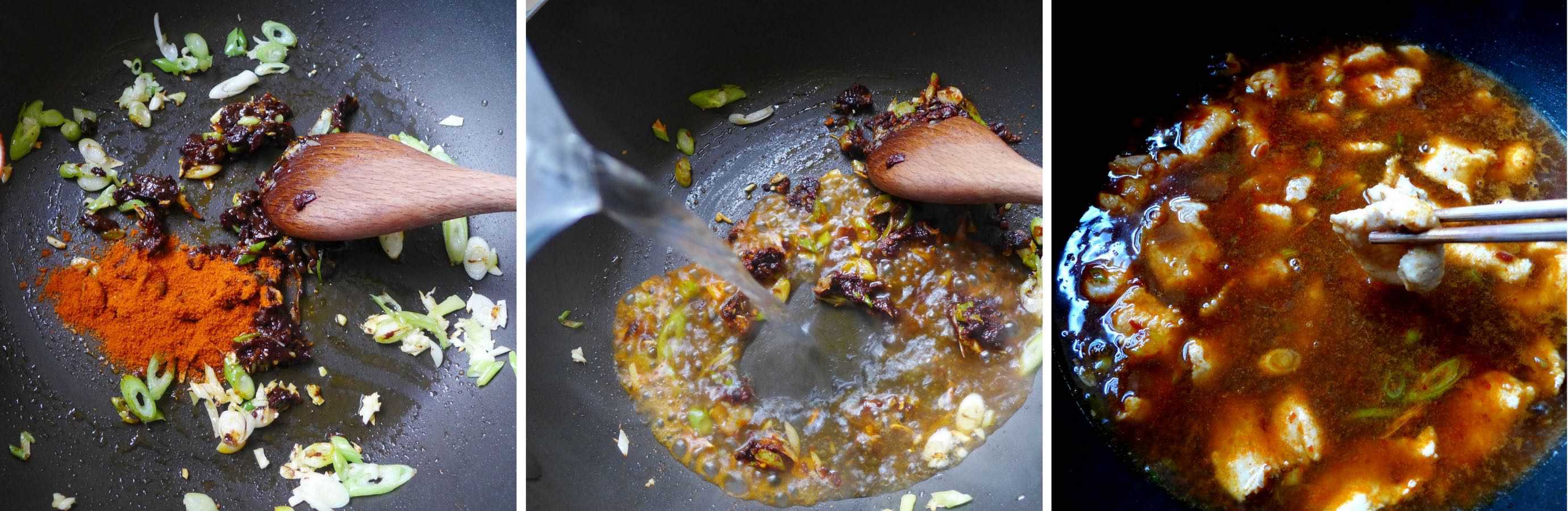
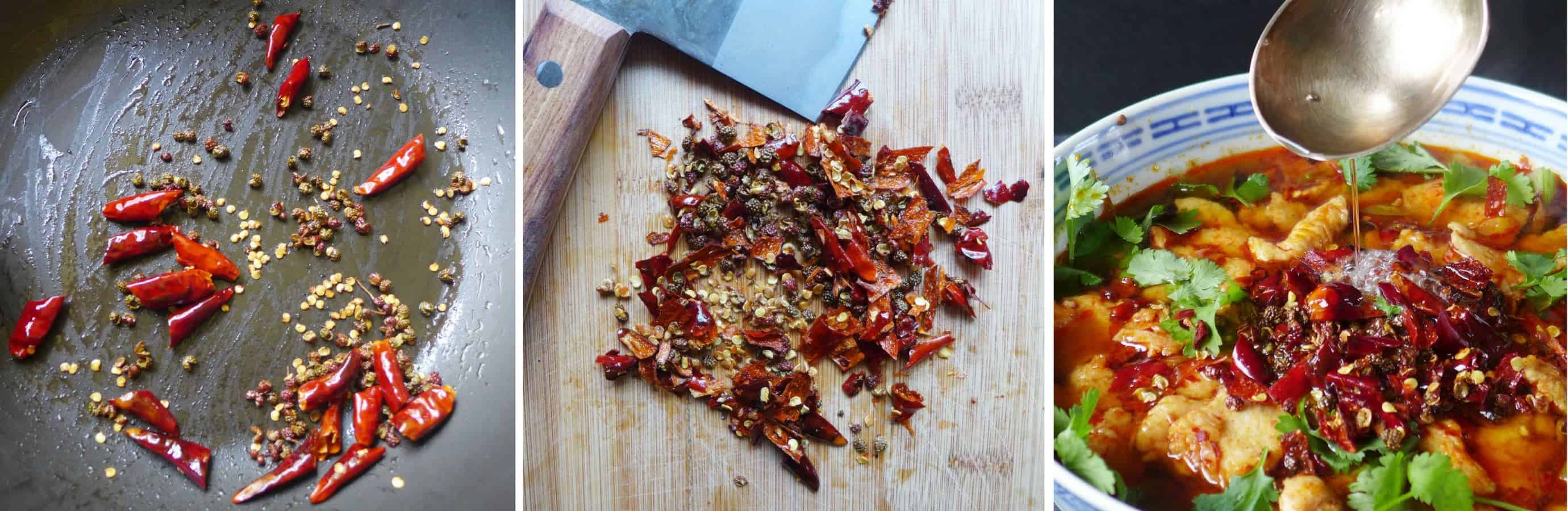
When reading the recipe card below, you will notice that I put ingredients in several groups. This corresponds to different cooking steps. Please note that cooking oil is listed in different groups for various purpose. The finished dish doesn’t taste greasy despite the generous use of oil. The oil is essential to draw out the full fragrance of the spices.
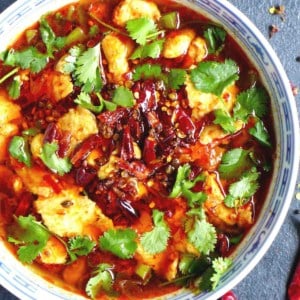
Sichuan boiled fish (Shui Zhu Yu, 水煮鱼)

Ingredients
For the fish
- 250 g skinless, boneless fish fillet, 9oz (see note 1)
- 1 pinch salt
- 1 pinch white pepper
- 1 teaspoon Shaoxing rice wine
- 1 teaspoon corn starch
For the spices
- 1/2 teaspoon cooking oil
- 15 dried chilli
- 2 teaspoon Sichuan peppercorn, see note 2
For the vegetable
- 1 teaspoon cooking oil
- 250 g celery, cut into thin strips, or bean sprouts
For the broth
- 2 tablespoon cooking oil
- 2 clove garlic, minced
- 1 teaspoon ginger, minced
- 1 stalk scallions, chopped
- 1.5 tablespoon Sichuan chilli bean paste, see note 3
- 1 teaspoon chilli powder
- 400 ml hot water, or chicken stock
For garnishing
- Coriander, chopped
- 2 tablespoon cooking oil
Instructions
Marinate the fish
- Slice the fish fillet diagonally. Marinate with salt, white pepper, rice wine & corn starch.
Fry the spices
- In a wok (or a deep frying pan), fry dried chilli and Sichuan pepper in oil over a low heat until fragrant (do not burn them). Chop coarsely when cooled. Set aside.
Cook the vegetable
- In the same wok, heat up oil over a medium heat, stir in celery. Cook for 1.5 minutes or so (30 seconds if using bean sprouts instead). Transfer to a serving bowl. Set aside.
Make the broth
- Heat up oil in the wok, fry garlic, ginger and spring onion. Add Sichuan chilli bean paste and chilli powder. Pour in water (or chicken stock). Bring it to a full boil.
Cook the fish
- Gently place the fish slices into the wok. When cooked, pour the fish and the soup onto the vegetable.
Garnishing
- Top with fried spices and coriander. Heat up oil then pour over to sizzle the spices. Serve immediately with plain rice.
Notes
Your Recipe Notes
Nutrition
Nutrition information is automatically calculated, so should only be used as an approximation.












Great, thank you! I raise tilapia in an aquaponics garden. I used this recipe with a little mod (doubled recipe, less sichuan pepper, and more garden greens) and it was wonderful with the fresh fish. Tilapia really take on the flavors. It was a hit!
You are welcome! Very happy that you liked my recipe and thank you for sharing your cooking experience.
Wonderful! Been looking for this for some time. As an exchange student in Singapore last year, this became my favorite dish! I’m determined to learn to make it. Will be a challenge to find some of the ingredients in Sweden but hopefully a lot can be ordered online. Xie xie ni!
You are welcome Danne! Good luck on searching for the ingredients.
I just made this for my husband and myself, and we love it! The only substitution I’d make next time is reduce the amount of dry red chilies as we found that we prefer the spice of the sichuan peppercorns to that of the chilies. We made it with cod. Other than that, everything was spot on! Thank you for this easy recipe!
Great news to hear! Very happy to know you find my recipe easy and tasty. Enjoy your kitchen adventure!
This dish was amazing. I have made a few recipes from your site, all great, but this was as you said, easy and so good. Thumbs up from my family. This is on my top ten favorite go to recipes for sure. Thank you for sharing your passion. Best, Lee
You are more than welcome Lee! This is one of my favourite dishes too. I used to eat it very often with my friends in China and we usually had a huge bowl and some plain rice. No other dishes needed. Very happy to know you and your family enjoyed it!
My husband and I love authentic Sichuan food and make it regularly at home. We found a Chengdu restaurant near us and tried the food and we crave for it all the time. Last night we tried this recipe and loved it! We added Bokchoy to it to add some greens and it was delicious! we will buy the green peppercorn when we are in an Asian store next time….cannot wait to try it with chicken or Pork! Thanks for sharing! Can you please share your website for other recipes like this? Thanks, we like the detailed step by step and groupings…..makes it easy to make.
Hi Hema! So happy to hear you and your husband liked my recipe. I LOVE Sichuan cuisine and will surely share more similar recipes.
Wonderful recipe, I’ve been preparing this with beef. One thing I’m struggling with: achieving this lovely deep red colour after pouring the hot oil on top. I use the Pixian Dou Ban chilli bean paste, which is dark brown (whereas those bean pastes I see on instruction video’s are pretty red). Well, two things: how much oil should be poured on top at the end, ideally? I find it hard to find the right ratio between sauce and oil. Thanks!
Hi Paul! The colour of Pixian Dou Ban chilli bean paste may vary depends on the brands (As shown in the instruction photos above, my one is quite dark too). The red colour of this dish also comes from the chilli powder so you can achieve a brighter colour by adding more chilli powder. Cooking for my family, I usually pour 2 tablespoons of hot oil over the spicy topping. But in Chinese restaurants, chefs tend to pour much more oil (and much more dried chilli as well) to make the dish tastier. Please feel free to increase the volume of the oil if you wish. Hope this is helpful.
Hi! Perhaps I’m a bit of an oddball, but I think the best version of this dish is made not with fish or beef, but with chicken. I’m just wondering – if I want to try this recipe but with chicken, can I just simply replace the fish with chicken, or is there also something else I need to be aware of?
Hi Michael! You can simply follow this recipe for a chicken version. For better texture and taste, I suggest you cut the chicken into thin slices and do not overcook it in the water (stock). Happy cooking!
There is a local restaurant that serves their version of this dish and calls it “Swimming Fire Fish.” It is one of my favorite dishes! I am so excited that you have shared this recipe! I can’t wait to create this dish at home!
Good luck in the kitchen Bill!
Excellent recipe. This is authentic Shui Zhu Yu. I live in Shanghai, so I am able to find all the necessary ingredients quite easily. I use grass carp as the fish to keep it more traditional; the local market sells the fish alive, and I have the guy cut the fish up for me too. This tastes better than any restaurant’s version I have had.
Thank you Jason for your kind comment. Yes! Fresh fish does make a difference. I miss wet markets in China where you can get all the fresh ingredients. Enjoy your life in Shanghai!
I can’t wait to try this!
Thank you Rachel! Tell me how you like it!
I can’t wait to try this. I will pick up some chili bean paste tomorrow and make this for sure. Thank you for shareing and making that possible.
You are welcome Rachael! Happy cooking!