
Tasty, moist pork wrapped with half-soft, half-crispy dough, Shanghai Sheng Jian Bao (生煎包, pan-fried pork buns), traditionally served as breakfast, make a great party food.
Pin this now to find it later!
Pin ItLike many modern cities, Shanghai is full of wonderful choices when it comes to food. I had numerous scrumptious meals during my trips there.
The diversity and creativity of this giant city’s culinary profile was quite impressive. However, the most memorable meal I had there was at a humble, busy breakfast stall which served the local speciality: Sheng Jian Bao/生煎包 (pan-fried pork buns).
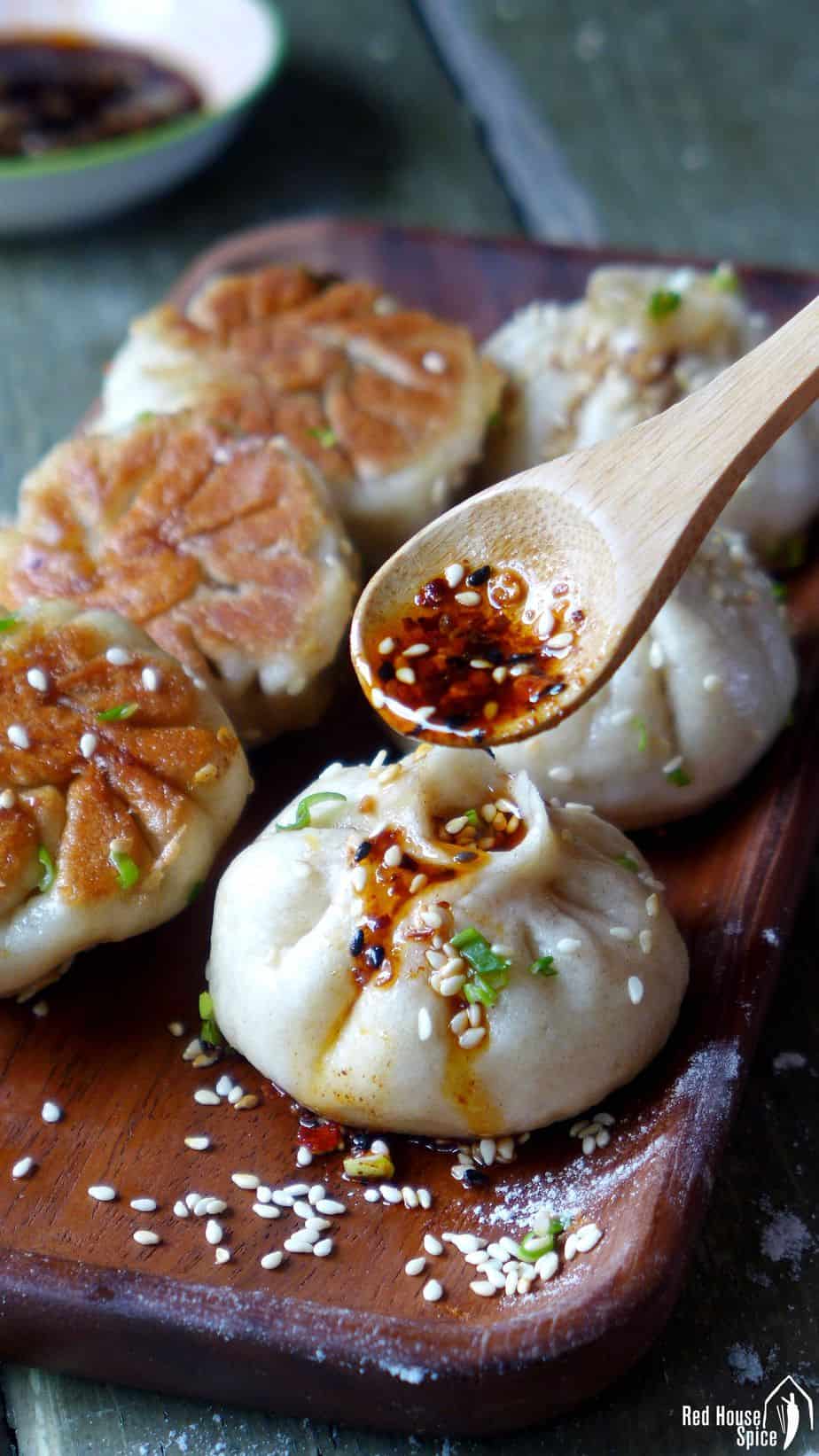
Sheng Jian Bao/生煎包 (aka Sheng Jian Mantou/生煎馒头) is a type of Chinese pan fried bao buns. The wrapper is made from yeast dough and the filling contains minced pork, spring onion and various seasonings. It’s quite small in size, similar to a golf ball or even smaller.
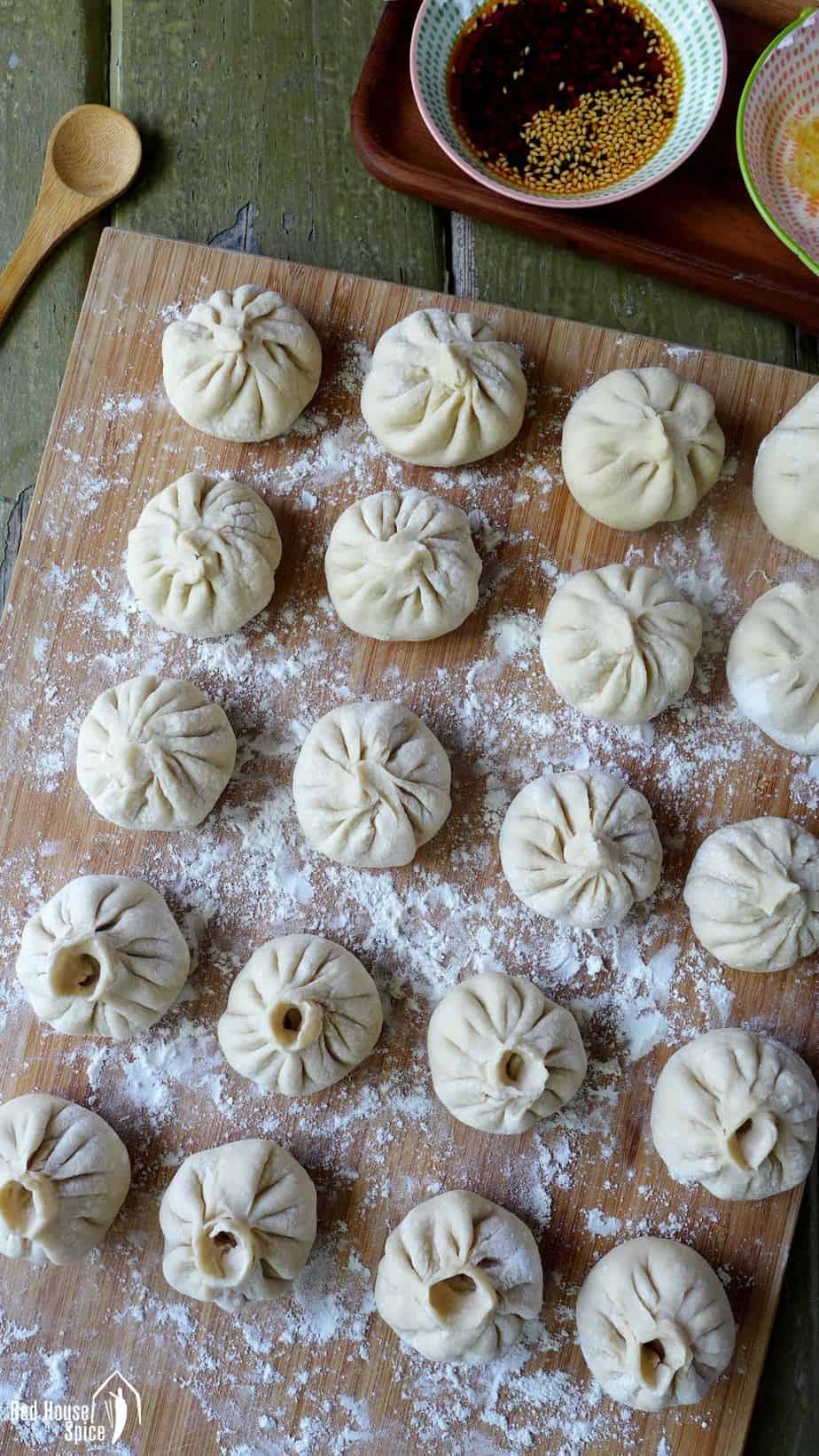
In Shanghai, Sheng Jian Bao/生煎包 (pan-fried pork buns) are traditionally served as breakfast at little cafes and street stalls. They are often cooked in a large pan in front of the queueing customers.
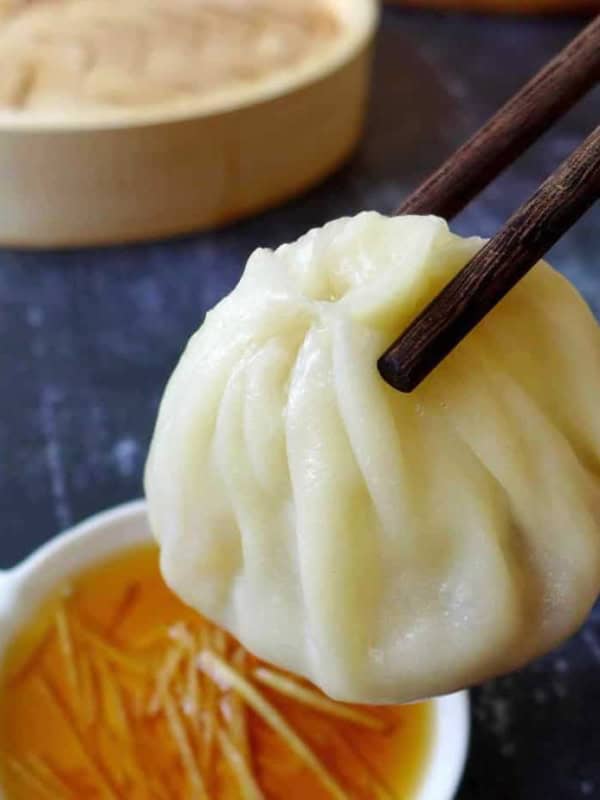
Truly fresh and super tasty, they are simply irresistible! The wrapper has a lovely soft texture with a golden, crispy base . The filling is very flavoursome and moist.
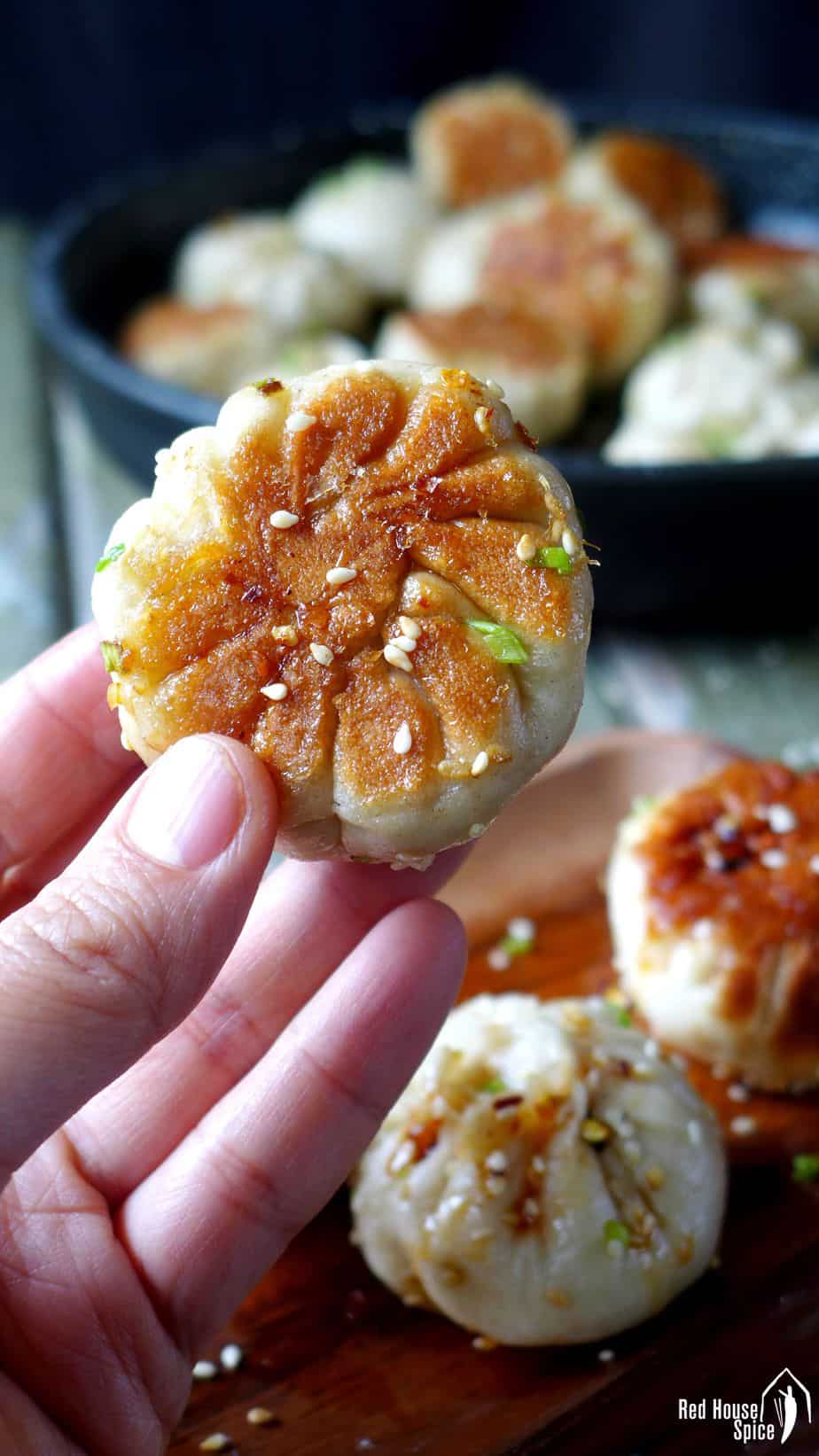
A few years ago, I got a chance to learn the technique of making Sheng Jian Bao/生煎包 (pan-fried pork buns) from a Shanghainese friend. I found it rather simple as it was very similar to how we cook Shui Jian Bao (水煎包, means water-fried buns literally, often vegetarian) in the North-west of China where I grew up. There are five steps to follow:
1. Make the dough. It’s a type of simple yeast dough used in many Chinese dishes, like the one I shared earlier: Spring onion flatbread.
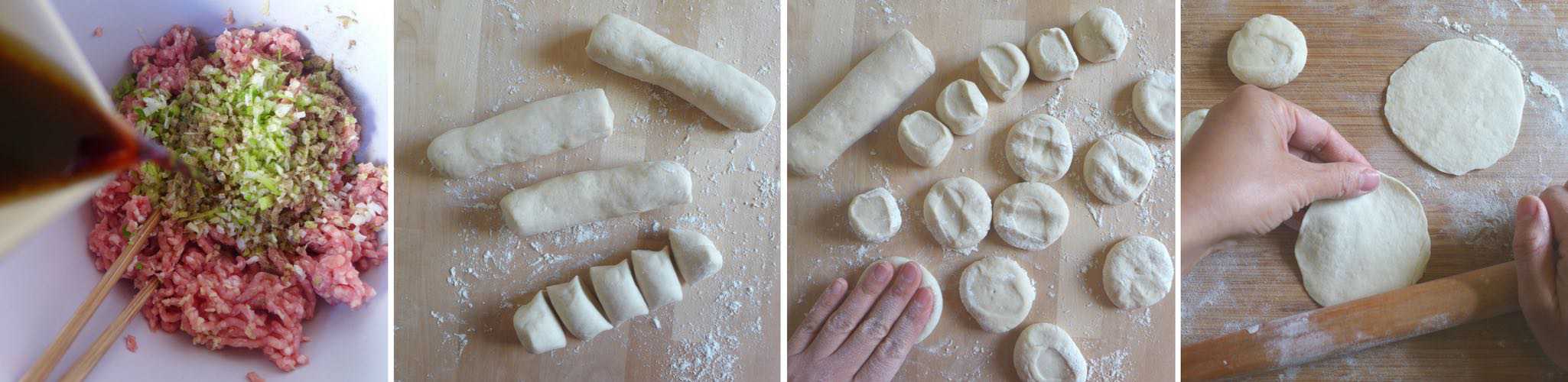
2. Mix the filling. The minced pork is seasoned with spring onion, ginger, light soy sauce, rice wine, Sichuan pepper and sesame oil, etc. In order to make the cooked filling soft and moist, you need to gradually add quite a bit of water (or even better, chicken stock) to the mixture. Stir constantly until no more liquid can be seen.
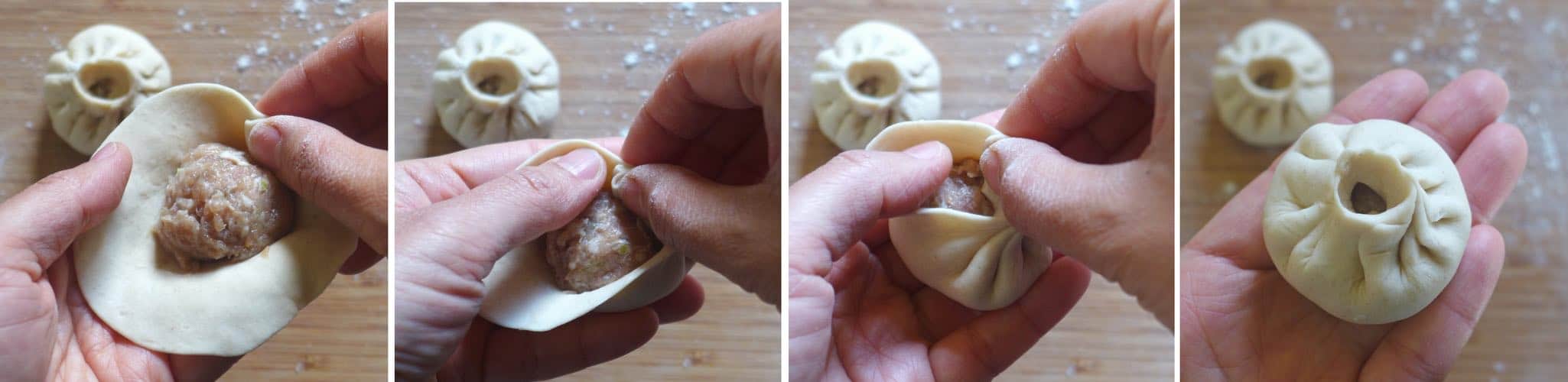
3. Shape the buns. In this part, you might find it a bit intimidating to seal the buns. It is time consuming if you are not familiar with the folding technique. But I’m sure you’ll soon get the hang of it (please refer to the images above for instructions).
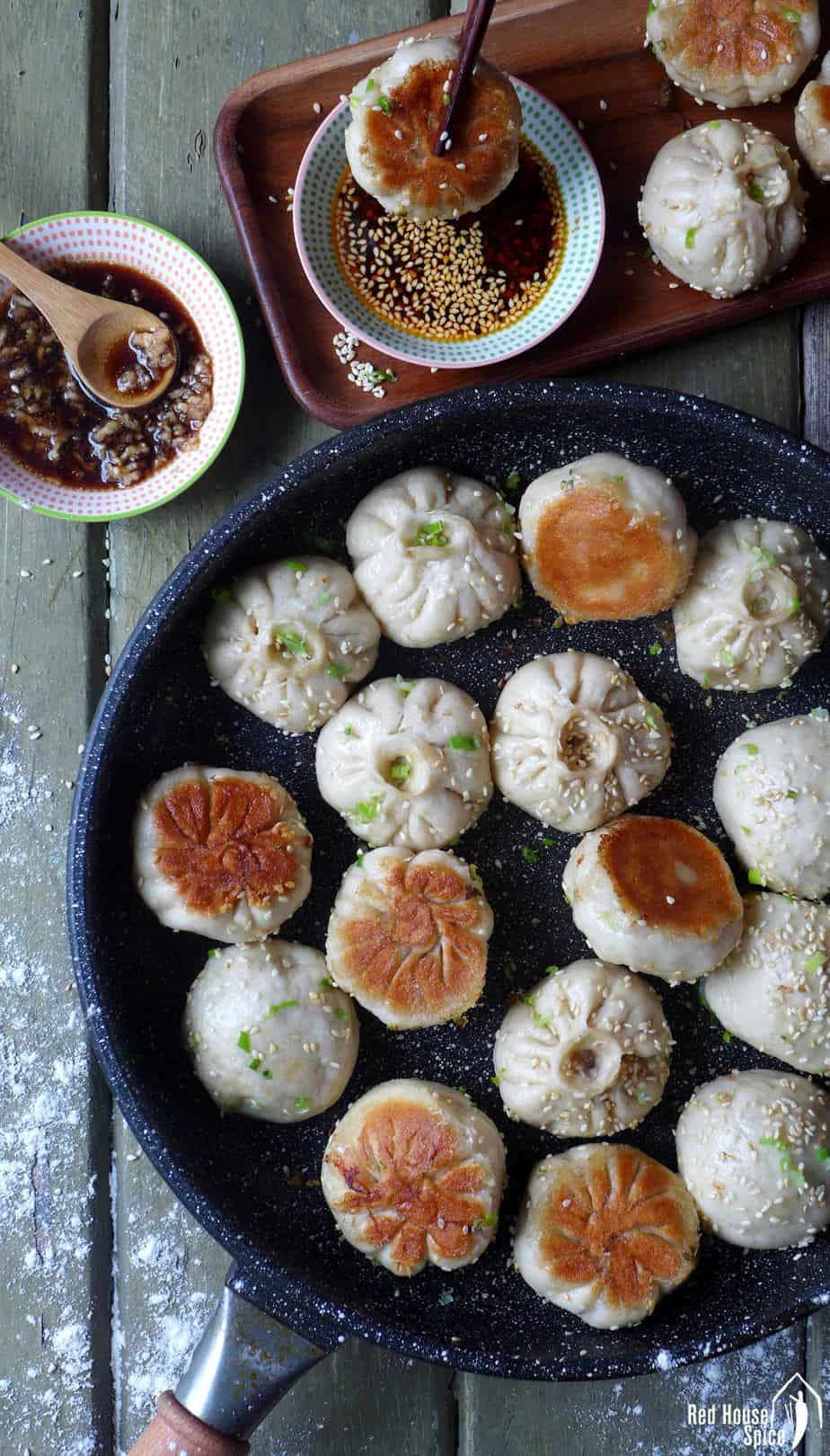
4. Fry the buns. Firstly, crisp the bottom part of the buns in hot oil. Then pour water into the pan and cover with a lid. The steam will help to cook through pretty quickly. A tip: You can either put the folded side facing up or down (As shown in the photos below, I cooked a panful in two ways). Just remember to securely seal the top if you prefer the latter to avoid any juice leaking from the filling.
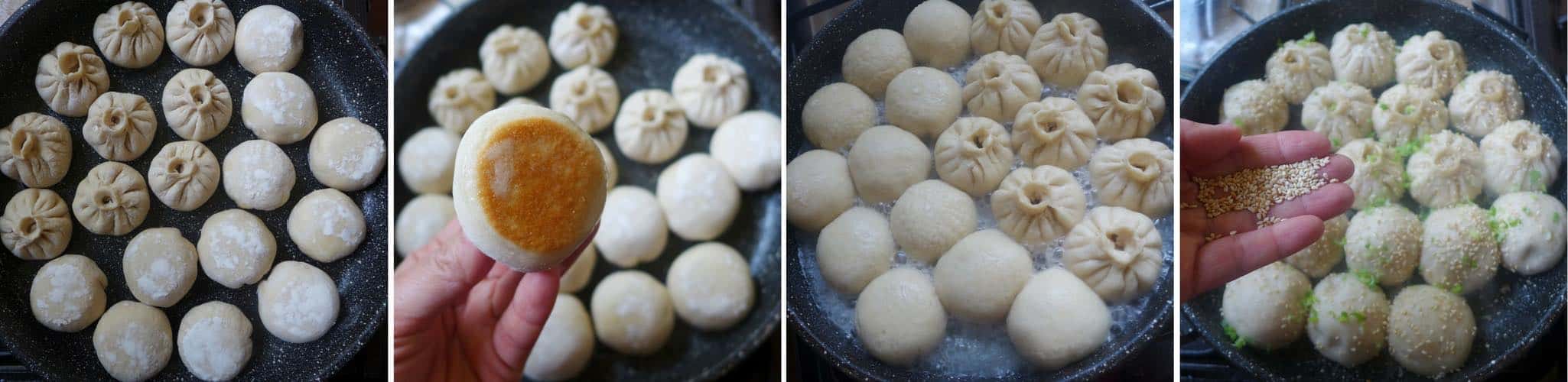
5. Sprinkle the garnish. I particular like this final touch. Sprinkle finely chopped spring onion and toasted sesame seeds onto the buns at the very last stage of cooking. The remaining steam in the pan helps these sprinkles to stick onto the wrappers. Not only does it looks pretty, it also adds extra flavour to the buns.
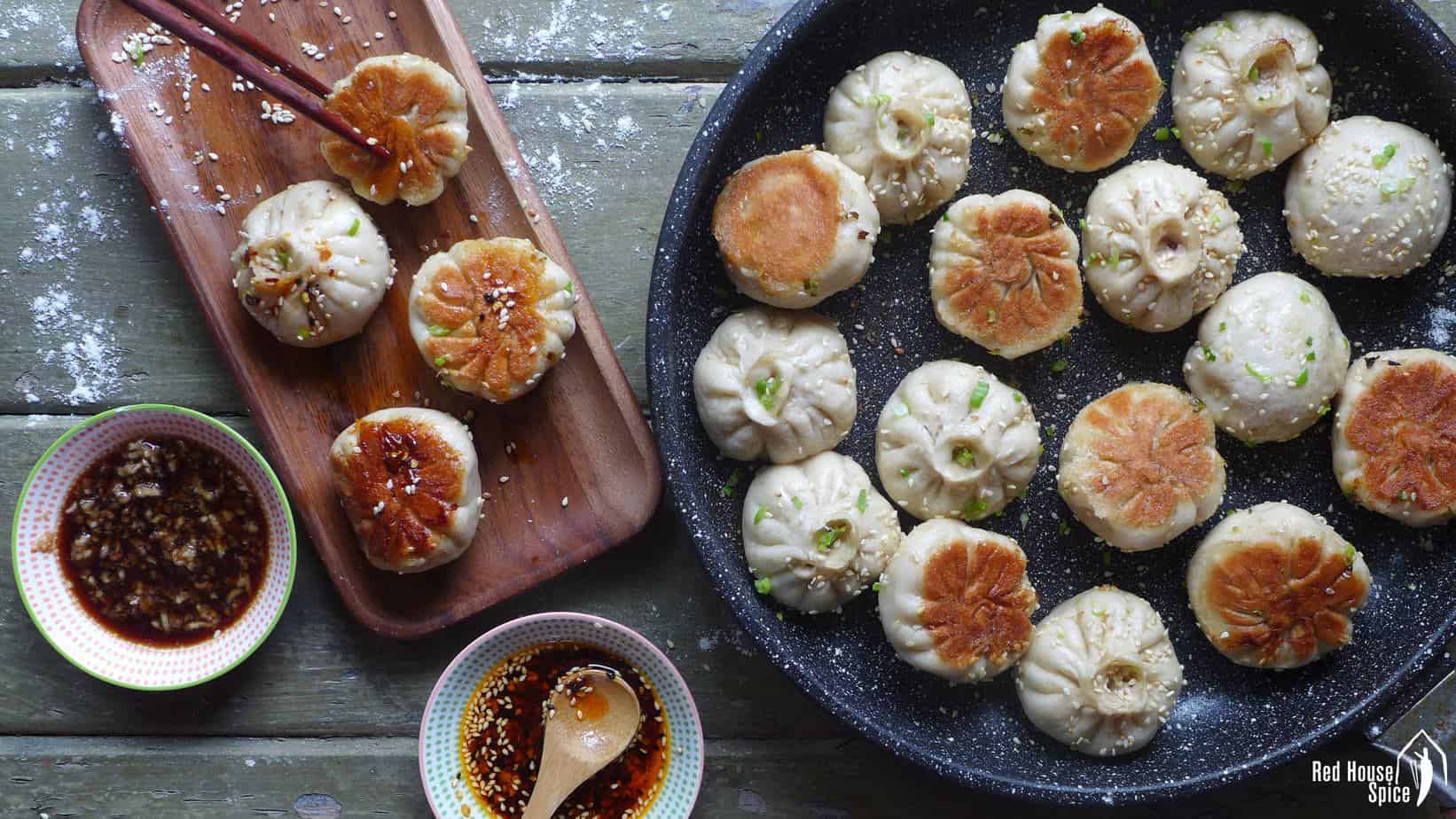
I often make Shanghai Sheng Jian Bao/生煎包 (pan-fried pork buns) for parties. It’s a perfect finger food that’s loved by young and old. If you wish, prepare some dipping sauce on the side. For example, you can use the dressing recipes for dumplings, etc.. Don’t forget to add a dash of homemade chilli oil if you fancy spicing up the buns.
Other bao recipes
Looking for more bao recipes? here are some popular ones to try:


Sheng Jian Bao: Pan-fried pork buns (生煎包)

Ingredients
For the wrappers
- 250 g all-purpose flour, about 2 cups (see note 1)
- 1 teaspoon sugar
- 1 teaspoon dried instant yeast, see note 2
- 140 ml lukewarm water, about 9 tbsp
For the filling
- 250 g minced pork, 9oz
- 2 tablespoon spring onion, finely chopped
- 1/2 tablespoon ginger, minced
- 2 teaspoon light soy sauce
- ½ teaspoon sesame oil
- ¼ teaspoon salt
- 1 pinch ground Sichuan pepper, or Chinese five-spice powder
- 5 tablespoon water, or chicken stock
For frying
- 1 tablespoon cooking oil
- 240 ml water, about 1 cup
For garnishing
- Toasted sesame seeds
- Spring onion, finely chopped
Instructions
Prepare the dough
- In a large bowl, mix flour, yeast and sugar. Pour in water little by little while stirring with a pair of chopsticks (or a fork).
- Then knead with your hand until a smooth, elastic dough forms (see note 3). Cover the bowl with a wet kitchen towel.
- Leave to rise in a warm place until double in size. It will take between 40 minutes to 1.5 hours depending on the room temperature.
Mix the filling
- Put all the ingredients for the filling (except for water/stock) into a large bowl.
- Swirl constantly in the same direction while gradually adding water/stock spoon by spoon into the mixture.
Shape the buns
- Knead the dough on a floured work surface until it goes back to its original size.
- Divide it into 20 equal portions. Roll each piece into a disk-like wrapper.
- Hold the wrapper in the palm of one hand. Place some filling in the middle. Use the other hand to fold the edge anticlockwise by pinching with thumb and index finger until the bun is completely sealed (please refer to the images above).
- Leave to rest for 15 minutes before frying.
Fry the buns
- Heat up oil in a frying pan over a high heat. Place in the buns (see note 4 & 5).
- When the bottom part becomes golden brown, pour in water then cover with a lid.
- Uncover when the water evaporates completely. Sprinkle sesame seeds and spring onion over.
- Cook another 30 seconds or so to crisp up.
Notes
Your Recipe Notes
Nutrition
Nutrition information is automatically calculated, so should only be used as an approximation.












I tried the recipe today and it went pretty well but I had to use way more than 9 tbsp of water for the dough.. it took around 15tbsp of water for the dough to come together. Also used 350g of pork instead of 250g because it looked like very little.. The flavour was still good and it came out perfect! Also it was very hard to tell how large to roll out the dough. These were smaller than I expected but will definitely will make it again with more filling.
Thank you Joy for trying out my recipe. I’m very surprised to hear that you’ve used 15 tbsp of water (225ml) for 250g flour. Your Ratio is almost 1:1. For Chinese type of dough (leavened or unleavened), the ideal ratio is 1 part of flour with a little bit over 1/2 part of water (All my other dough recipes use this ratio). I wonder if your measurement of flour was accurate enough. Authentic Sheng Jian Bao are quite small in size. The wrappers shouldn’t be too thin. Otherwise you’ll lose the fluffiness of the cooked dough. Each wrapper should measure no more than 10cm in diameter. Hope this helps!
This looks sooo good! I really want to try it. I was wondering if this recipe would work with ground beef?
Yes Winnie! It would be very tasty if you use ground beef that’s not too lean. Happy cooking!
Hi Wei! I love your blog!! It has been an amazing surprise to find it and to be able to try some of your recipes. I missed a lot this baos from Shanghai and I tried them today to give a surprise to my wife and although the taste was right but not as well the aspect :). I definitely have to improve my shaping and wrapping skills but I wanted to check with you about the cooking time. I carefully followed the recipe and got 20 discs (around 12cm each) but meat only for 10 so I put half of the water (covering around half of the baos) and after 5 minutes the water was gone. Since I had the impression that the dough wasn’t properly cooked (it was very wet from the water and steam) I mistakenly put more water and ended in overcooked baos :(. Could you let me know more or less how long should be cooking? As I saw them so wet after 5m, I thought they weren’t properly cooked… Thank you!!!
Hi John! Here are my answers to your questions.
For frying 20 buns, it takes me 7 mins to cook (from the moment I pour in the water). The time required may vary a little depending on the performance of each cooker, the quality of the pan and how tightly the lid fits on the pan. As I described in the recipe, if the water has completely evaporated, the buns are cooked.
Authentic Sheng Jian Bao are quite small in size. I think you’ve rolled out the wrappers too big. They should be about 10cm in diameter. The dough weighs 400g so each wrapper is 20g. My recipe makes about 360g filling (meat + all the other ingredients) so each bun holds about 18g of filling which I think is perfect for Sheng Jian Bao. After assembling (before resting), each bun measures about 5 cm in diameter.
Hope this helps!
thank you Wei! Very precise answer!! Indeed the main issue was that the ones I tried in Shanghai were bigger and that was the reference I used :). Next time I know it and as well how long more or less to cook them. I am looking forward to cook them again! Thanks again, much appreciated!!!
Hi Wei, I have a question how, many grams does each dough weigh to get exactly 20 pieces in total. Thanks
Hi Joyce! Each wrapper weighs about 20 grams.
Thanks so much, Wei. I made these with a chicken filling and they were the perfect mouth size. Your recipe is A++!
Hi! Is it possible to prepare the dough the night before and let it rise slowly in the fridge? I’d love to prepare the dough beforehand and be able to make the buns in the morning for breakfast. Thanks!
Yes you can. But you need to bring the dough back to room temperature, then start shaping the buns.
Hi Wei, I was wondering once the buns are in the pan, how long do I simmer it for to make sure (the meat is completely cooked) and will I need to turn the heat lower when I simmer it with the water?
Hi Zoe! Follow my instructions precisely. Always cook on high heat. Add 1 cup of cold water as suggested. They will be cooked when all the water has evaporated. You don’t need to count the time. If you cook a smaller batch, reduce the water accordingly (it should be about 1/3 to 1/2 height of the bao). Hope this helps.
Does the pork need to be cooked prior to shaping into balls and into the dough? I didn’t see instructions on cooking the pork but I assume it needs to be cooked before filling the bun.
You don’t cook the pork beforehand. As I mentioned in the instructions, you mix the raw meat with seasonings to make the filling. Also, you don’t need to shape the filling into balls. Just place a spoonful in the middle of the wrapper then pleat. If you are interested, have a look at my tutorial video of Steamed Bao Buns which shows you the filling & assembling techniques.
Thank you! I was hoping for a quick response since I have the dough rising now 🤗 so excited
Made these bad boys and turned out a hit with the family. It’s rare to have first attempts meet expectations, but your recipe was spot on. Thanks!
That’s great to hear! My great pleasure to share. They are one of the favourites in our Red House too.
Hi Wei, I tried making these last night but I found that the buns tended to stick to my plate and when transferring them to my pan to cook, it was such a nightmare trying to peel them off the plate and I broke the skins of many of them 🙁 Do you have any tips on what to do between making the buns and cooking them? Do you tend to put them on a separate plate, or do you just cook them as soon as you’re done wrapping them? many thanks! 🙂
Sorry to hear that YuXin. After assembling, you need to lay the buns on a flat surface (worktop, a chopping board, a tray) dusted with flour to prevent sticking. Ideally they need to rest for 15 mins or so before frying, as I mentioned in the recipe. Hope this helps.
It was not easy to make attractive looking bao (even though you make it look easy! haha), but they tasted great and took us right back to Shanghai. Already passed the recipe on to others and will make again for sure! 🙂
Thank you Tina for sharing my recipe with others. Very happy to know you’ve enjoyed these buns.