
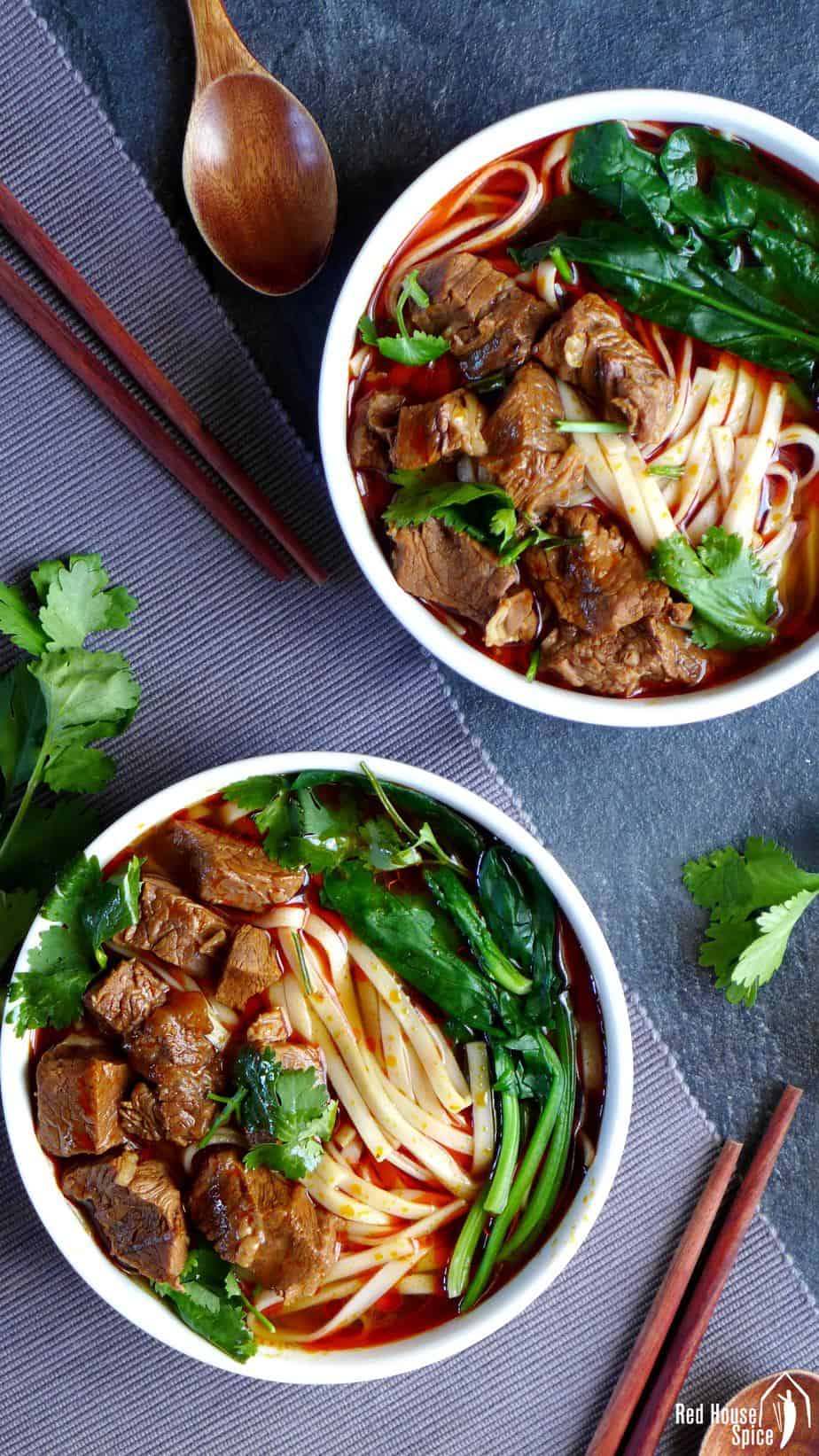
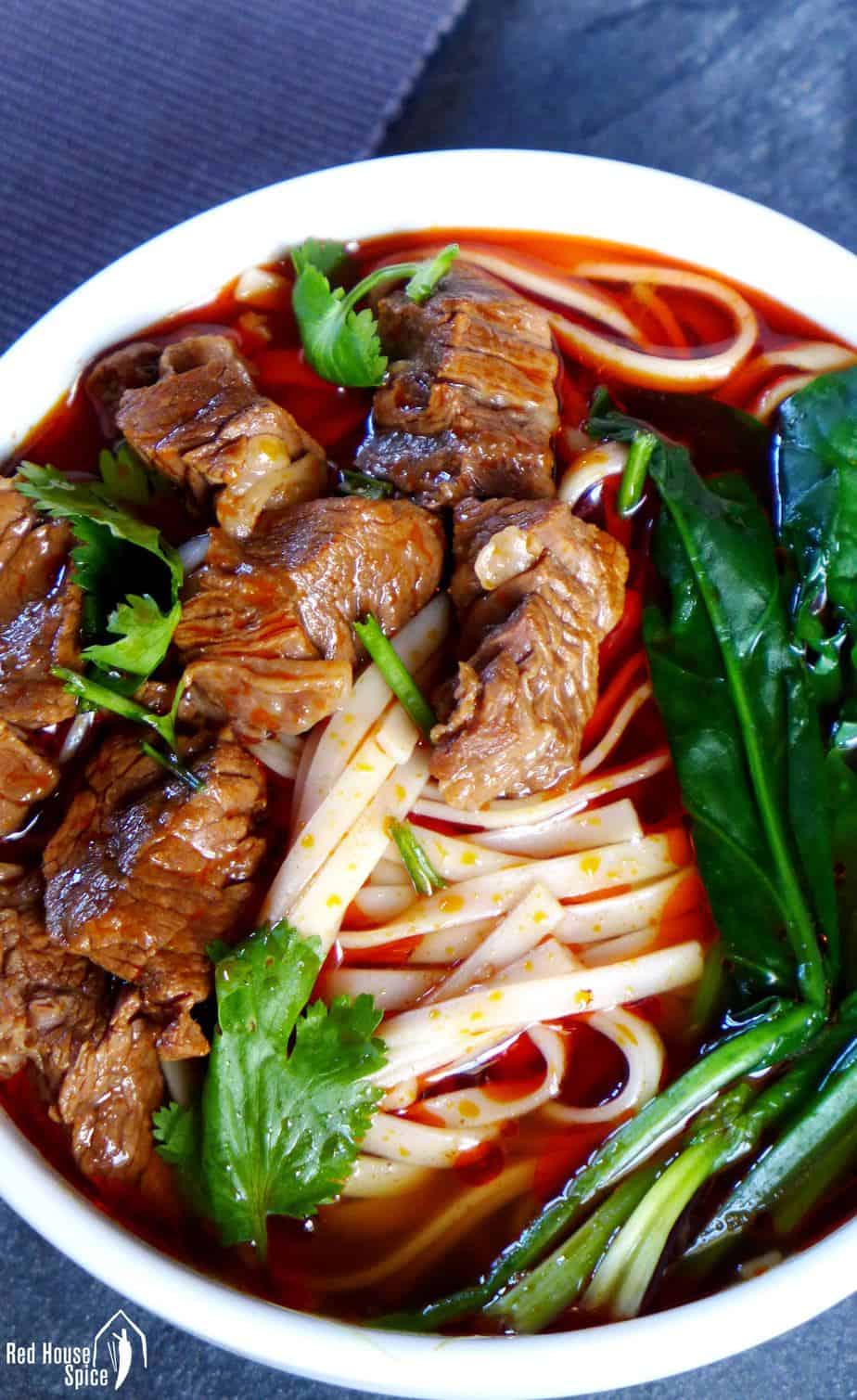
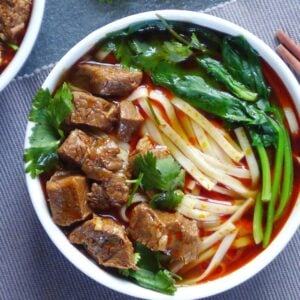
A bowl of noodles in a well-spiced broth topped with tender beef cubes, spicy beef noodle soup is pungent, fragrant and very comforting indeed.
Pin this now to find it later!
Pin ItCold winter days are approaching! Here in our Red House everyone is craving something hearty and comforting for dinner. I bought some nice cuts of beef the other day and cooked beef noodle soup in two ways. One with light, clear broth for the children and another with lots of spices for the hot food lovers in our house. If you are also looking for a dish to warm you up, don’t miss today’s recipe: Spicy beef noodle soup (香辣牛肉面).
Choose marbled beef cuts
To make a bowl of delicious beef noodle soup, first you need to find the ideal cut of beef. Generally speaking, the cuts which have generous amounts of marbling are great for stew dishes (such as beef and potato stew and braised beef with daikon). They have a higher fat content thus take less time to cook and deliver a beautiful beefy flavour. I came across an article explaining how to choose the best cuts for beef stew. Have a look if you are interested.
Make a well-spiced broth
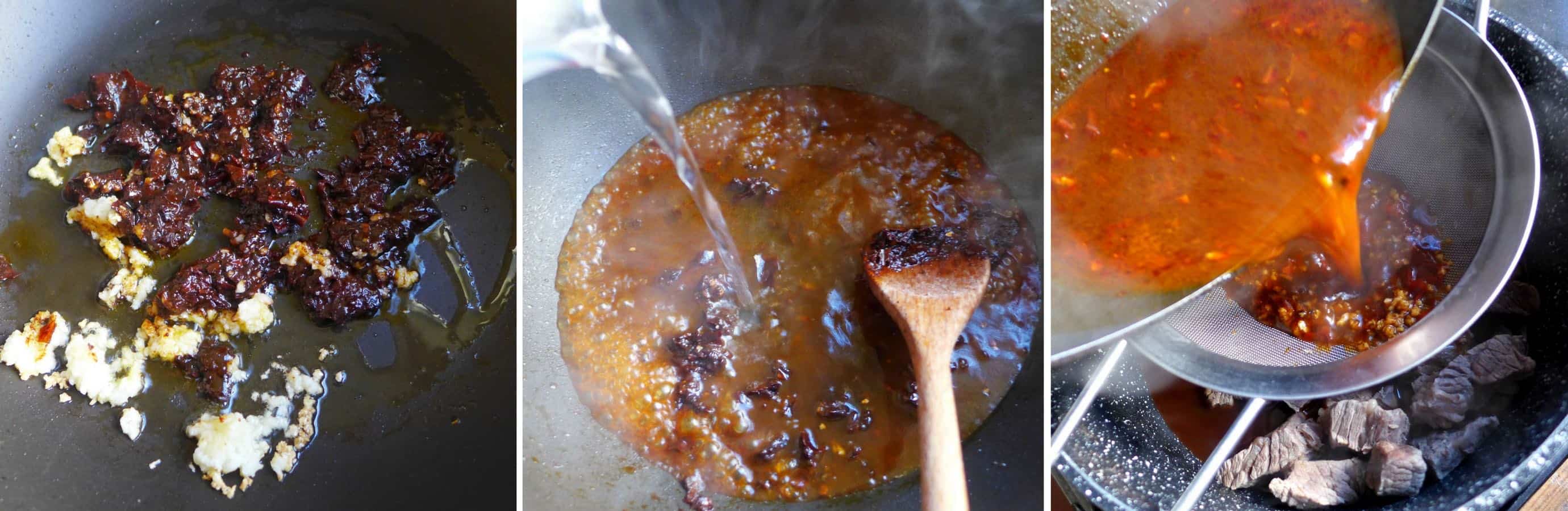
In my recipe for spicy beef noodle soup, the beef cubes are simmered in a well-spiced soup. Firstly, briefly fry minced garlic and Sichuan chilli bean paste in a little oil to fully release their fragrance. Then add water and leave it to simmer for several minutes.
When the soup is ready, pour it into the pot filled with blanched and drained beef cubes. Please note that it’s recommended to filter the soup through a sieve to get rid of the remaining lumps of garlic and chilli bean paste.
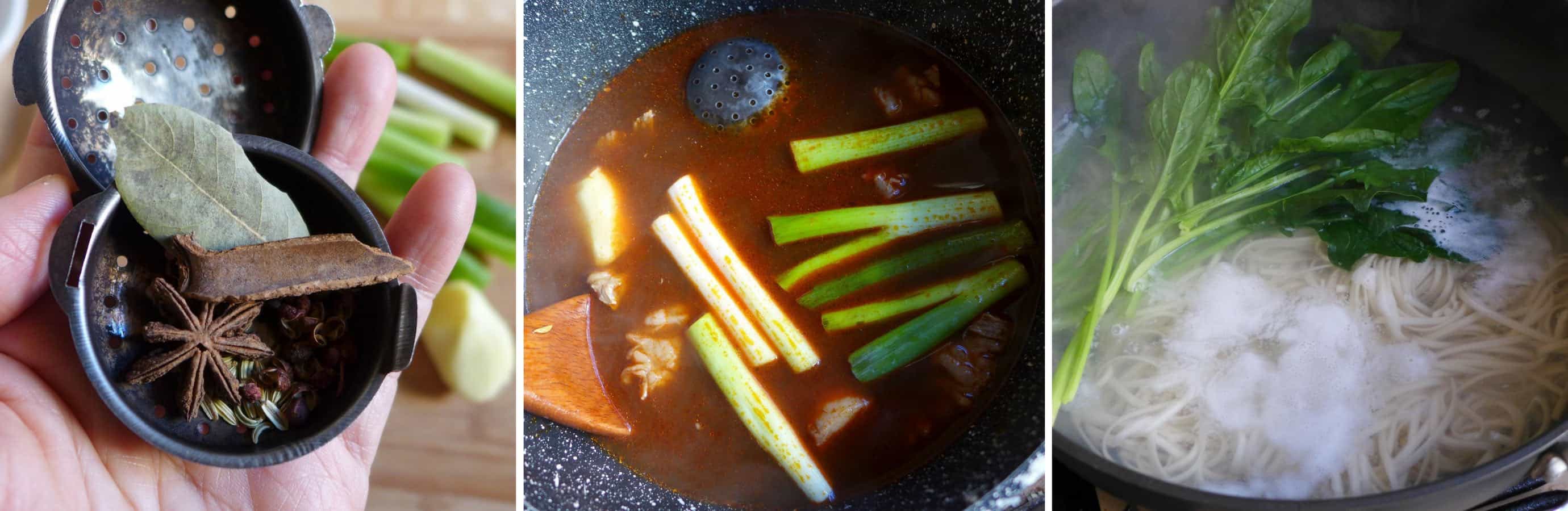
The last step is to add more spices and herb to the simmering soup. Bay leaf, star-anise, Chinese cinnamon, Sichuan pepper and fennel seeds are used to flavour the broth.
However you wouldn’t want them in the serving bowl. I have a tip for you: If available, place the spices in a closed tea strainer while simmering. Later you will be able to discard them easily.
Noodle Choices
For shooting this recipe, I used dried, flat noodles. Other types of noodles would work well too. If you have extra time at hand, I high recommend you try making fresh noodles from scratch. Here are some homemade noodle recipes:
Do not cook noodles in the broth
For preparing noodle soup, please allow me to repeat one important tip that I’ve mentioned in Chicken meatball noodle soup: do not cook noodles in the broth. The starch coming off the noodles will change the flavour and the consistency of the broth. Instead, you should boil noodles in a clean pot filled with plenty of water.

Add some greens
To make spicy beef noodle soup healthier, you can blanch some leafy green vegetables while cooking the noodles. Spinach, pak choi (bok choy) or Chinese choy sum are great choices.
Spicy beef noodle soup (香辣牛肉面)

Ingredients
For stewing the beef
- 600 g beef, cut in cubes, 21oz
- 2 tablespoon cooking oil
- 4 cloves garlic, minced
- 3 tablespoon Sichuan chilli bean paste, see note 1
- ½ teaspoon chilli powder
- 1500 ml hot water, 6½ cups
- 1 thumb-sized ginger
- 2 stalks scallions, cut in sections
- 1 bay leaf
- 1 star-anise
- 1 small piece Chinese cinnamon/cassia cinnamon
- 10 Sichuan pepper
- 1 pinch fennel seeds
- ½ teaspoon sugar
You also need:
- 4 portions noodles, see note 2
- Spinach, or pak choi / bok choy
- Fresh coriander, chopped
Instructions
Blanch the beef
- Add beef cubes to a pot filled with water, Bring it to a full boil. Remove any impurities that appears on the surface. Drain then put the beef back into the pot.
Prepare the soup
- Heat up oil in a wok (or a deep frying pan) over medium heat. Stir in garlic, Sichuan chilli bean paste and chilli powder.
- Cook until fragrant (do not burn). Pour in 1500ml (6½ cups) hot water. Cover and leave to simmer for 5 minutes.
Simmer the beef
- Through a sieve, pour the spiced soup into the beef pot. Add ginger, scallions and all the other spices (see note 3).
- Bring the soup to a boil then simmer for 1 to 1.5 hours. Once the beef becomes tender cooked, discard the ginger, scallions and spices.
Cook the noodles
- Cook the noodles in another pot with plenty of water. At the end of the process, quickly blanch spinach (or pak choi) in the same pot. Drain and rinse the noodles and vegetable under cold water for a few seconds.
Assemble the dish
- Place the noodles and vegetable in serving bowls. Pour in the broth then place the beef on top. Sprinkle coriander to garnish. Serve immediately (see note 4).
Notes
Your Recipe Notes
Nutrition information is automatically calculated, so should only be used as an approximation.










Hi,
Do you use the liquid from the blanching step or discard it?
Hi Amai! You need to discard the liquid. The purpose of blanching is to remove the impurities/blood from the beef. The process is quite quick so there isn’t much flavour in the liquid.
Hi Wei! I wanted to ask you about the chilli bean paste a little more. First, is the sauce and paste are the same thing? And although both me and my husband love spicy food, but unfortunately his stomach not so much. Is there a non spicy version, or substitute or I just simply skip it when a recipe asks for? (I know, I know that is the heart of the dish )
Hi Simona! It depends on the translation. Some are labelled as chilli bean paste while the other chilli bean sauce. In general, they should be the same thing. For a non spicy version, have a look at these two recipes: Lanzhou Beef Noodle Soup (the broth is non-spicy) and Chinese Braised Beef Shank.
Can I make my own Sichuan chilli bean paste? I have fermented black beans (the one you recommended in the pantry section) and your chili oil (now a house staple!) in my fridge. Thank you!!
Yes Sarah! Your combination would work too. The taste will be different but still nice. Happy cooking!
I love your blog and recipes! Am looking forward to making this recipe this week. For the Chinese cinnamon can I use regular cinnamon instead? And is it ok to skip on some spices like fennel seed and star anise?
Hi Adrian! It’s ok to use regular cinnamon as substitute. You could skip fennel seeds and star anise but the taste of the broth will be a little different. I highly recommend you get some star anise when you have a chance. It’s almost compulsory for Chinese braised dishes. Happy cooking!
Hello, what type of noodles would I use? Would regular rice noodle used for Phad Thai work? TIA
This dish usually calls for wheat flour noodles. However, please feel free to use any other noodles that you like. They will taste great too.
Is there a way to modify this recipe to cook with an instant pot? If so, how would you recommend doing it?
Yes, you can make it in an instant pot. Follow the instruction 1 & 2 as usual, then move on to step 3 using your instant pot. Choose the stew function or whatever you think is good for cooking through cubes of beef. Please be aware that noodles need to be cooked separately in a normal pot.
I absolutely love getting your emails and all those great recipes. What an awesome blog you have.
Thank you so much Jacquie for your compliment! Very happy to know you enjoy receiving my recipes. Wish you a lovely time in your kitchen!
Do you use a European, Indian, or some other bay leaf?
Hi Melody! I use European bay leaf which refers to bay laurel sometimes.
I loved your recipe! My Boyfriend and I went to China last summer and we had beef noodle soup almost every day, until we really just couldn’t stand it anymore :D. But I was just craving it so much last week that I had to make it, and it came out tasting delicious! Your blog is awesome and I want to try all your recipes! 🙂 Thank you so much for posting them xxx
Thank you very much for your kind message. I know what it’s like when you crave something. I’m so glad that my recipe met your need. Happy cooking!
My delightful husband 🙂 made this for dinner on Sunday night, although he didn’t track down the Sichuan chilli bean paste. It was still delicious, but I would imagine it has a richer flavor with this ingredient. Thanks for the recipe!
Thanks Heddi!! Looks like your delightful husband has become a fan of my blog! I’m planning to write a post on beef noodle soup with clear broth which doesn’t involve chilli bean paste. It’s more suitable for people who doesn’t like spicy food. Yet you can always add some chilli oil if you wish. Have a lovely day!