
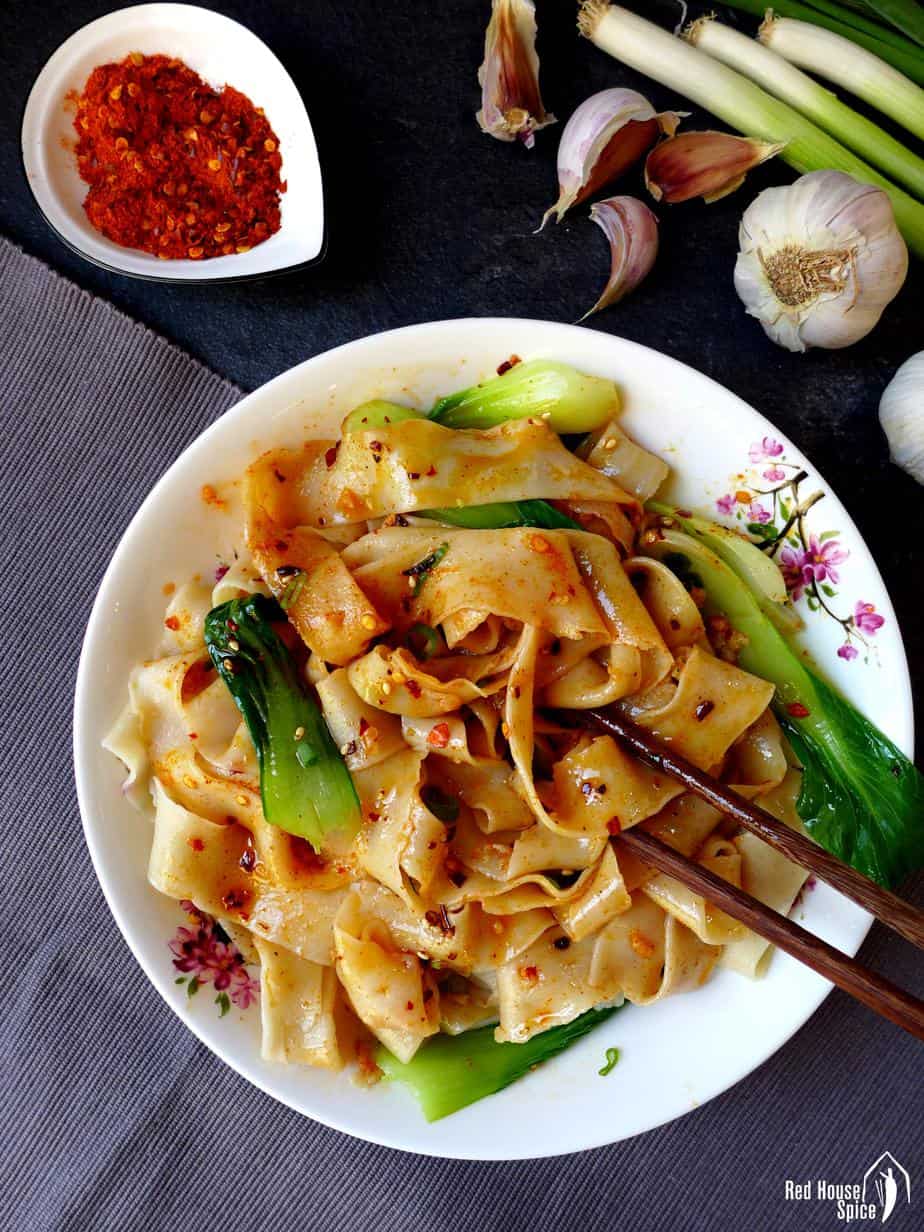
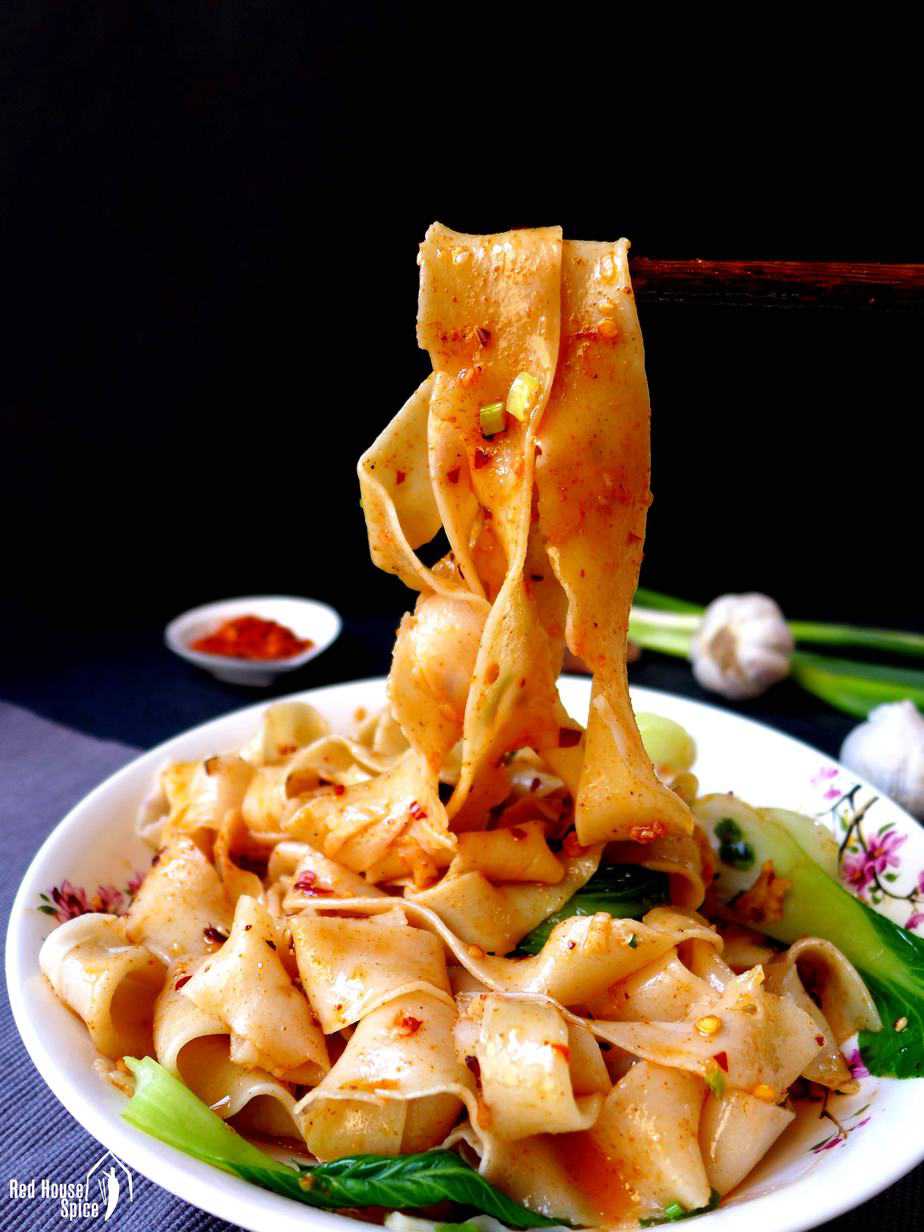
Thick, broad, hand-pulled noodles seasoned with chilli, garlic and Sichuan pepper, Xi’an Biang Biang noodles offer a delectable taste and texture.
Pin this now to find it later!
Pin ItI had my parents over to our Red House in England last holiday season. I spent lots of time with them cooking in the kitchen as this is our favourite way to connect.
Today I’m sharing my mum’s favourite childhood dish Biang Biang Noodles, a hand-pulled noodle dish originated from her home town, Xi’an.
“Biang” the most complex Chinese character
One of the signature dishes of Xi’an cuisine, Biang Biang noodles refer to wheat flour noodles that are hand-pulled to a long, thick and broad shape (can be as wide as a belt). They have a chewy texture and are often served with a pungent, spicy dressing. Not only is this dish famous for its delectable taste and texture, it’s also renowned for the special character used in its name.
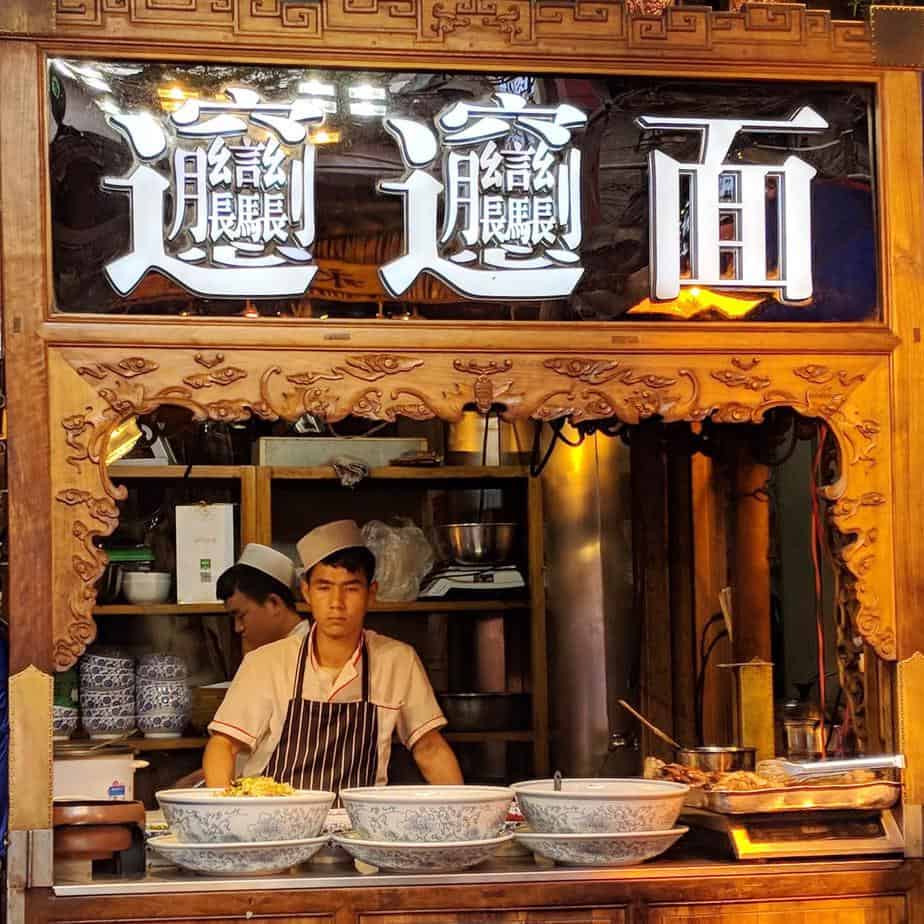
The character for “Biang” is considered to be the most complex Chinese character. Depending on the variation, it has between 42 to 71 stokes. It’s so complicated that even today this character can’t be written by a computer. The photo on the left is a Biang Biang noodle stall that I saw in Xi’an on my last Culinary Tour of China. See how complicated the first two characters are!
Choose the right flour
For Biang Biang noodles, I use British standard plain flour (all-purpose flour) with a protein content ranging between 10% and 11%. If your flour has a higher protein content (over 12%, eg. bread flour), I suggest you add a little cake flour. Otherwise, the dough might be too elastic, tending to easily return to its original form after pulling.
My recommended flour-water ratio is 2:1 in weight. After the first kneading, the dough needs to be medium-firm and it will get softer over time. The ratio may vary slightly depending on the brand. Adjust accordingly.
Allow time to rest the dough
You only need three basic ingredients to make the dough for Biang Biang noodles: flour, water and a little salt. However, another “intangible ingredient” plays an important role if you’d like a fail-proof experience. That is patience.
In other words, you need to allow the dough enough time to rest. I know the importance of this trick from watching my parents cooking long ago, but I didn’t know the reason why resting makes dough stretchy until I read a scientific article about the dough:
From the moment you bring a liquid ingredient (such as milk or water) in contact with wheat flour, the individual gluten proteins in the flour unravel and hook onto one another, creating strong bonds. With time, an elaborate network of interconnected gluten strings forms…… It is the gluten network that holds a dough together and gives it elasticity and the ability to stretch.
——The Scientific Secret of Stretchy Dough, SCIENTIFIC AMERICAN
Three stages of dough resting
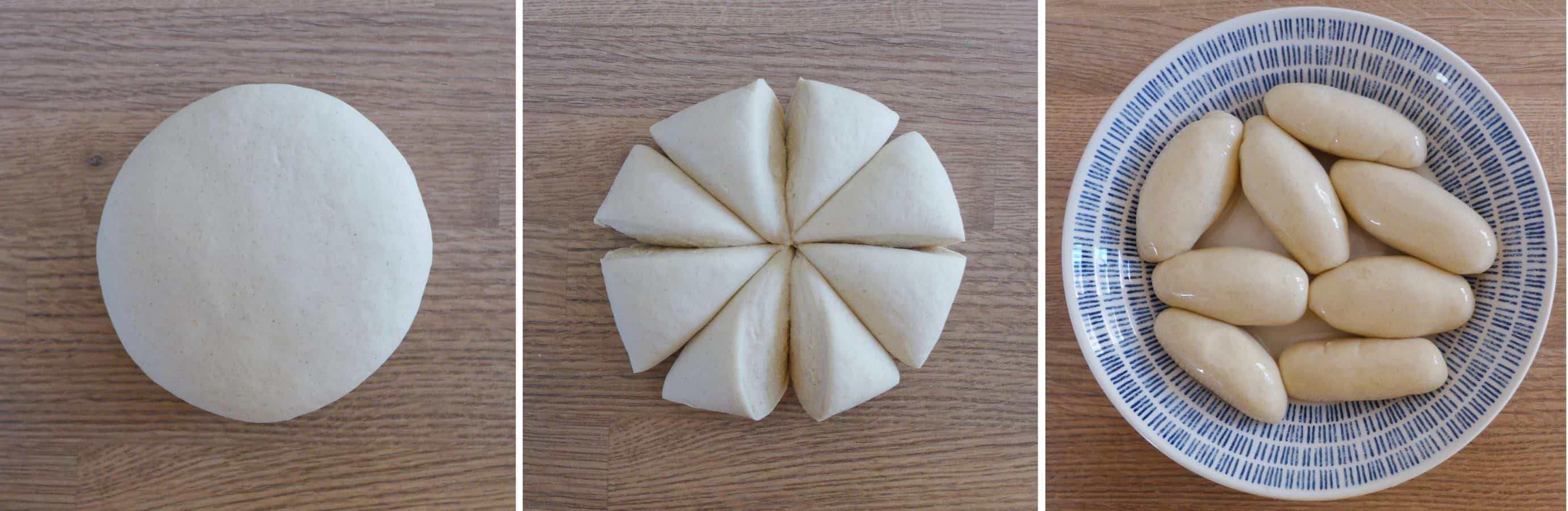
Plan ahead and never rush. If you keep to this golden rule, you will find it so easy to make hand-pulled noodles. The resting process takes place in three stages:
- The first resting procedure applies to the situation where you knead the dough by hands. Roughly combine the ingredients to form a dough. Leave it to rest for 10- 15 minutes then knead it again. This will help you to achieve a very smooth dough without too much effort (If using a stand mixer, simply knead at a low speed for 5 minutes).
- After dividing the dough into small pieces and coating each piece with oil, leave them to rest for at least 1 hour.
- When ready, flatten the dough piece into a rectangle shape. Do not pull it straight away. Allow it a little time to rest again. By the time you’ve flattened other pieces, the first piece will be ready to be pulled.
How to pull the noodles
Pulling noodles with your hands may seem a little intimidating. In fact, it can be quite easy if you prepare and rest the dough properly. I have a separate blog post “Hand-pulled Noodles, a Foolproof Recipe” which demonstrates hand-pulling techniques with great tips and detailed instructions.
For making Biang Biang Noodles, I use the traditional method which has a slight twist. Here is how exactly I do it (Please also refer to the video in this post):

- Press the flattened dough piece in the middle lengthways using a rolling pin or a chopstick.
- Hold each end of the dough and pull gently until it stretches to your preferred thickness.
- Put the noodle on a surface. Break it apart from the middle line to make a loop.
Make an intensely flavored dressing
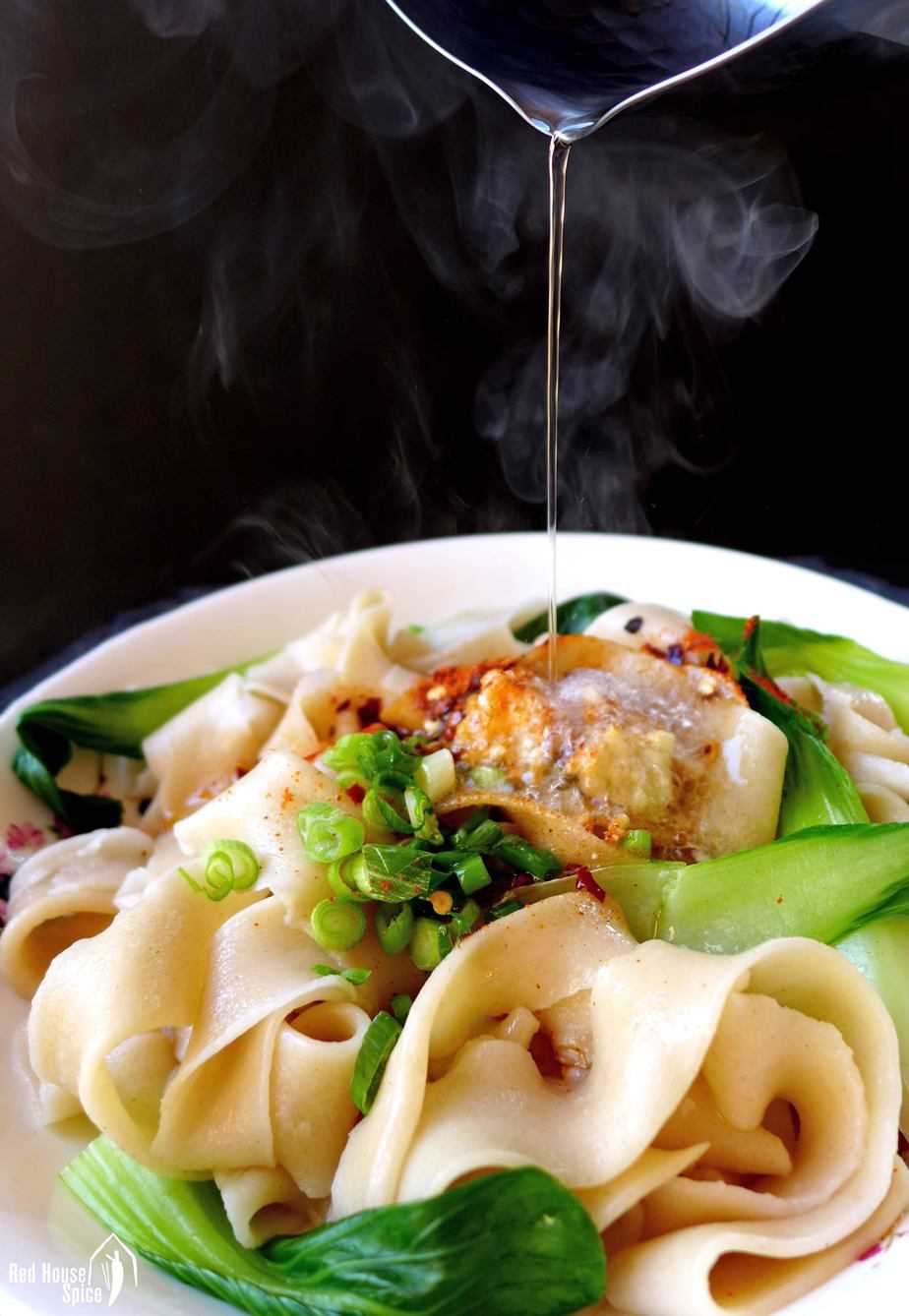
Biang Biang noodles are also called You Po Che Mian/油泼扯面 which literally means “Oil pouring over hand-pulled noodles”. This name explains a particular method of seasoning “You Po”: place chilli flakes, chilli powder, ground Sichuan pepper, minced garlic and scallions on top of the cooked noodles, then pour hot oil over.
The heat immediately releases the full flavour of all the herbs and spices. I love it when the pungent fragrance suffuses my kitchen. Simply irresistible!
Other noodle dishes
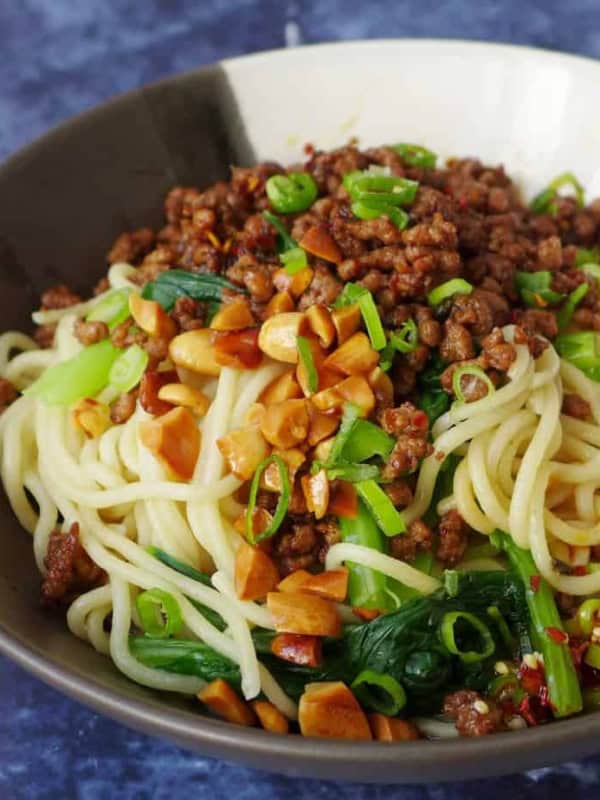
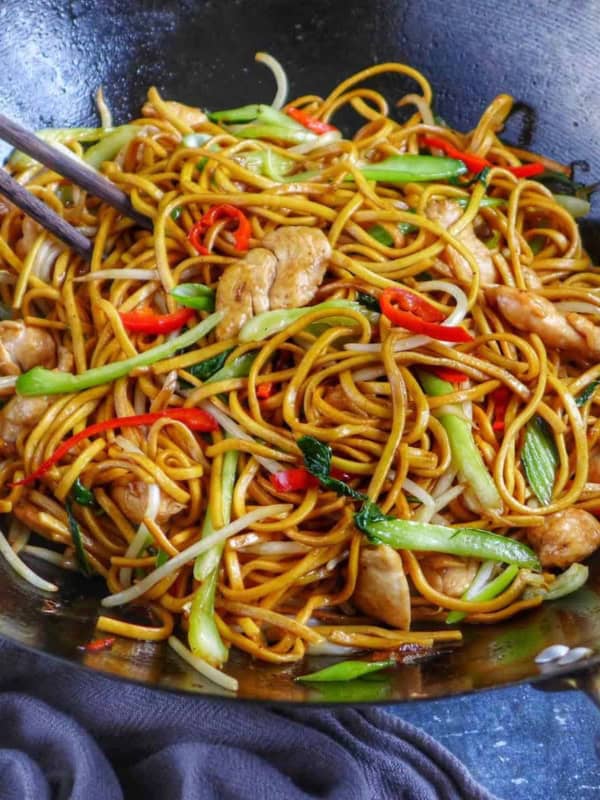
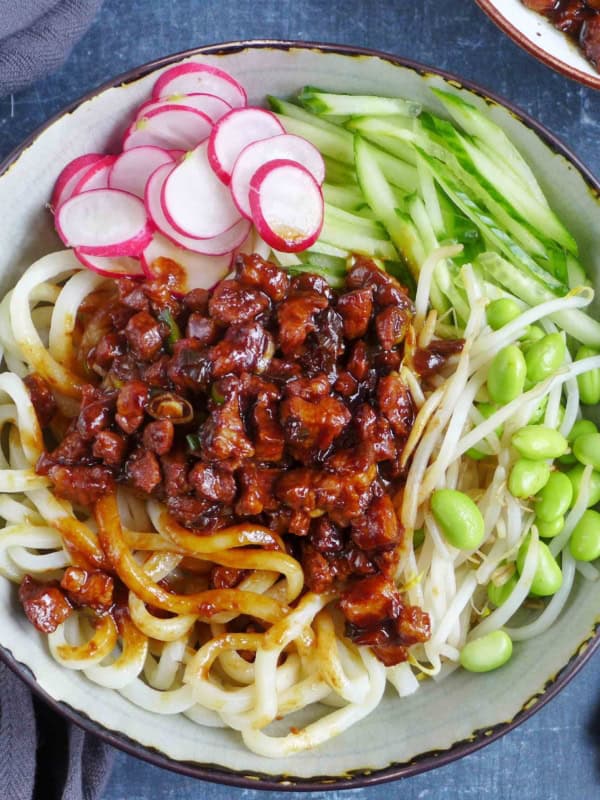
Looking for more classic Chinese noodle dishes? Check out these popular recipes:

📋 Recipe card
Love this recipe? Please leave a 🌟🌟🌟🌟🌟 rating and a comment. Thank you!
Xi’an Biang Biang noodles

Video
Ingredients
For the noodles
- 250 g all-purpose flour, about 2 cups
- ¼ teaspoon salt
- 125 ml water, ½ cup+2 tsp (see note 1)
- cooking oil, for coating the dough
For the seasoning
- 1 tablespoon scallions, finely chopped
- 2 teaspoon garlic, minced
- Chili flakes, to taste
- Chili powder, to taste
- ¼ teaspoon ground Sichuan pepper
- Salt, to taste
- 3 tablespoon cooking oil
- 1 tablespoon light soy sauce
- 1 tablespoon black rice vinegar
You may also need
- 1 head bok choy, or other green leafy vegetables
Instructions
Make the dough
- If using hands: Put flour and salt into a mixing bowl. Pour water over gradually while mixing with chopsticks. Combine and knead to form the rough-looking dough. Leave to rest for 10 minutes, then knead again until it develops a medium-firm, smooth texture .
- If using a stand mixer: Add flour, salt, and water to the mix bowl. Use a dough hook to mix and knead on low speed for about 8 minutes, until a smooth dough forms.
Shape the dough
- Divide the dough into 8 equal pieces. Knead each one again, then roll it into a gherkin shape. Thoroughly coat each dough piece with oil then place them on a plate or in a container. Cover with cling film and leave to rest for 1 hour (See note 2).
Pull the noodles (please refer to the video in the post above)
- Heat up a pot of water for cooking the noodles. While waiting, flatten each dough piece into a rectangle shape with a rolling pin. Once the water begins to boil, start the process of noodle pulling.
- Press the dough down the middle lengthwise using a rolling pin or a chopstick to create an indentation (be careful not to tear the dough).
- Hold each end of the dough and gently pull to stretch it to your desired thickness. Place the stretched dough on a surface and tear it along the indentation, creating a loop-shaped noodle.
Cook the noodles
- Immediately after pulling, place the noodle into the boiling water (do not let it sit on the counter). Repeat the procedure to pull other dough pieces. Boil four noodles per portion at a time, then repeat the process to cook the other portion.
- When the noodles are nearly cooked through, add bok choy and blanch for 20 seconds.
Season the noodles
- Put the drained noodles and blanched bok choy into 2 serving plates or bowls. Top them with chopped scallions, minced garlic, chili flakes, chili powder, ground Sichuan pepper, and salt.
- Heat up the oil in a small pan. When it starts to smoke, pour it over the aromatics and spices to sizzle. Add light soy sauce and black rice vinegar. Stir to coat the noodles evenly.
Notes
Your Recipe Notes
Nutrition
Nutrition information is automatically calculated, so should only be used as an approximation.










I lived in Xi’an for three months back in 2017, and fell in love with the food there. Unfortunately, since returning to the USA I haven’t found any authentic Shaanxi food, until I made this recipe. It came out deliciously, and was a nice reminder of my wonderful time in China. Thank you for this recipe. Can’t wait to try more!
Tip/Cheat: I used a rolling pin to thin out the noodles some more after I (poorly) hand-stretched them.
Hi Clare! So happy to know my recipe has helped you to satisfy your craving!
Your video link is broken
Hi Ryan! I’ve checked on several devices/browsers and I didn’t find any problem with my video. I’m not sure what happened at your end. Give it a try again. Otherwise, have a look at the video in my post “Hand-pulled noodles, a foolproof recipe“.
Ryan, I had the same problem with the video links and it turned out to be a permission issue with my adblocker. Try looking at the site with a different browser than what you usually use and see if the links are present. If they are, take a look through any ad blockers or whitelisting apps you’re using. It might be that simple.
Yup! Had to disable my ad blocker completely. I tried disabling for the page, but I think the way they load it wasn’t making any difference.
So excited to try this! Was wondering if I can freeze the noodles after they’re boiled or leave them in the fridge to eat the next day? Or would it be better to just put the leftover oiled dough in the fridge and pull them the next day? Any idea on how long either the noodles or the dough will last in the fridge?
For fresh, handmade noodles, it’s best to serve immediately. I don’t recommend you freeze them. Instead, you can keep cooked noodles in the fridge for up to 2 days. Make sure you rinse and drain the noodles, then coat with a little oil to avoid sticking (Do not season though). You may leave the dough in the fridge overnight. Before pulling, make sure the dough comes back to room temperature.
Hi Wei, how long does the chili oil last? (e.g. 2 months, 6 months). Thanks so much for sharing this recipe!
Hi Denise! I keep my homemade chilli oil on the counter for 1 month or so. It should last up to 6 months if kept in the fridge. Check out my recipe: https://redhousespice.com/chinese-chilli-oil/
hi wei!
i don’t have black rice vinegar will japanese vinegar or regular vinegar work?
Black rice vinegar tastes very different from Japanese vinegar or regular vinegar. If you have to choose one as substitute, Japanese version is a little better. However, make these noodles another time with Chinese black rice vinegar if you can find it in the future.
Thank you for this recipe! I have tried to make noodles before and always struggled to achieve a smooth, elastic dough when kneading by hand. Your tips on letting the dough rest really did the trick. These turned out perfectly!
So happy to know that you find my recipe helpful!
I have seen recipes where the dough is rested multple times. If it isn’t elastic let it rest again.
I live in Canada what flour would you recommend. I really want to try these.
Hi Charlene! You may use Canadian all purpose flour which contains 12-13g protein per 100g flour. It’s a little higher in protein than British/American all purpose flour but still works for this recipe. You might need to adjust the volume of the water a little bit as different flour absorbs water differently. Happy cooking!
I loved this so much. Thank you.
You are welcome Jodi!
Just made these today and while mine did not turn out as smooth as yours, it tasted sooo good! I specifically got the Sichuan pepper, roasted it and ground it in the mortar. I added some spring onions and blanched bok choy (mostly for color and a little crunch).
What I would add is that it’s quite difficult to take the noodles from the boiling water. After trying to get them with a spoon, salad tongs and chop sticks, I finally resorted to a large colander. Just a little heads up for anyone making this recipe in the future, which I can’t recommend highly enough!
Thank you Sarah for trying my recipe and providing valuable tips. Glad that you enjoyed it!
Bonjour from Montréal! I have tried several recipes from your blog and all are delicious and authentic. I eat Asian dishes most days, whether morning or evening and cannot find any other cuisine as succulent and varied as Sichuan. In general, I love all that is related to Asian cuisine, from all provinces and countries. I qualify myself as an expert Chinese food cook and I am proud of this fact. Thank you for adding to my knowledge!
My daughter and I, both all-time fans of Chinese cuisine are planning to take your tour possibly in 2019, if all things go well. We will be in touch then.
Kuddos for the great work, your dedication and authenticity is so much appreciated and valued
Best regards, au revoir!
Michèle
Bonjour Michèle! Merci beaucoup pour ces mots gentils.
So happy to know that my recipes worked out fine for you. Would be brilliant to have an expert Chinese food cook on my tour.
Enjoy your passion for great food!
Love the video! You make it look very easy to make these!! I can see why they’re your mom’s favorite.
Thank you Heddi! I just love working with dough (I know you are the same). Give it a try!