

A complete guide to Chinese hand-pulled noodles. Techniques explained in detail and two shapes introduced. Following this recipe, everyone can make them with ease!
Pin this now to find it later!
Pin ItTable of Contents
What are hand-pulled noodles
Hand-pulled noodles, known as Lā Miàn/拉面, Lā Tiáo Zi/拉条子 or Chě Miàn/扯面, is a recipe that I’ve been meaning to share for a long time. Growing up in Gansu province, China where it’s a common dish in restaurants and households, I learned the technique through observing my parents’ cooking. I enjoy the pleasure of both making and eating them.
As its name suggests, hand-pulled noodles are formed by pulling wheat flour dough by hand into long, elastic strips. Compared to hand-cut and machine-made noodles, they usually have a more silky, springy and chewy texture. They are always served super fresh as the pulling and cooking process happens at the same time.
These fresh noodles contain three basic ingredients: wheat flour, salt and water. In some cases, an alkaline agent is added to the dough to make the noodles more springy.
Professional version vs easy version
The professional version
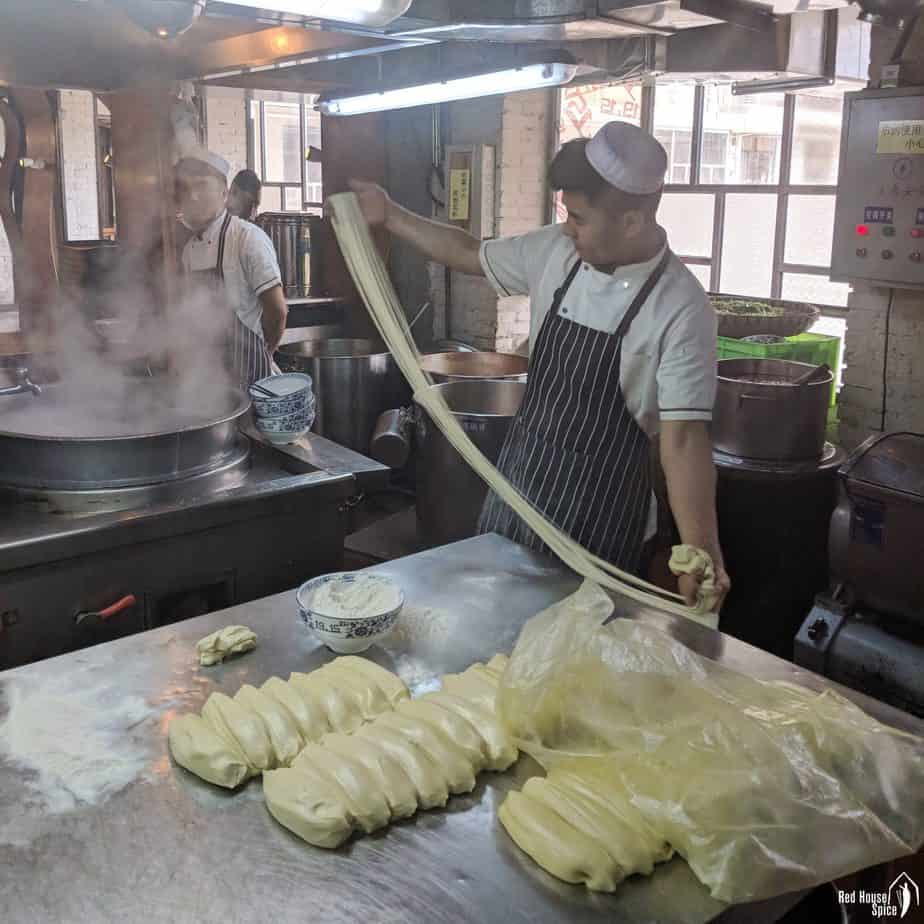
▲ A young chef pulling noodles at Lanzhou 1915 beef noodle soup restaurant.
One serving of noodles are pulled from one single piece of dough by folding multiple times. Lanzhou Beef Noodle Soup/兰州牛肉面 (aka Lanzhou Lā Miàn, 兰州拉面), the classic dish of my hometown, showcases this amazing culinary art of noodle making. The use of an alkaline agent (Péng Huī/蓬灰 in this case) makes the dough super flexible and stretchy.
If you haven’t seen how they are made, I suggest you take a look at a noodle pulling video I took on one of my Culinary Tours of China. My tour participants were very lucky to have the chance to visit the back kitchen and communicate with the chefs. On my next tours, we will go one step further to put our hands on the dough and learn from professional noodle masters.
The easy home version
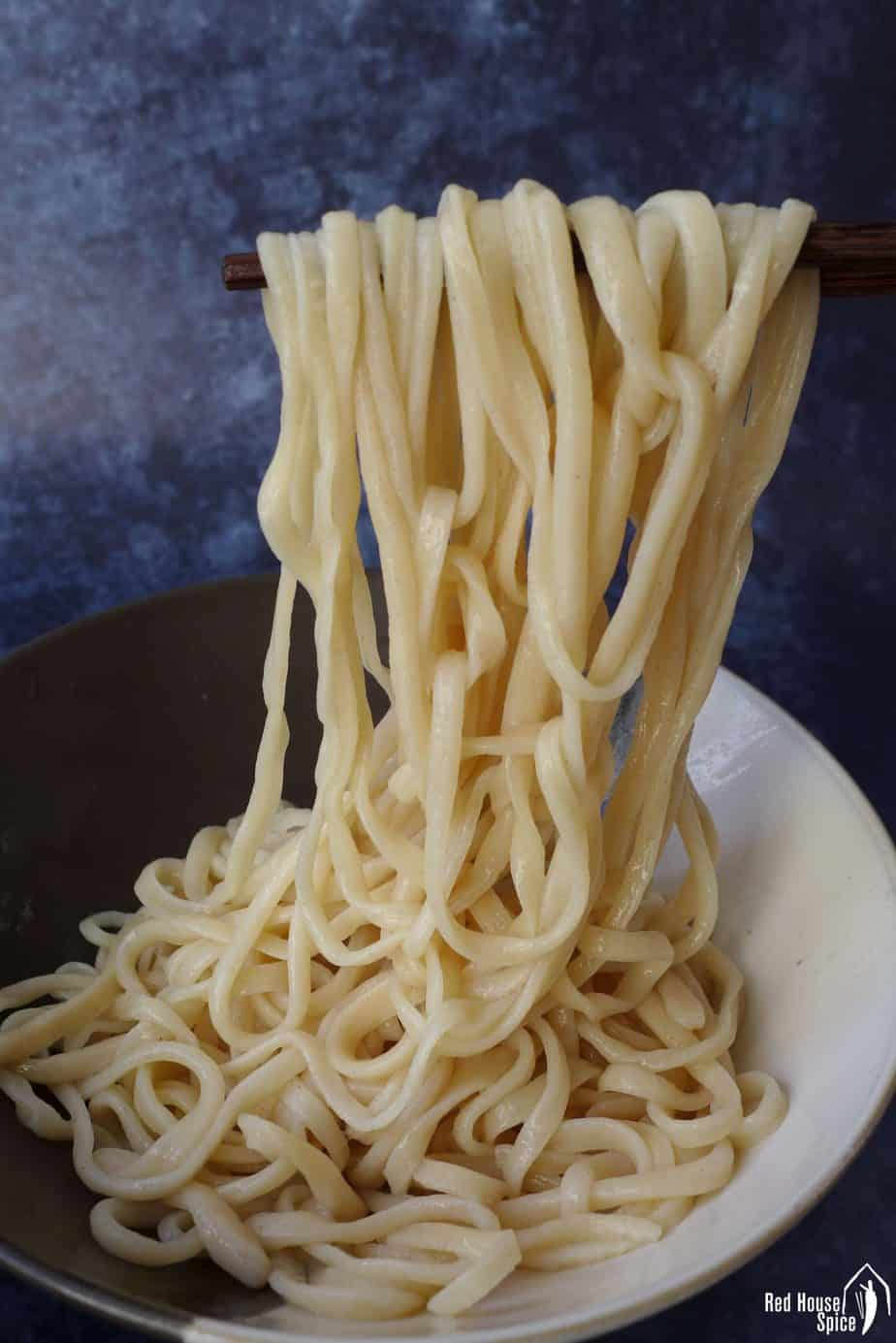
My recipe introduces another type of hand-pulled noodles: the dough is firstly cut into strips then pulled one by one into long noodles. The popular Xi’an Biang Biang Noodles are made this way.
Compared to the professional method, this technique is much easier to master. Although simple to make, I’d like to explain in detail every aspect of this dish. I hope my complete guide will help you, including kitchen novices, to have a fail-proof experience learning this cooking skill.
The basic workflow
Before we get down to the detailed explanations, let me first outline the procedures for making hand-pulled noodles.
- Make a smooth, fairly firm dough using flour, salt & water.
- Divide then flatten the dough. Coat with oil then leave to rest.
- Bring a pot of water to boil. Cut the dough pieces into strips.
- Pull the strips into long noodles one at a time. Drop into the water.
- Cook for 1-2 minutes then dish out.
How to make the perfect dough
The dough for hand-pulled noodles involves three basic ingredients: wheat flour, water and a little salt. The finished dough should be soft, smooth and elastic thus can be easily pulled into the desired shapes without breaking. Paying attention to the following rules, everyone can make perfect dough with ease.
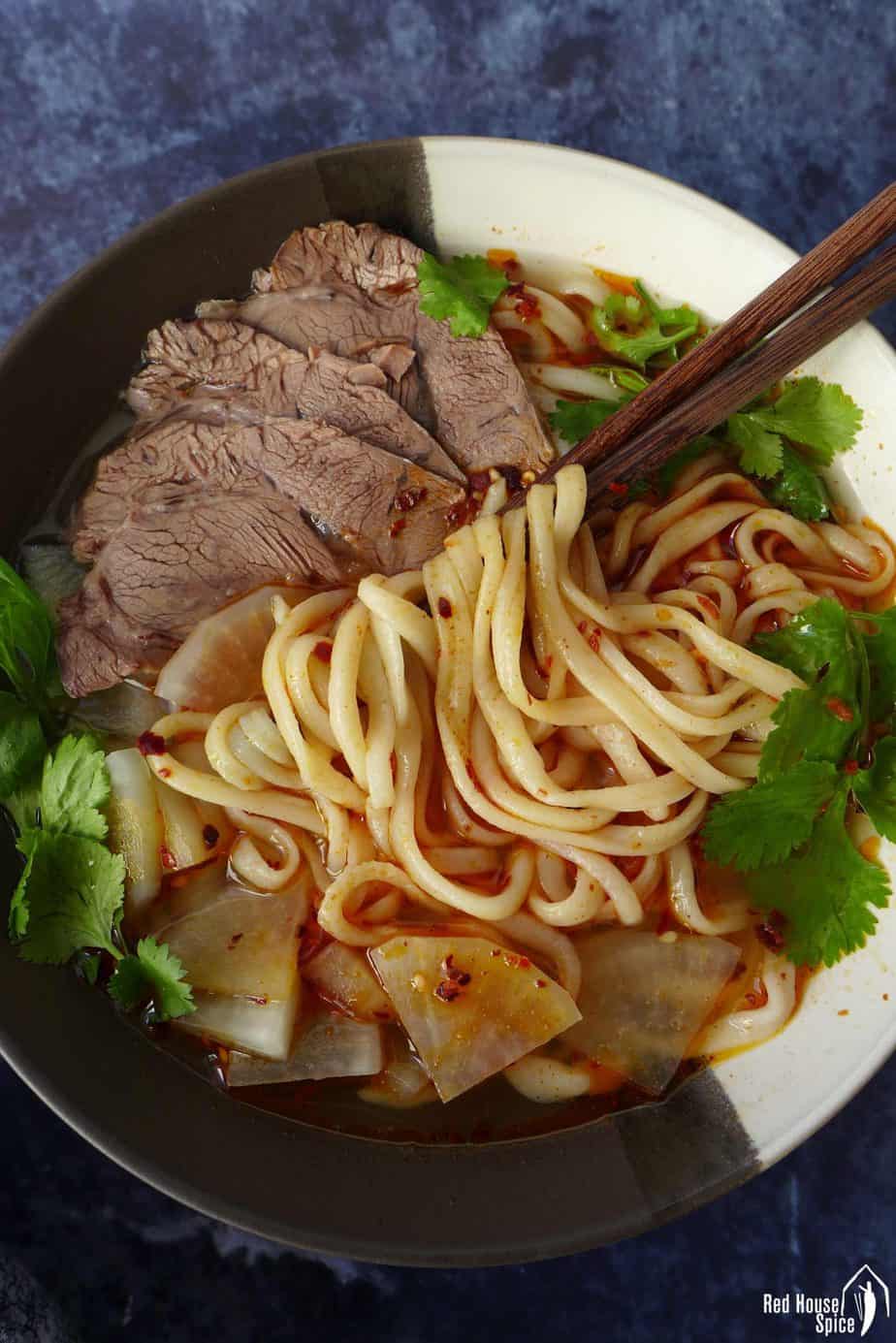
▲ Lanzhou beef noodle soup using my easy version of hand-pulled noodles.
Use all-purpose flour with medium gluten
Flour with a medium level of gluten works the best for hand-pulled noodles. That is to say that the protein content should be 10-11g per 100g flour. All-purpose flour (aka plain white flour) sold in the US and the UK falls into this range.
However, the gluten level of all-purpose flour varies among countries. Check the nutrition label on the package to learn the protein content.
Flour high in gluten (above 13g protein per 100g flour), such as very strong bread flour, can be used for this recipe but it’s harder to work on. Due to its strong, super elastic gluten, the dough tends to shrink back and breaks more easily when pulled.
NB: Wholemeal flour/gluten-free flour is not suitable for making hand-pulled noodles.
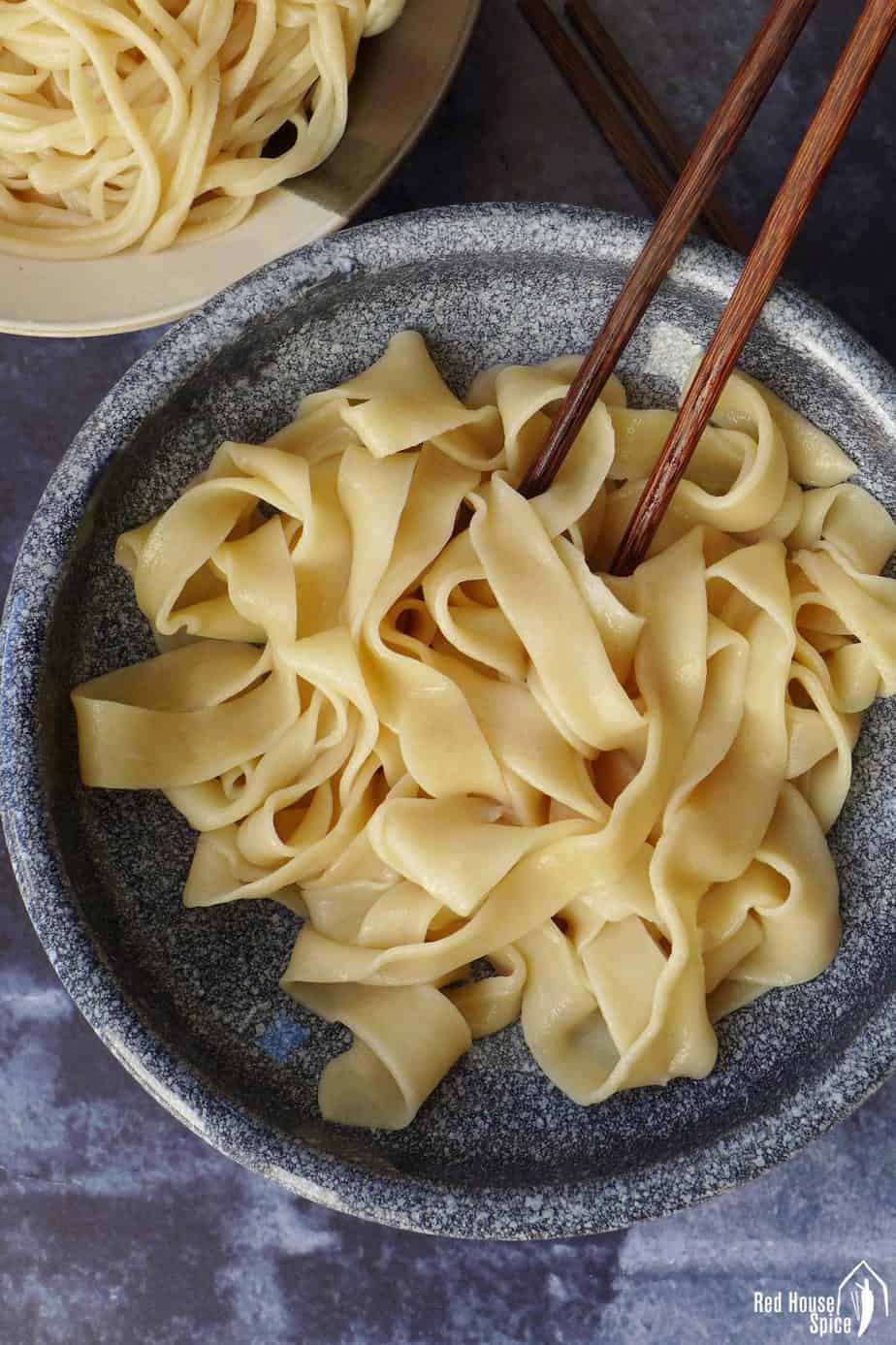
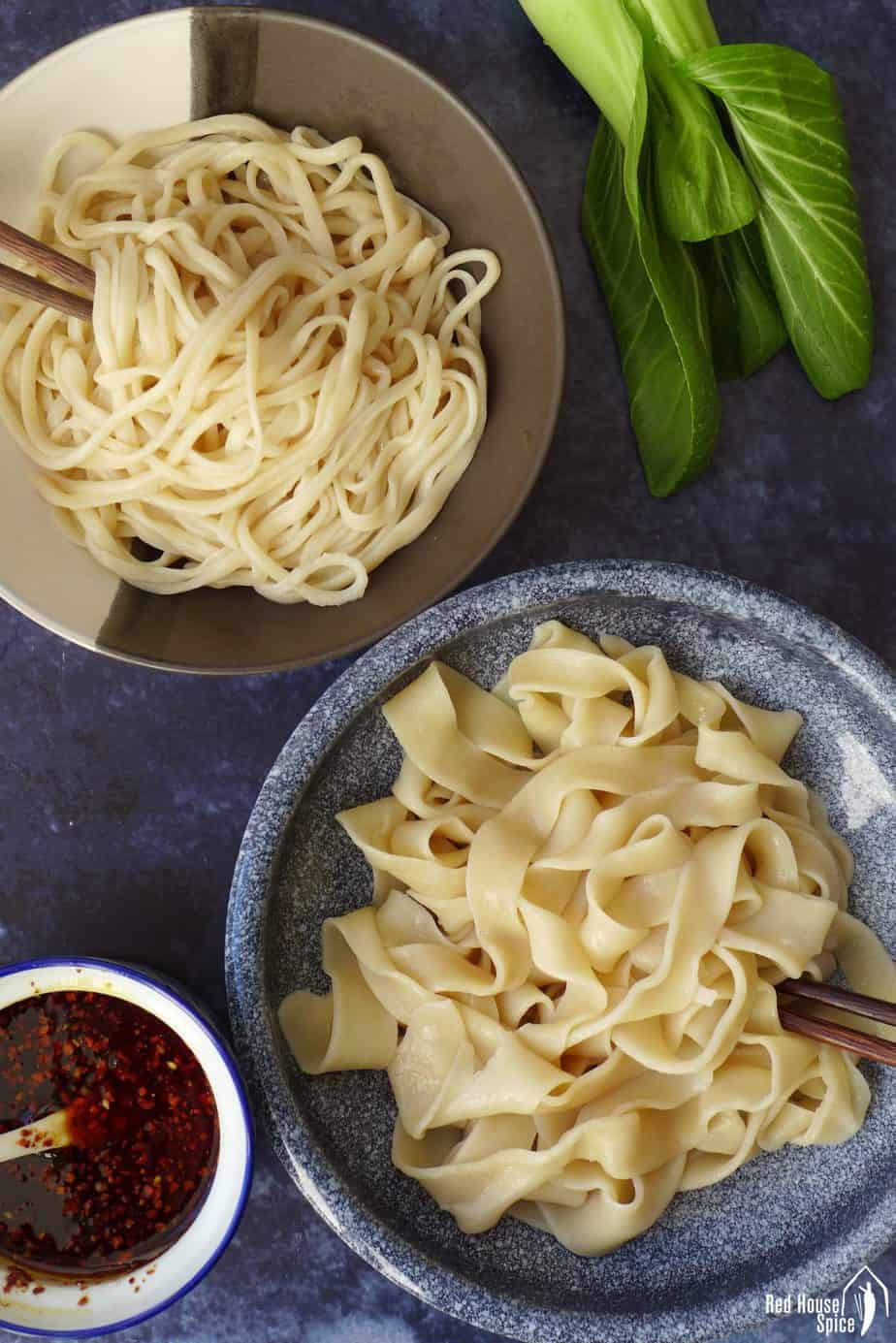
▲ Flat, wide noodles pulled the easy way.
The flour-water ratio is 2:1 by weight
To ensure a fail-proof experience, I recommend you measure flour by weight as it’s much more accurate than measuring with a cup.
The flour-water ratio is 2:1 by weight. In my recipe, I add 125g/ml water to 250g flour to make a dough for 2 servings.
You might need to slightly adjust the water volume as flour of different brands absorbs water differently. The initial dough (before resting) should be smooth but quite firm. You wouldn’t need to dust the work surface with flour when kneading/rolling.
Add a little salt to the dough
Just like my parents always do, I add a little salt to the dough for hand-pulled noodles. This is to make cooked noodles more “Jīn Dào, 筋道” meaning “Al Dente”.
In “On Food and Cooking”, scientist Harold Mcgee explains the purpose of adding salt to noodles: “It tightens the gluten network and stabilizes the starch granules, keeping them intact even as they absorb water and swell.”
Coat the dough with oil thoroughly
After the dough has been formed, you need to do the following before leaving it to rest:
- Cut the dough into sections. If you are making 2 servings, then cut it into two pieces.
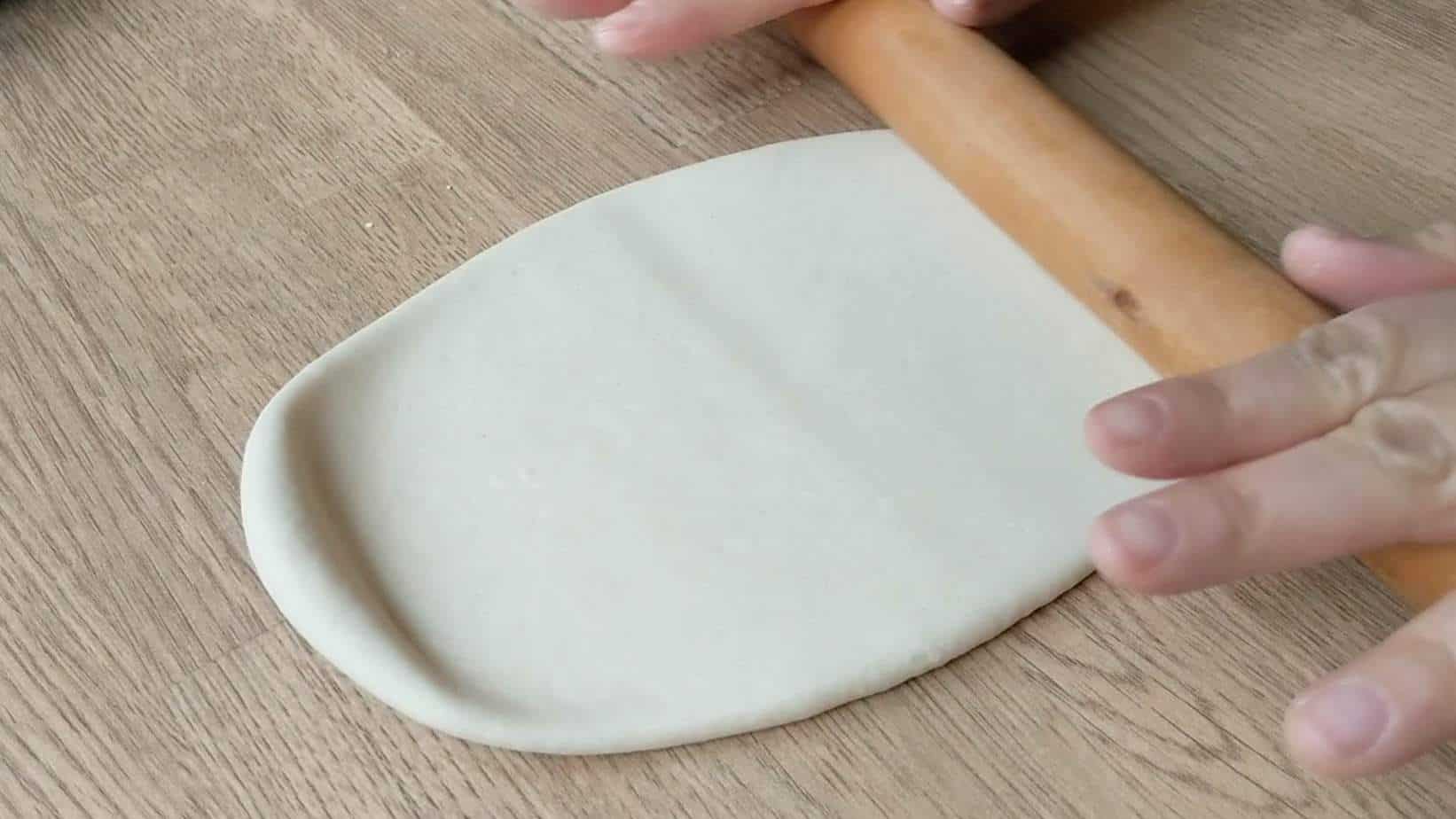
- With a rolling pin, flatten each piece to about 1/2 cm in thickness.
- Coat each piece with cooking oil thoroughly (both sides). Place them one on top of another in a tray. Cover with clingfilm.
Coating with oil is a crucial procedure. It prevents the dough pieces from sticking to each other. It also helps the final noodles to gain a smooth, silky look.
Some people coat the dough with flour instead. This also works but the cooked noodles tend to have a rougher appearance and a stickier texture on the surface.
Allow enough time to rest the dough
When it comes to dough preparation, resting is very important and can not be skipped. As I mentioned above, the initially formed dough is quite firm. Over time, the elasticity of the dough relaxes. It becomes softer and more malleable. This process makes noodle pulling so much easier!
I recommend you rest the flattened dough pieces for at least 1.5 hours. If you prepare the dough in advance and pull it the next day, you can store it in the fridge. But, remember to allow it to come back to room temperature before you start working on it.
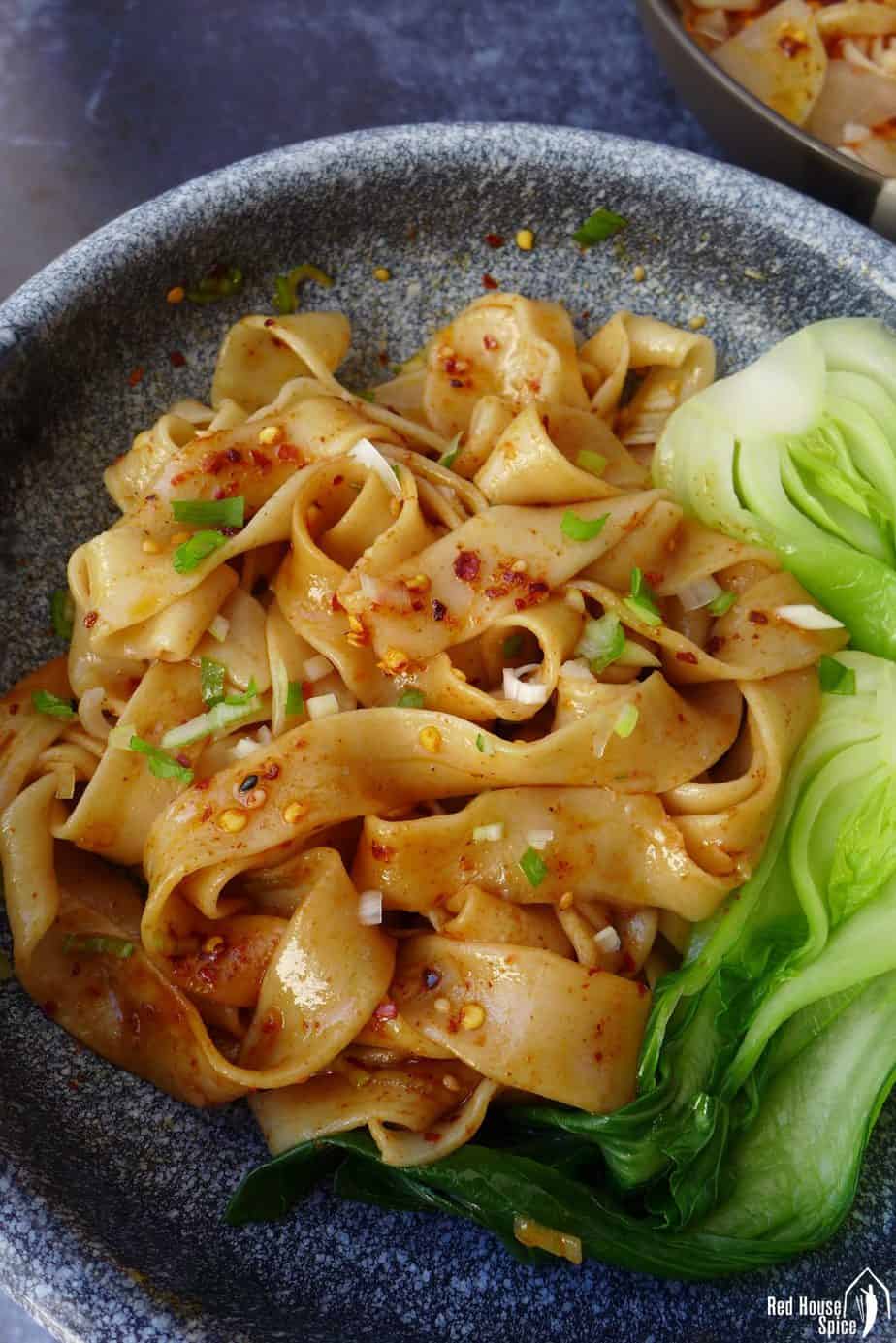
▲ Biang Biang Noodles made with my easy hand-pulled method
How to pull the noodles
Here comes the most exciting part (probably the most intimidating too): Pull the noodles with your hands. Unlike the master chefs in Lanzhou beef noodle restaurants, Chinese home cooks, like my parents, pull their noodles one strip at a time. My foolproof recipe uses the same method.
First of all, you need to cut the flattened dough pieces into strips. Be gentle when you transfer them onto the work surface as they’ve become very soft after resting. Try to retain their shape and do not pinch or pull (yet!).
Round or flat? Choose the noodle size
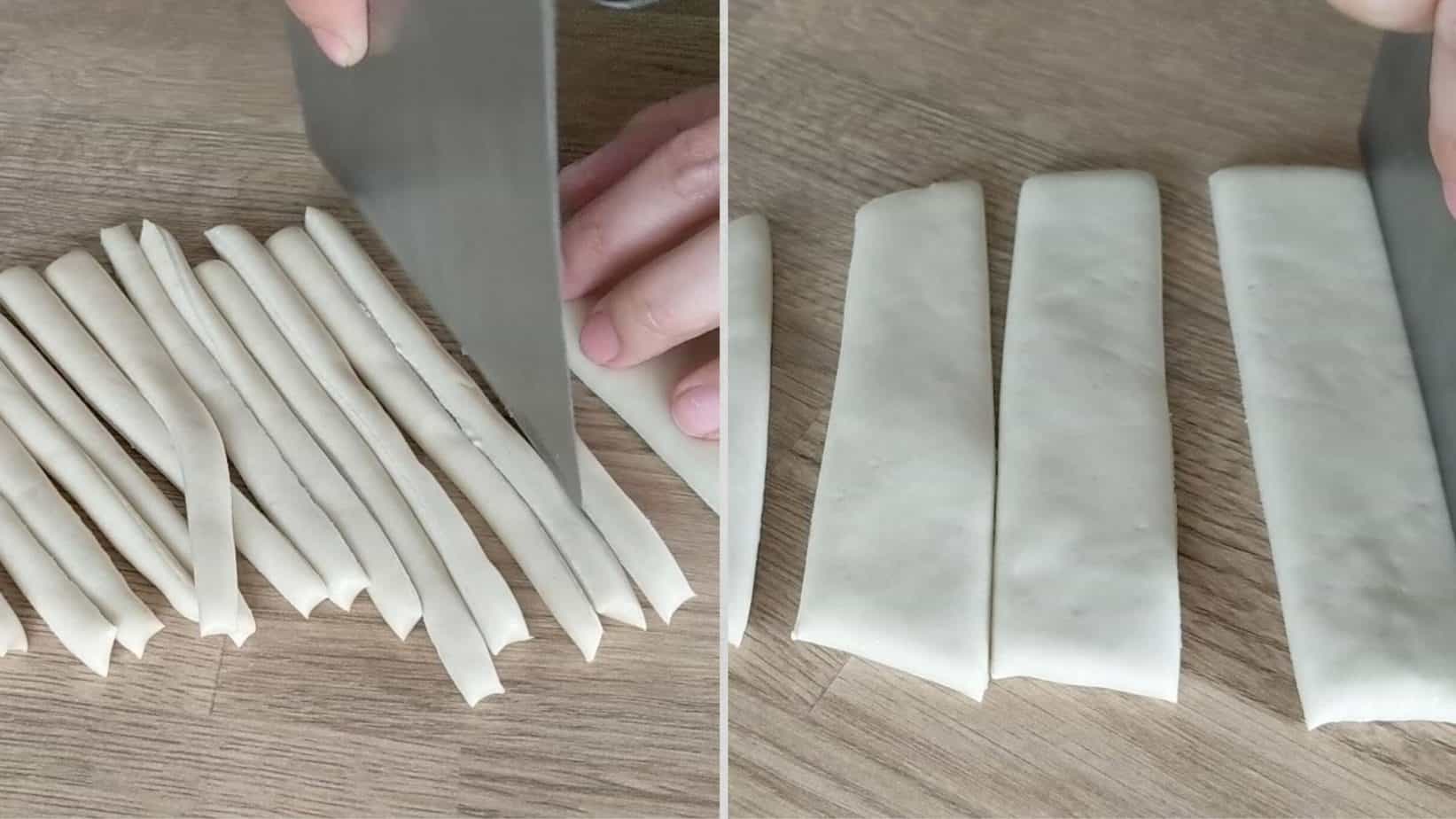
Do you have a preference for the shape of the noodles? Round, thin ones or flat wide ones? I love both. So my recipe includes two ways of shaping the noodles. Give both a try to see what works and tastes better for you.
- Round, thin noodles: Cut the flatten dough into thin strips, about 1 cm wide.
- Flat, wide noodles: Cut the flatten dough into wide strips, about 3 cm wide.
Noodle pulling technique
- Pick up one strip of dough by holding each end gently.
- Pull towards opposite directions. The movement should be smooth and consistent..
- As your arms move apart, bounce the noodle against the worktop to help it stretch further. Fold the noodle and repeat the movement.
Please check out my tutorial video (above in the post & below in the recipe card)to see exactly how I do it.
An alternative method
If you find the technique above difficult to master, try the alternative method: Over a pot of boiling water, hold one end of a strip of dough and pull the other end towards the water. Drop the pulled part into the water and continue pulling the remaining part (Please refer to the video).
How to cook the noodles
Compared to other types of noodles, the dough for hand-pulled noodles has a very high water content thus it’s very soft, easy to stick and can be cooked through fairly quickly. When cooking them, you need to take this characteristic into account. Here are some general rules to follow:
Cook one serving at a time
Pulling and cooking happen at the same time. Drop one pulled noodle straight into the boiling water then work on the next one. Stop when you finish all the dough strips for one serving.
Do not overcook
It takes quite a short time to cook hand-pulled noodles. If making round, narrow ones, leave to cook for 1 minute. If making flat, wide ones, leave to cook for 2 minutes. Do not overcook. Perfectly cooked noodles should be smooth, silky in appearance and quite chewy in texture.
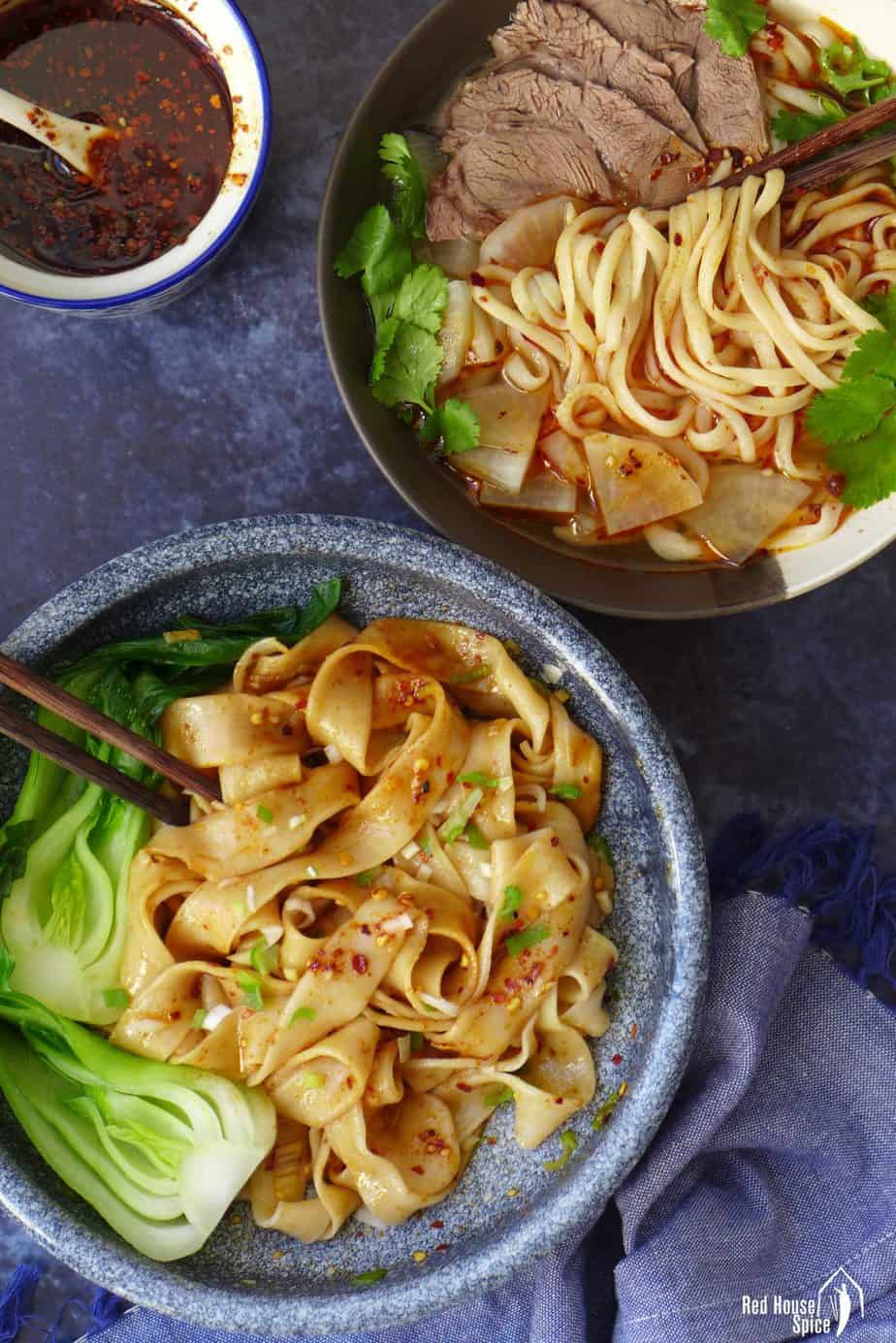
Serving ideas
Now let’s talk about how to serve your beautifully made noodles. Here are some inspirations:
- Add delicious broth/soup along with cooked meat, blanched vegetables, etc. For example, the classic Lanzhou Beef Noodle Soup; Sichuan Style Spicy Beef Noodles Soup; Chicken Meatball Noodles Soup
- Mix with saucy toppings, such as the Beijing signature noodle dish Zha Jiang Mian; Classic street foods: Dan Dan Noodles, Chongqing Noodles
- Spicy them up with a scrumptious dressing. For example, Xi’an’s popular dish Biang Biang Noodles, Classic Shanghai delicacy Scallion Oil Noodles
- Mix with stir-fry dishes of your choice. Try the following: Tomato & Egg Stir-fry; Black Pepper Beef; Sichuan Shredded Pork with Garlic Sauce
Other homemade noodles
Looking for other ways to make noodles from scratch? Check these recipes:
- Ramen Noodles (Alkaline Noodles)
- Hand-rolled Noodles
- Hand-Torn Noodles
- Scissor-cut Noodles
- Cold Skin Noodles (Liang Pi)
- Steamed Rice Noodle Rolls (Cheung Fun)
- Sweet Water Noodles (Tian Shui Mian)
📋 Recipe card
Love this recipe? Please leave a 🌟🌟🌟🌟🌟 rating and a comment. Thank you!
Hand-pulled noodles (La Mian), a foolproof recipe

Video
Ingredients
- 250 g all-purpose flour, about 2 cups (see note 1)
- 1/4 teaspoon salt
- 125 ml water, 1/2 cup + 1 tsp
- cooking oil, for coating the dough
Instructions
Prepare the dough
- IF KNEADING BY HAND: Mix flour and salt. Add water gradually. Mix with chopsticks/spatula until no more loose flour can be seen. Combine and knead briefly into a dough. Leave to rest for 10-15 minutes (covered). Knead again for about 2 minutes until very smooth.
- IF KNEADING WITH A STAND MIXER: Add flour, salt and water into the mixing bowl. Knead on low speed until a very smooth dough forms.
Coat & rest the dough
- Divide the dough into two equal parts. With a rolling pin, flatten each piece into a rectangle shape (about 1/2 cm thick).
- Thoroughly coat each piece with oil then place them on a tray. Cover with cling film then leave to rest for 1.5 hours.
Cut the dough
- Bring a large pot of water to a full boil. While waiting, cut the dough.
- Place one piece of dough on a chopping board. Widthways, cut it into strips: about 1 cm wide if making round, thin noodles; about 3 cm wide if making flat, wide noodles.
Pull the noodles (see note 3 for alternative method)
- Pick up one strip of dough by holding each end gently. Pull towards opposite directions. The movement should be smooth and consistent.
- As your arms move apart, bounce the noodle against the worktop to help it stretch further.
- Fold the noodle and repeat the movement (Please refer to the video below).
Cook the noodles
- Drop the pulled noodle into boiling water. Repeat the procedure to pull other strips cut from the first piece of dough.
- Cook 1 minute for the thin noodles or 2 minutes for the wide noodles (While waiting, cut the second piece of dough into strips.). Transfer the noodles to a serving bowl using a pair of chopsticks.
- Repeat to pull and cook the second bowl of noodles.
Serve the noodles
- To avoid the noodles sticking to each other, serve immediately.
- You may add a broth or mix the noodles with toppings/dressings. Please see note 4 for recipe links.
Store & Reheat
- If not serving straight away, you need to briefly rinse the noodles with cold water then add a few drops of sesame oil and stir well. Keep in the fridge for up to 2 days.
- To reheat: Bring a pot of water to a full boil. Add the noodles and cook for no more than 30 seconds.
Notes
Your Recipe Notes
Nutrition
Nutrition information is automatically calculated, so should only be used as an approximation.










I made this for my daughter and I and we absolutely loved it. Nothing beats the texture and taste of fresh noodles.
Very happy to know that! Totally agree that homemade noodles have very special texture & taste.
thanks for sharing the type of flour and water ratio. thats what i am looking for as i only mix and knead by hand.
can i quick quick the noodle and store it? thanks.
Hi Frank! Yes, you can store cooked noodles. Rinse under cold water then drain. Coat with a little sesame oil to prevent sticking. Reheat the noodles in boiling water for no more than 30 seconds. Hope this helps.
I can only find 9% protein all purpose flour. will it be okay?
Yes, it’s OK to use it. The texture will be a little different though.
This is a fantastic recipe, the family absolutely loved them. Should I add baked baking soda or another alkaline solution to the dough, or would that negatively impact the final product?
Thanks for the amazing recipe.
Hi Kim! Very happy to know my recipe worked well for you. Baking soda is definitely a NO. I’ve mentioned in the post that a particular alkaline agent called “Penghui/蓬灰” is used in the professional version of hand-pulled noodles. I haven’t tried other alkaline solutions for my easy version. To be honest, I don’t think there is any need. Hope this helps.
I was always intimidated to make these, even though I make my own pasta all the time. I’m definitely going to give these a try today! #isolife
It’s great fun making them. Good luck & enjoy!
Having just failed miserably at a hand pulled noodle attempt, I definitely want to give this recipe a try! i see from the video that the noodles are incredibly stretchy, is there any particular step or ingredient that makes it like this? I’ll probably be using basic UK all purpose flour ~10% protein
Only just discovered your site, your explanations are so detailed, will definitely be trying the various bun recipes too, keep up the great work!
Sorry to hear that David. There aren’t any hidden ingredients or steps. I always use UK plain flour from mainstream supermarkets (10% protein). I’m not sure what went wrong with your dough. I suggest you read my post again to understand all tips to troubleshoot. The dough should be very stretchy if you follow all my measurements/steps precisely (resting is very important). Let me know if you have any other questions. Good luck!
Hey, after a failed first attempt, there is two things that are crucial to this in my amateur opinion.
Kneading the dough until the surface is smooth (means you really mixed it proper) and letting the dough rest. Apparently the longer the better, I did it after about an hour and I was elated to see the super stretch!
This is the best and most detailed blog I have seen on the home-made, hand-pulled noodle that is so common and popular in northwestern China.
Thanks for the compliment! I grew up in northwest China and these hand-pulled noodles were a house regular.
I made the noodles following your exact recipe, but I used semolina flour / pasta flour (in German speaking area, it’s Knöpfli / Spätzle Mehl). This flour works perfectly with this recipe. This is the first time ever that I made hand pulled noodles. Heck, I am Indian so no one in the family has ever made this either! I miss hand pulled noodles from my time in Singapore. The video is super helpful as the pulling and beating against the surface is a bit difficult to explain. The end result was fabulous. My husband got the first portion and it was over before I assembled mine. It’s just so different from other noodles, This will be a regular in the house. Thank you again for the detailed recipe!
Thank you Sam for sharing your experience! High gluten flour does work well as long as you rest the dough as instructed. Glad to know it’s going to be a regular on your dining table. Try different toppings/soup and enjoy!
Hello,
This looks great! I would love to try your recipe, but for some reason can’t see the video. Is it just my browser, or has it been taken down?
Hi Jacelyn! My video appears twice in my post. One is right after the first paragraph. The other is located inside the recipe card (Underneath “Instructions”). If for whatever reason you still can’t find it, you can view it on my Youtube channel. Here is the link: https://www.youtube.com/watch?v=-oEOTTr6LaA
I had the same problem and had to turn off my ad-blocker to see the videos.
WOW! That is impressive and so simple. Thank you for the recipe and for providing a video to demonstrate how to do make them the noodles from scratch. I never liked using my pasta maker anyways, and your method is a lot more fun and less fussy, too. I will definitely give this try. Xia Xia.
You are welcome! Hand-pulled noodles taste so different from machine made ones. Yes, it’s great fun making them too! Enjoy!