
Chinese sesame paste is a popular condiment used in noodles, salad, hot-pot dipping sauce, etc. It can be substituted in three ways.

Pin this now to find it later!
Pin ItA versatile condiment
Made from toasted sesame seeds, Chinese sesame paste (芝麻酱) is a thick, brown paste, with a strong, distinctive nutty aroma.
It’s widely used in Chinese cuisine, for noodles, salad, hot-pot dipping sauce, steamed twisted buns or simply as a spread like peanut butter. Normally it’s sold in glass jars, with a layer of oil on top to preserve its freshness.
How to thin the paste
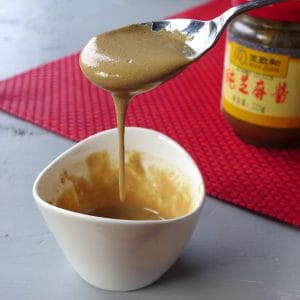
In my recipes, I always use PURE Chinese sesame paste which has a very thick consistency (on the left of the photo above). You need to thin it with the same amount of water before adding to dishes.
Use the back of a spoon to swirl gently. It takes a bit of time to completely combine the paste and the water. It should be smooth and semi-runny in the end.
It’s different from Tahini
Do not confuse Chinese sesame paste with Tahini (the main component of hummus), a paste which is also made from sesame seeds.
The former is made from toasted whole sesame seeds, whereas the latter is made with raw, hulled sesame seeds (sometimes lightly toasted). Thus, they have very different tastes and texture.
Three substitute ideas
You can find Chinese sesame paste in most Chinese/Asian shops. If not available, I have three substitute ideas for you.
- Option 1: Add 1/4 part sesame oil to 1 part Tahini, then mix well.
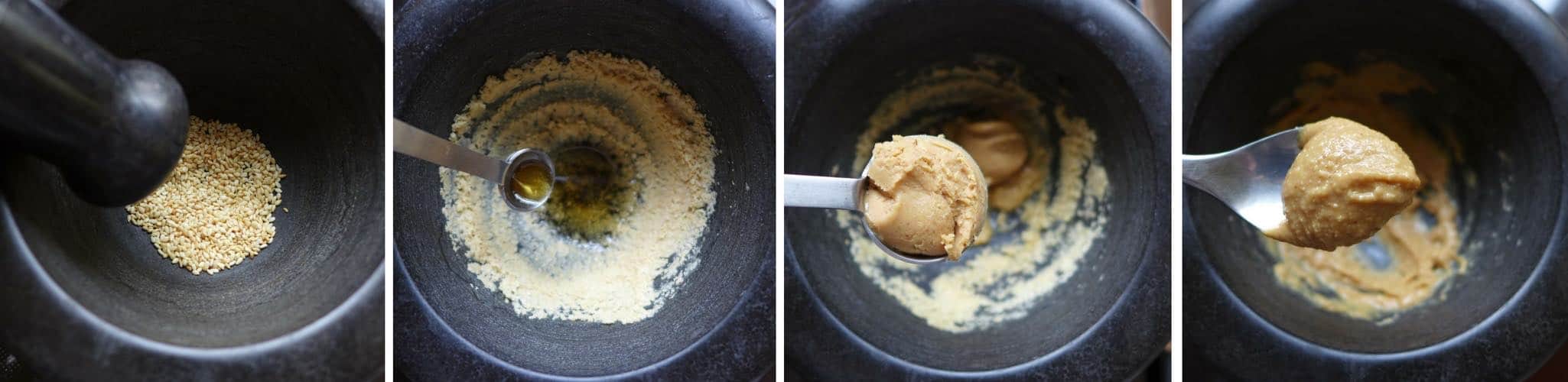
- Option 2: Grind 1 part toasted sesame seeds in a mortar (or in a grinder), add 1/4 part sesame oil and 1 part unsweetened peanut butter. Mix until well combined. (As shown in photos above)
- Option 3: Grind 1 part toasted sesame seeds into a smooth paste. Add sesame oil then mix well.
Obviously, substitutes are unlikely to provide exactly the same flavour and texture. But I find those three options are great for certain dishes, such as the famous Sichuan street food Dan Dan noodles and the iconic breakfast of Wuhan Hot Dry Noodles.
For storage, it’s recommended to keep opened Chinese sesame paste in the fridge and consume within 3 months.
3 substitutes for Chinese sesame paste

Ingredients
For substitute 1
- 1/4 part sesame oil, see note
- 1 part Tahini
For substitute 2
- 1 part toasted sesame seeds
- 1/4 part sesame oil, see note
- 1 part peanut butter, unsweetened
For substitute 3
- 1 part toasted sesame seeds.
- 1/8 part sesame oil, see note
Instructions
Substitute 1
- Add sesame oil to Tahini, then mix to combine.
Substitute 2
- Grind toasted sesame seeds into a paste in a mortar (or in a grinder).
- Add sesame oil and peanut butter. Mix until well combined.
Substitute 3
- Grind toasted sesame seeds to a smooth paste in a mortar (or in a grinder).
- Add sesame oil then mix well.
Notes
Your Recipe Notes
Nutrition information is automatically calculated, so should only be used as an approximation.












Im having dificulty getting sweet bean sauce can I use sweet bean paste instead?
Yes, sweet bean paste may be the same thing, as English names vary between brands. Look for 甜面酱 (tián miàn jiàng) on the label and check the ingredients. Wheat flour should be the main ingredient. Happy cooking!
I was really happy to find this article, because I’m allergic to sesame; but then it turned out that all the substitutes also have sesame! Can you suggest an alternative for dishes like dan-dan-noodles?
In this case, you can use peanut butter as a substitute for Dan Dan Noodles. Happy cooking Peter!
Hello Wei!
Could you please let me know for how long should I toast sesame seeds for the second option?
The toasting time depends on the quantity of the cookware and the heat level. Usually I don’t count the time but observe the seeds. Remove them from the pan once they become plump (raw ones are flat) and can be crushed easily with your fingertips.
Hi Wei,
Is the second substitue the Satay sauce? If not, could you write a recipe of the satay chicken? 🙂 Thank you!
It’s not satay sauce which contains many other ingredients.
Hello Wei, what other recipes can we make using chinese sesame paste? We bought it to try Dan dan noodles and it is good. 🙂
Hi Ann! You can use it to make Wuhan Hot Dry Noodles. It also can be used to make hot pot dipping sauce.
Wow, I have just discovered that I was making this paste believing I was making my own tahini! 😀 I always toast sesame seeds very well before blending. Now I read that tahini is raw, not toasted seeds.
Hi Wei! Today I wanted to cook the Dam Dam noodles, which as I told you in another post I have 300 grams. Give mustard greens and they are making me like 3 kilos, it is used very little and I am afraid that it will spoil, I hate having to throw food away. Anyway, great that you give alternatives to Chinese ingredients. I go, well, I was going, a lot to the Asia supermarket in Madrid, now with all the restrictions, impossible (I live 60 km from Madrid) Now I buy online, but it is not the same; I really enjoyed going to the supermarket. I also wanted to thank you for putting the recipes for 2, so I don’t have to calculate from recipes for 6 or 8, you make it easy for me. We have been 2 since a long time, I have an empty nest. Wei, take care of yourself and I wish you a nice weekend. Kisses
Nice to hear from you Wendy! Very happy that you find my recipes helpful. Happy cooking!